Authorization To Travel With One Parent In Maryland
Description


Get your form ready online
Our built-in tools help you complete, sign, share, and store your documents in one place.
Make edits, fill in missing information, and update formatting in US Legal Forms—just like you would in MS Word.
Download a copy, print it, send it by email, or mail it via USPS—whatever works best for your next step.
Sign and collect signatures with our SignNow integration. Send to multiple recipients, set reminders, and more. Go Premium to unlock E-Sign.
If this form requires notarization, complete it online through a secure video call—no need to meet a notary in person or wait for an appointment.
We protect your documents and personal data by following strict security and privacy standards.

Make edits, fill in missing information, and update formatting in US Legal Forms—just like you would in MS Word.

Download a copy, print it, send it by email, or mail it via USPS—whatever works best for your next step.

Sign and collect signatures with our SignNow integration. Send to multiple recipients, set reminders, and more. Go Premium to unlock E-Sign.

If this form requires notarization, complete it online through a secure video call—no need to meet a notary in person or wait for an appointment.

We protect your documents and personal data by following strict security and privacy standards.
Looking for another form?
Form popularity
FAQ
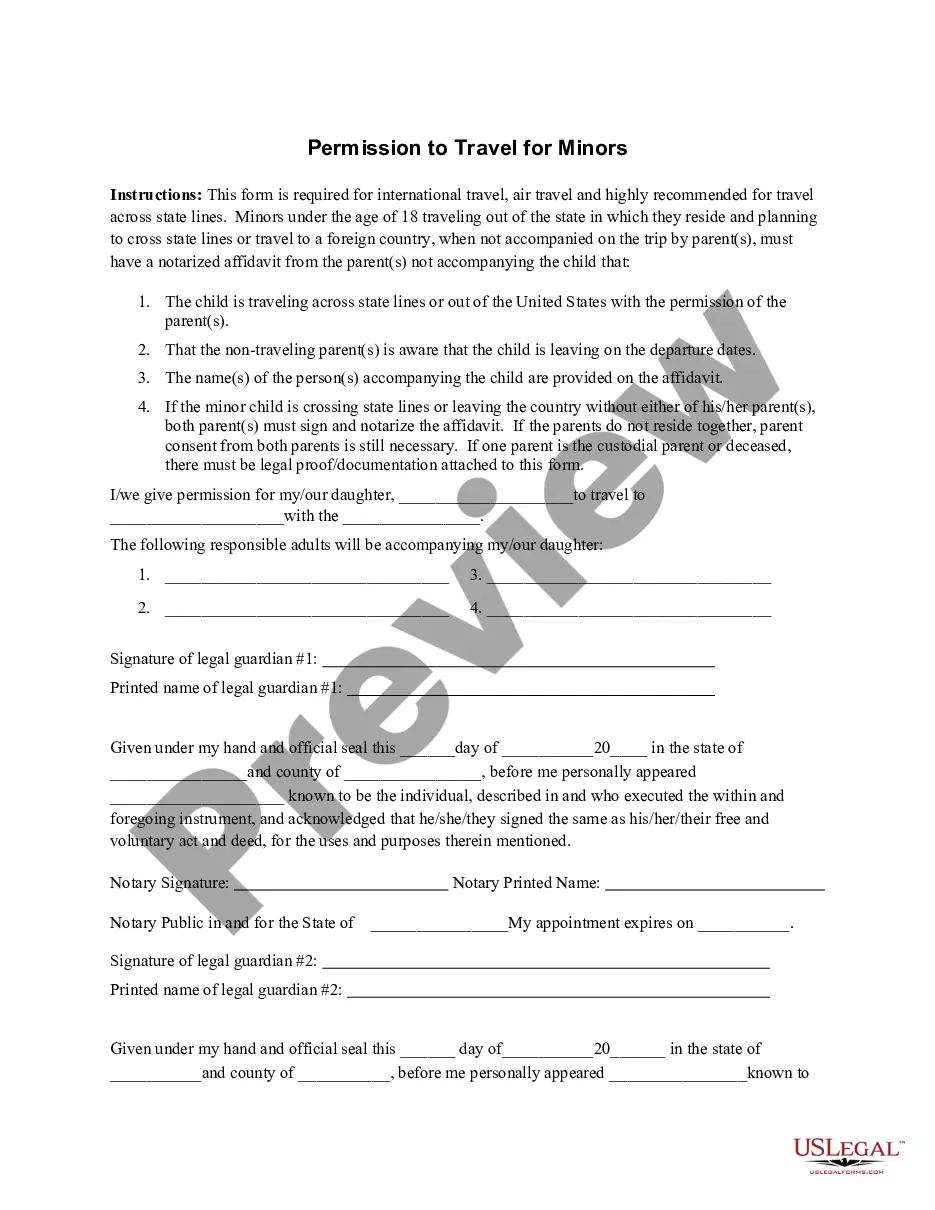
Include a salutation like "To Whom It May Concern." Write out the purpose of the letter (e.g., letting a child go on a school trip). List important information about your child and any other relevant info. Mention the scope of what you are/aren't permitting.
If you're planning on traveling with your own offspring, presenting their passport or birth certificate might suffice; however, if you're accompanying a minor who isn't your biological or adopted child then this notarized document becomes essential.
How do I write a consent letter for my child to travel? List your child's name, birth date/place, and passport details. Provide the parent's/guardian's name, custody information, and passport details. Add contact information for the non-traveling parents/guardians. Detail the child's destination and dates of travel.
Your child will need a Child Travel Consent any time they're traveling without all their parents or legal guardians present. If your child is traveling alone, with only one parent, or with a non-legal guardian, they will require a Child Travel Consent signed by both parents or legal guardians.
The letter should include the other person's contact details and details about the trip. It also helps if you've: evidence of your relationship with the child, for example a birth or adoption certificate. a divorce or marriage certificate, if you are a single parent but your family name is different from the child's.
``I, your partner's name, give my permission for my child, your child's name, date of birth, and passport number, to travel with my spouse, your name, to destination's name, from date you begin travel to the date you plan to return.'' Be sure to include the following information in your consent letter:
I am writing to give my consent for my child, (Child's Name), to participate in the upcoming school trip to (Destination) on (Date). I understand that the trip will involve (briefly describe activities, if known), and I agree to all the planned activities. Details: Trip Destination: (Destination)
A child travel consent form allows a minor to travel alone or with another person or group. It is written by one or both parents and can be used for domestic or international travel.
Yes, the consent letter MUST be notarized or you probably won't get out of the US, yet alone the DR. The consent must of the names of both parents and signatures, the name and signature of the person doing the travel with the minor, your travel destination and when you are to leave the US and return.
The letter should include the other person's contact details and details about the trip. It also helps if you've: evidence of your relationship with the child, for example a birth or adoption certificate. a divorce or marriage certificate, if you are a single parent but your family name is different from the child's.

