Homestead Act In Missouri In Massachusetts
Description





Get your form ready online
Our built-in tools help you complete, sign, share, and store your documents in one place.
Make edits, fill in missing information, and update formatting in US Legal Forms—just like you would in MS Word.
Download a copy, print it, send it by email, or mail it via USPS—whatever works best for your next step.
Sign and collect signatures with our SignNow integration. Send to multiple recipients, set reminders, and more. Go Premium to unlock E-Sign.
If this form requires notarization, complete it online through a secure video call—no need to meet a notary in person or wait for an appointment.
We protect your documents and personal data by following strict security and privacy standards.

Make edits, fill in missing information, and update formatting in US Legal Forms—just like you would in MS Word.

Download a copy, print it, send it by email, or mail it via USPS—whatever works best for your next step.

Sign and collect signatures with our SignNow integration. Send to multiple recipients, set reminders, and more. Go Premium to unlock E-Sign.

If this form requires notarization, complete it online through a secure video call—no need to meet a notary in person or wait for an appointment.

We protect your documents and personal data by following strict security and privacy standards.
Looking for another form?




Form popularity
FAQ
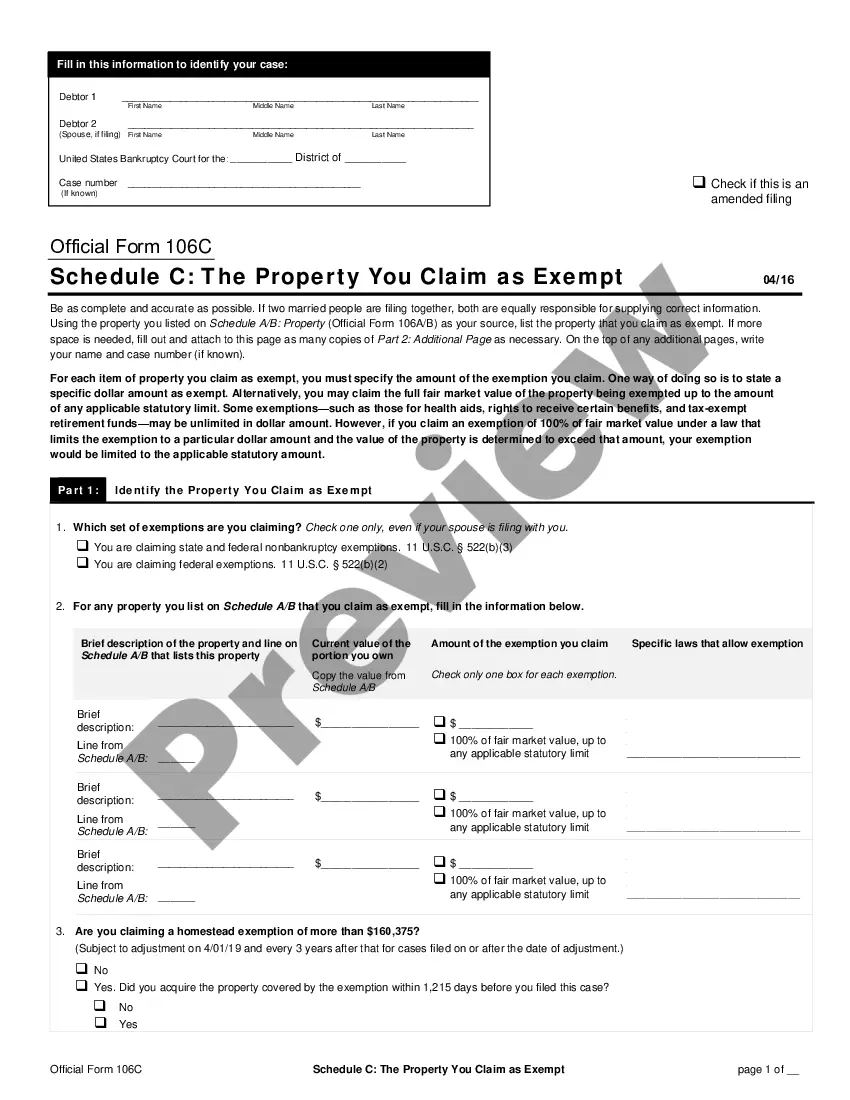
If you file for bankruptcy in Missouri, the homestead exemption will protect some of the equity in your home. If you're considering filing for bankruptcy in Missouri, the Missouri homestead exemption will help you protect the equity in your home.
While the specifics can vary by state, generally, homestead exemptions are only available for an individual or family's primary residence. This means you cannot claim homestead exemptions in multiple states.
Most states have homestead exemptions except New Jersey and Pennsylvania. Some states have other homestead laws such as provisions that protect surviving spouses from creditors.
Missouri homestead law allows for a $15,000 exemption, which is applicable to "a dwelling house and appurtenances, and the land used in connection therewith." In other words, the state's homestead law is limited to homes, corresponding buildings, and the land on which they stand.
Homestead Exemption Statutes Vary By State Some states, such as Florida, Iowa, Kansas, Oklahoma, South Dakota and Texas have provisions, if followed properly, allowing 100% of the equity to be protected. Other states, such as New Jersey and Pennsylvania do not offer any homestead protection.
Homestead Exemption Statutes Vary By State Some states, such as Florida, Iowa, Kansas, Oklahoma, South Dakota and Texas have provisions, if followed properly, allowing 100% of the equity to be protected. Other states, such as New Jersey and Pennsylvania do not offer any homestead protection.
Delinquent Taxes: If a real estate parcel has a delinquent tax that is 3 years old, that property faces a foreclosure sale to recover back taxes.
Any social, civic, religious, political subdivision or educational organization can apply for a sales tax exemption by completing Form 1746 Document, Missouri Sales Tax Exemption Application. This form lists the information needed to verify the organization is indeed a tax-exempt non-profit organization.
In order to obtain exemption, the owner must present substantial and persuasive evidence demonstrating the property meets the requirements of Article X, Section 6 of the Missouri Constitution and Section 137.100 of the Missouri Revised Statutes.
To protect the value of your property up to one million dollars ($1,000,000) per residence, per family, you must file a document called a “Declaration of Homestead”. You can file this form at the Registry of Deeds in the county or district where your property is located, referencing the title/deed to the property.
