Letter Instruction Sample With Cc In Michigan
Description

Get your form ready online
Our built-in tools help you complete, sign, share, and store your documents in one place.
Make edits, fill in missing information, and update formatting in US Legal Forms—just like you would in MS Word.
Download a copy, print it, send it by email, or mail it via USPS—whatever works best for your next step.
Sign and collect signatures with our SignNow integration. Send to multiple recipients, set reminders, and more. Go Premium to unlock E-Sign.
If this form requires notarization, complete it online through a secure video call—no need to meet a notary in person or wait for an appointment.
We protect your documents and personal data by following strict security and privacy standards.

Make edits, fill in missing information, and update formatting in US Legal Forms—just like you would in MS Word.

Download a copy, print it, send it by email, or mail it via USPS—whatever works best for your next step.

Sign and collect signatures with our SignNow integration. Send to multiple recipients, set reminders, and more. Go Premium to unlock E-Sign.

If this form requires notarization, complete it online through a secure video call—no need to meet a notary in person or wait for an appointment.

We protect your documents and personal data by following strict security and privacy standards.
Looking for another form?







Form popularity
FAQ
To get a divorce in Michigan, you'll need to file your paperwork in the family division of the circuit court (also called a "trial court") in the county where either spouse lives.
A Proof of Service is a document filed with the Court to show that the summons and complaint were successfully served on the defendant in a lawsuit.
It is possible to get a divorce without going to court, especially in cases where both parties mutually agree to the divorce and its terms. This process is often referred to as an ``uncontested divorce'' or ``amicable divorce.'' Here are the key steps and considerations:
Michigan has “no-fault” divorce. No-fault means you don't have to prove cheating, abandonment, cruelty, or anything else to get a divorce. Your spouse doesn't have to agree to give you a divorce. You can get a divorce even if you did something that made your marriage end.
Process may be served on a resident or nonresident individual by (1) delivering a summons and a copy of the complaint to the defendant personally; or (2) sending a summons and a copy of the complaint by registered or certified mail, return receipt requested, and delivery restricted to the addressee.
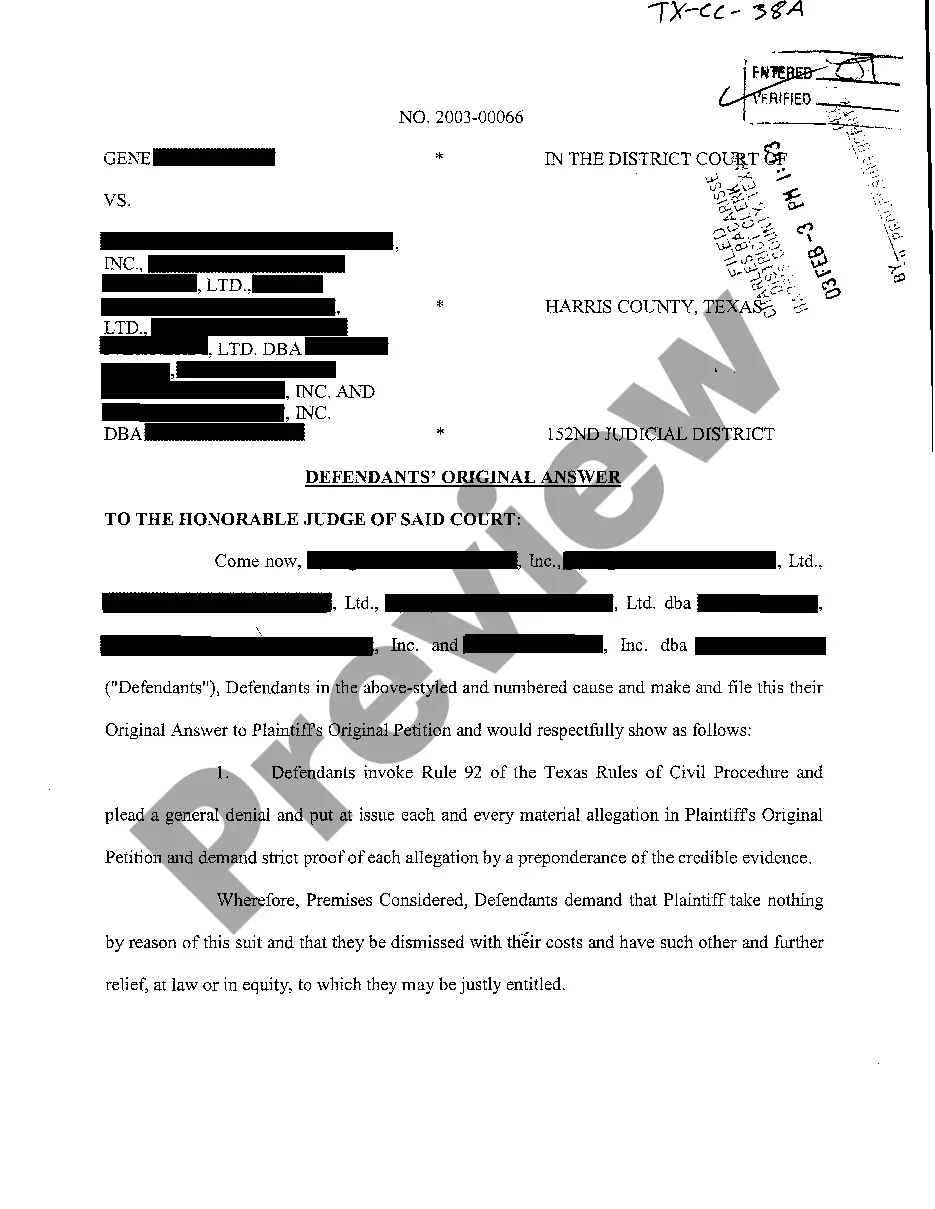
Fill out form MC 03 (Answer, Civil) on the website or get a paper copy from the court to fill out. Write in the court number, case number, the court address, the court telephone number, and the names, addresses, and telephone numbers of the plaintiff and the defendant exactly as they are on your court papers.
The State Court Administrative Office (SCAO) is the administrative agency of the Michigan Supreme Court.
To get a divorce in Michigan, you'll need to file your paperwork in the family division of the circuit court (also called a "trial court") in the county where either spouse lives. Some courts in Michigan require that you file the papers electronically.
For each numbered paragraph in the complaint, type "Admitted" if you admit the allegation or "Denied" if you deny the allegation. If you don't have enough information to know whether the fact is true or false, respond with "Lack enough information to respond to Plaintiff's allegations."
How to Format an Answer Letter for a Civil Summons Provide the name of the court at the top of the Answer. List the name of the plaintiff on the left side. Write the case number on the right side of the Answer. Address the Judge and discuss your side of the case.