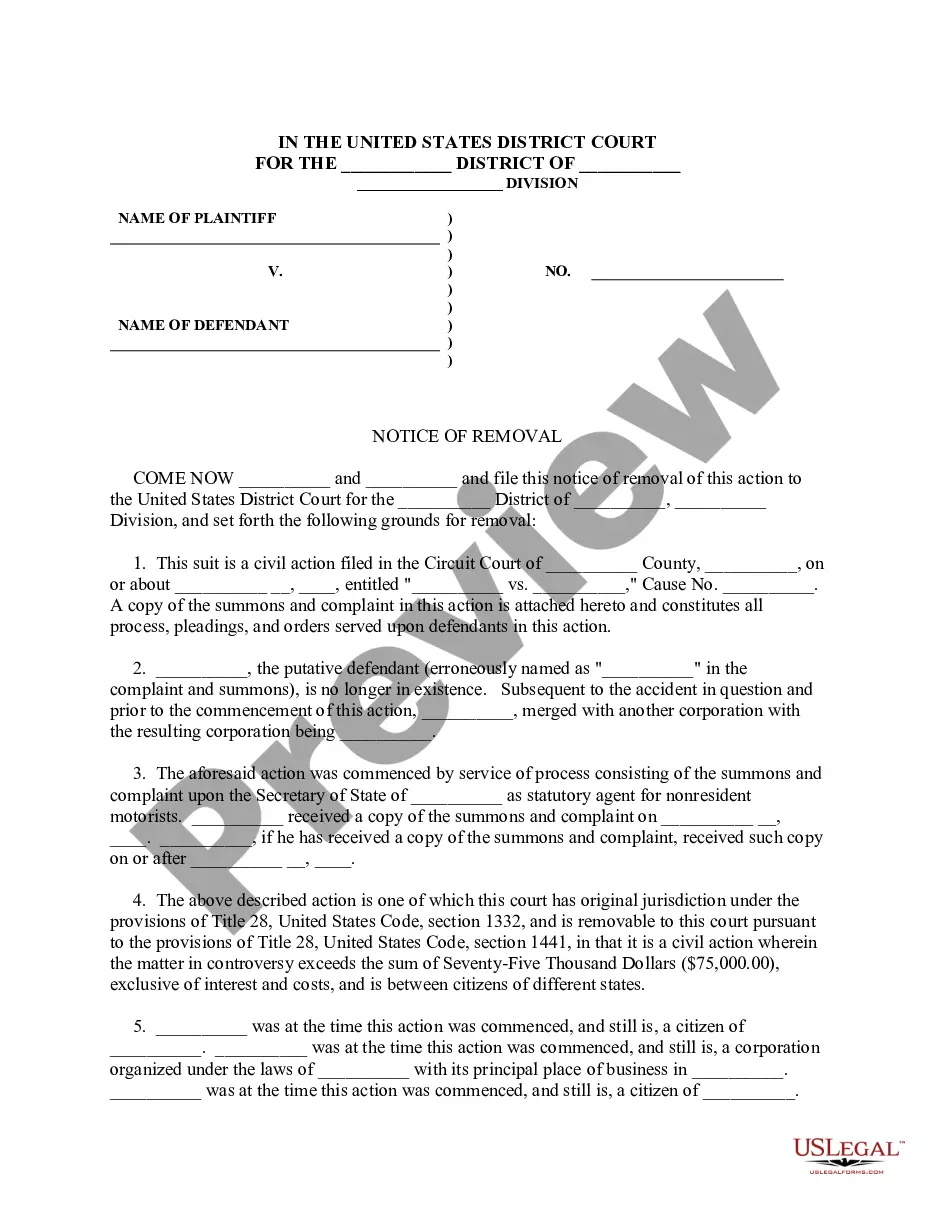
Notice Of Removal Template Without Signature In Florida
Description
Get your form ready online
Our built-in tools help you complete, sign, share, and store your documents in one place.
Make edits, fill in missing information, and update formatting in US Legal Forms—just like you would in MS Word.
Download a copy, print it, send it by email, or mail it via USPS—whatever works best for your next step.
Sign and collect signatures with our SignNow integration. Send to multiple recipients, set reminders, and more. Go Premium to unlock E-Sign.
If this form requires notarization, complete it online through a secure video call—no need to meet a notary in person or wait for an appointment.
We protect your documents and personal data by following strict security and privacy standards.

Make edits, fill in missing information, and update formatting in US Legal Forms—just like you would in MS Word.

Download a copy, print it, send it by email, or mail it via USPS—whatever works best for your next step.

Sign and collect signatures with our SignNow integration. Send to multiple recipients, set reminders, and more. Go Premium to unlock E-Sign.

If this form requires notarization, complete it online through a secure video call—no need to meet a notary in person or wait for an appointment.

We protect your documents and personal data by following strict security and privacy standards.
Looking for another form?







Form popularity
FAQ
A defendant can remove a case from state to federal court by filing a notice of removal in federal court and then notifying the state court and the other parties. They might need the agreement or joinder of any other defendants, or they might be able to remove a case on their own.
The notice of removal of a civil action or proceeding shall be filed within 30 days after the receipt by the defendant, through service or otherwise, of a copy of the initial pleading setting forth the claim for relief upon which such action or proceeding is based, or within 30 days after the service of summons upon ...
Generally, removal jurisdiction exists only if, at the time plaintiff filed the action in state court, the federal court had a basis for exercising subject-matter jurisdiction over the action, such as diversity of citizenship of the parties or where plaintiff's action involves a claim under federal law.
A notice of removal is a legal document filed by a defendant to move a case from a state court to a federal court. The notice must be filed in the federal district court where the case is pending and must include a brief statement explaining the reasons for the removal.
(1) Service by Electronic Mail (“e-mail”). All documents required or permitted to be served on another party must be served by e-mail, unless the parties otherwise stipulate or this rule otherwise provides.
28 U.S.C. § 1448 governs the requirements of process after removal, providing that when defendants are not completely or perfectly served prior to removal, plaintiffs may complete such process or service, or new process may be issued in the same manner as in cases originally filed in the district court.
Every attorney representing a party or witness in any case or proceeding in this court must file a notice of appearance in the case or proceeding, except that the notice need not be filed when the appearance has previously been evidenced by the filing of a paper on behalf of the client.
Each defendant shall have 30 days after receipt by or service on that defendant of the initial pleading or summons described in paragraph (1) to file the notice of removal.
Rule 2.505 - ATTORNEYS (a) Scope and Purpose. All members of The Florida Bar in good standing are permitted to practice law in Florida. Attorneys of other states who are not members of The Florida Bar in good standing cannot engage in the practice of law in Florida except to the extent permitted by rule 2.510.