Certificate Of Service For Interrogatories In Palm Beach
Description


Get your form ready online
Our built-in tools help you complete, sign, share, and store your documents in one place.
Make edits, fill in missing information, and update formatting in US Legal Forms—just like you would in MS Word.
Download a copy, print it, send it by email, or mail it via USPS—whatever works best for your next step.
Sign and collect signatures with our SignNow integration. Send to multiple recipients, set reminders, and more. Go Premium to unlock E-Sign.
If this form requires notarization, complete it online through a secure video call—no need to meet a notary in person or wait for an appointment.
We protect your documents and personal data by following strict security and privacy standards.

Make edits, fill in missing information, and update formatting in US Legal Forms—just like you would in MS Word.

Download a copy, print it, send it by email, or mail it via USPS—whatever works best for your next step.

Sign and collect signatures with our SignNow integration. Send to multiple recipients, set reminders, and more. Go Premium to unlock E-Sign.

If this form requires notarization, complete it online through a secure video call—no need to meet a notary in person or wait for an appointment.

We protect your documents and personal data by following strict security and privacy standards.
Looking for another form?





Form popularity
FAQ
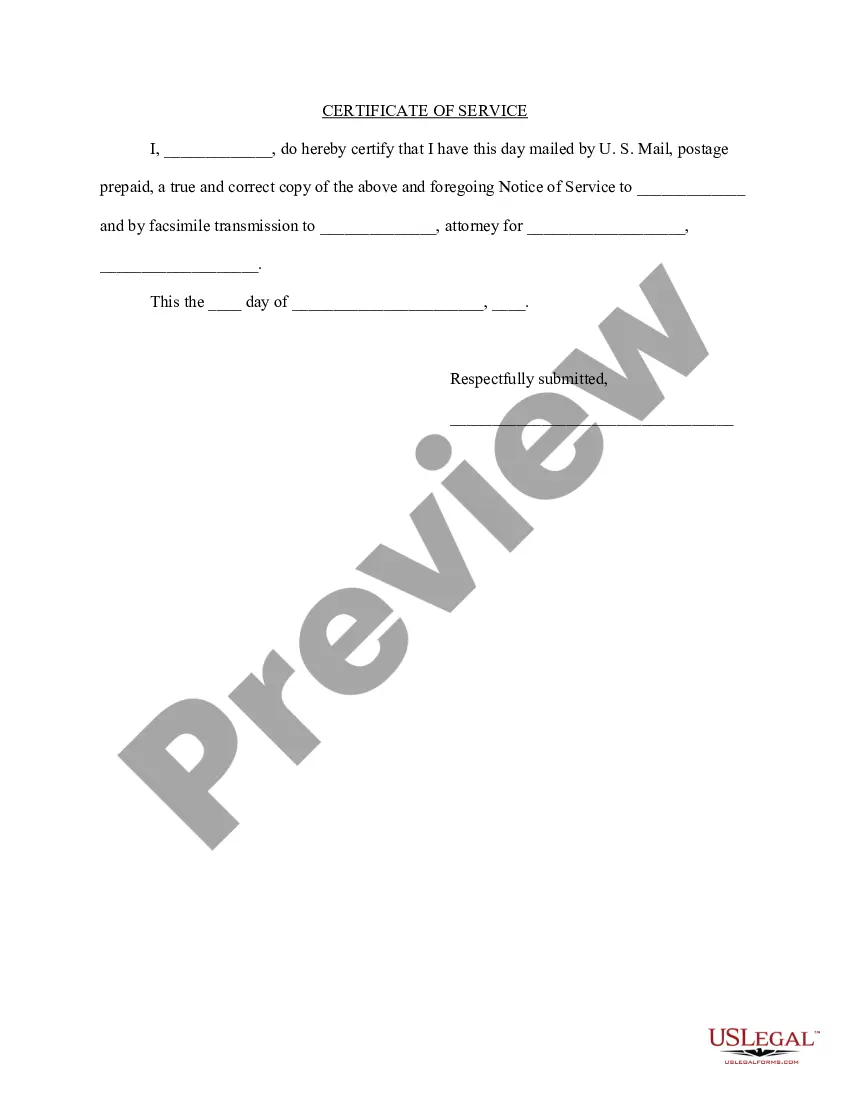
The Certificate of Service confirms that a copy of the document you are filing with the court has been provided to everyone connected with the case or the proceeding. If the papers are not served in the correct way at the correct time, the court cannot proceed with your case or proceeding.
The certificate of service attached to the end of the notice of hearing lets the court know that the other side was informed of the court date and knew that if they wanted to be a part of the trial, they were told when and where the trial would occur and on what day they were told about the trial.
A certificate of service lets the court know that you sent a copy of the form you're filing to certain additional parties, such as the trustee or a specific creditor.
The Certificate of Service confirms that a copy of the document you are filing with the court has been provided to everyone connected with the case or the proceeding. If the papers are not served in the correct way at the correct time, the court cannot proceed with your case or proceeding.
An example of a Proof of Service is a signed declaration from the person who served the documents, stating the name of the person who was served and the date, time, and manner of service. A Proof of Service may also include an affidavit, which is a sworn statement that the documents were properly served.
To show compliance with this requirement, a certificate of service must be included with each filing. The certificate must state the name of the person or persons served, the date of service, the method of service, and the mailing address or email address to which service was made, if not made in person.
The return-of-service form must list all pleadings and documents served and be signed by the person who effects the service of process. However, a person who is authorized under this chapter to serve process and who effects such service of process may sign the return-of-service form using an electronic signature.
In Florida, service by publication requires that you publish a Notice of Action. To be approved for service by publication in a family law case, you must complete and file an Affidavit of Due Diligence. This affidavit shows the court the efforts you have made to locate and serve the other party in your case.
This can either be by mail, in-person, or any other acceptable method. Indicate the date when you served the other party. After filling out all parts of the certificate of service, sign it and submit it to the court clerk.