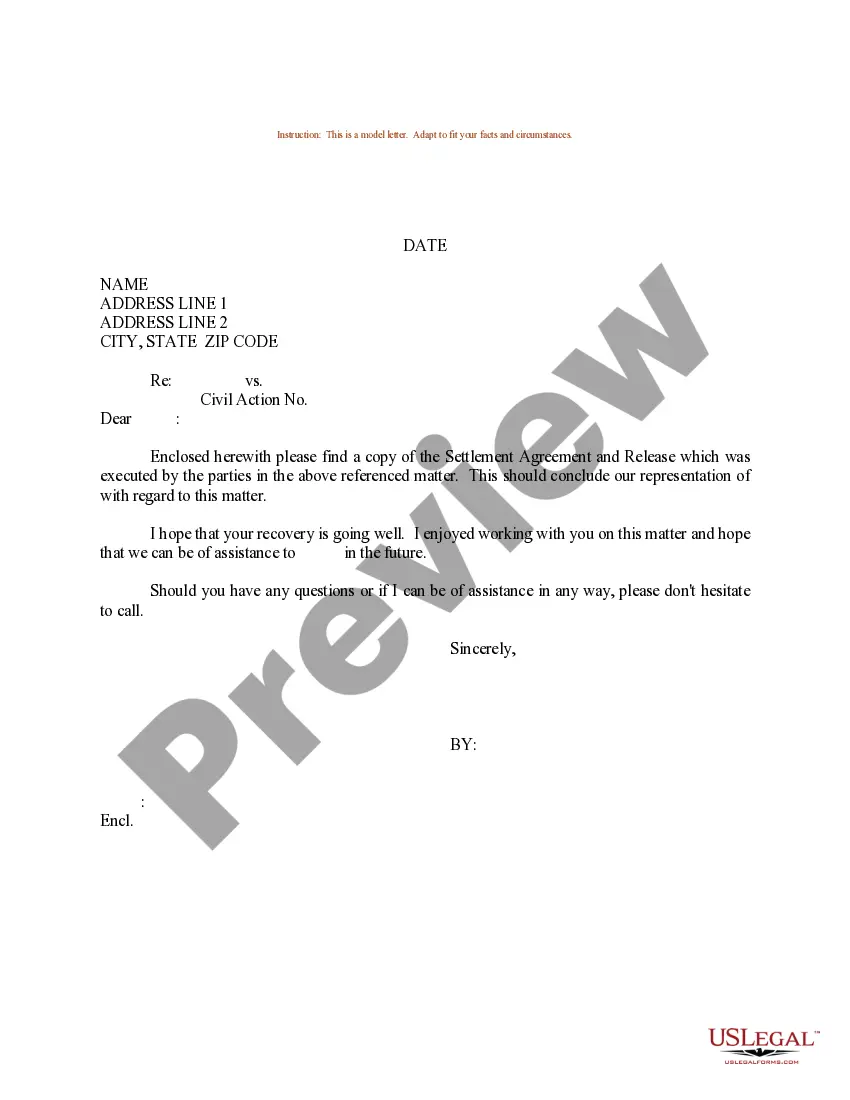
Settlement Confirmation Letter With Final In Mecklenburg
Description

Get your form ready online
Our built-in tools help you complete, sign, share, and store your documents in one place.
Make edits, fill in missing information, and update formatting in US Legal Forms—just like you would in MS Word.
Download a copy, print it, send it by email, or mail it via USPS—whatever works best for your next step.
Sign and collect signatures with our SignNow integration. Send to multiple recipients, set reminders, and more. Go Premium to unlock E-Sign.
If this form requires notarization, complete it online through a secure video call—no need to meet a notary in person or wait for an appointment.
We protect your documents and personal data by following strict security and privacy standards.

Make edits, fill in missing information, and update formatting in US Legal Forms—just like you would in MS Word.

Download a copy, print it, send it by email, or mail it via USPS—whatever works best for your next step.

Sign and collect signatures with our SignNow integration. Send to multiple recipients, set reminders, and more. Go Premium to unlock E-Sign.

If this form requires notarization, complete it online through a secure video call—no need to meet a notary in person or wait for an appointment.

We protect your documents and personal data by following strict security and privacy standards.
Looking for another form?









Form popularity
FAQ
Mecklenburg County Charlotte / County
Go to the public or vital records website for the state where the divorce took place. If you can't find the page to search for divorce records, check the county records website as well. You can visit the CDC's vital records directory to find your state's record office's address.
For divorce records from the year 1970 or later , please contact the Mecklenburg County Clerk of Court (704-686-0400). The Carolina Room has records for Mecklenburg County divorces dated 1846-1969, There is an index to them on this site, and the full records can be read on microfilm in the Carolina Room.
For divorce records from the year 1970 or later , please contact the Mecklenburg County Clerk of Court (704-686-0400).
One of the advantages of a separation agreement is that it is a private contract between the parties rather than a court order which is typically a matter of public record. In North Carolina, the court does not have to review or approve the parties' separation agreement.
Divorce filings in North Carolina are a matter of public record, so anyone can ask for them unless you take specific measures to restrict access. Divorce records tend to contain information such as the names of the parties and the grounds for divorce, which means they may be enough to embarrass someone.