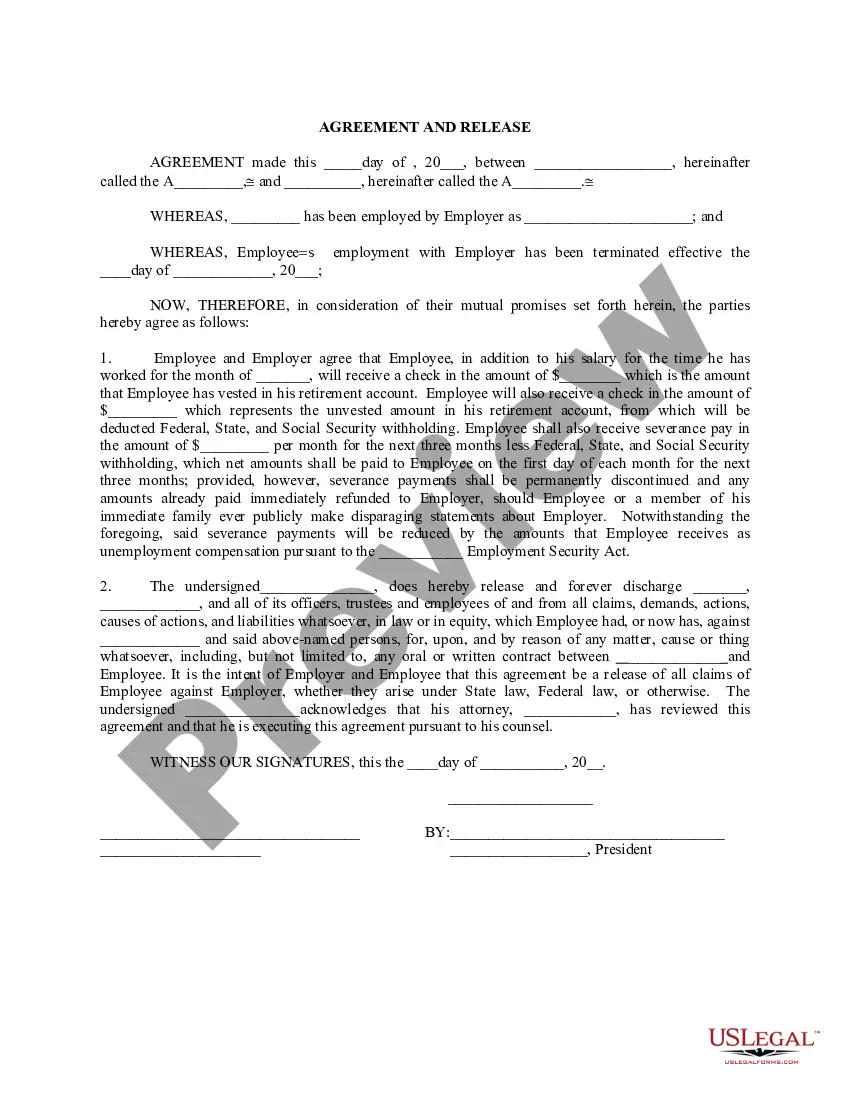
Termination With Severance In North Carolina
Description


Form popularity
FAQ
Most termination clauses are an agreement between the employer and the employee that in the event the employer elects to dismiss the employee without cause, the employee will only receive what they are entitled to under the Employment Standards Code.
Larry Gadea, founder of software maker Envoy, uses PIPs at his 250-person company and said PIPs often arise because managers fail to set clear expectations early on. He estimates that 10% to 25% of employees who get put on PIPs survive the process, a figure that several other CEOs and HR professionals echoed.
Aside from these limits, employers can terminate employees for good cause, bad cause, or no cause at all. Deciding whether to put an employee on a PIP or terminate must be decided on a case-by-case basis. A PIP is usually for job performance issues (hence, performance improvement plan).
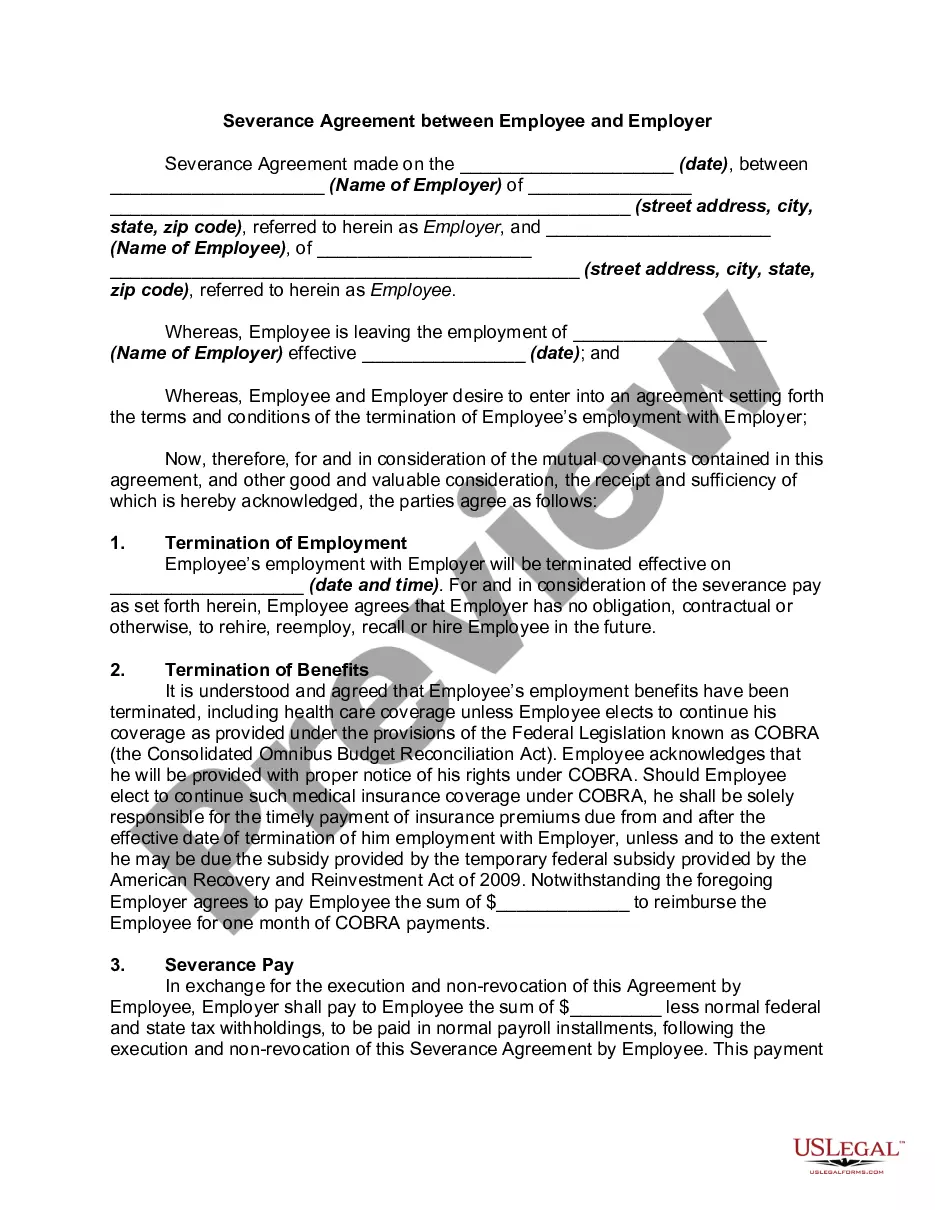
Despite this, many employers in North Carolina offer severance packages to departing employees. While there are no laws requiring them to do so, providing a severance package can be beneficial for employers.
Severance packages are typically offered to executives and employees who are laid off due to downsizing or restructuring. They are not usually offered to people who resign or who are fired for poor performance or other causes. Our California employment attorneys offer a Severance Package Review & Consultation.
Most termination clauses are an agreement between the employer and the employee that in the event the employer elects to dismiss the employee without cause, the employee will only receive what they are entitled to under the Employment Standards Code.
North Carolina Tax Rates, Collections, and Burdens North Carolina has a flat 4.50 percent individual income tax rate. North Carolina has a 2.25 percent corporate income tax rate. North Carolina also has a 4.75 percent state sales tax rate and an average combined state and local sales tax rate of 7.00 percent.
North Carolina is one of many "at-will employment" states. This removes protections for employees and minimizes the ability to seek wrongful termination damages by allowing employers to fire a worker for virtually any reason with few exceptions.