Termination With Severance In Georgia
Description

Form popularity
FAQ
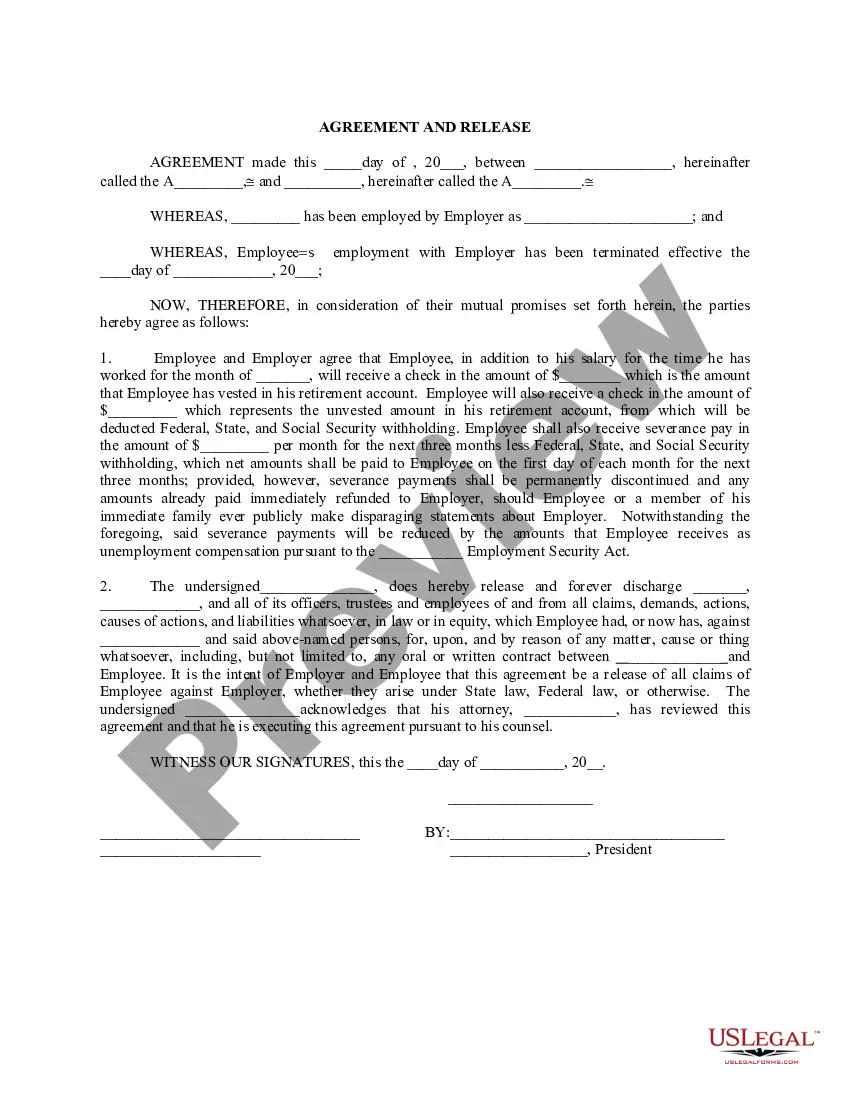
In Georgia, employees are presumed to be "at-will," and their employment may be terminated for any reason, at any time, with or without cause, as long as the reason is not specifically prohibited by law. This presumption is codified at O.C.G.A. § 34-7-1.
The difference between being laid off and fired is who is at fault. Being fired means you are terminated from your job due to something that the company deems was your fault. If you are laid off, that means the company deems that they are at fault.
Most termination clauses are an agreement between the employer and the employee that in the event the employer elects to dismiss the employee without cause, the employee will only receive what they are entitled to under the Employment Standards Code.
In ance with the Employment Security Law, OCGA Section 34-8-190(c) and Rules pursuant thereto, a Separation Notice must be completed for each worker who leaves your employment, regardless of the reason for the separation.
Extension of Benefits Under Rule of 70 To be eligible to retire, you must be at least age 55 with 10 years of service or age 65. Years of service for the “Rule of 70” eligibility purposes, means total years of employment from date of hire to date of termination.
In Georgia, employees are presumed to be "at-will," and their employment may be terminated for any reason, at any time, with or without cause, as long as the reason is not specifically prohibited by law. This presumption is codified at O.C.G.A. § 34-7-1.
Eligibility for Retiree Health and Life Insurance Benefits Rule of 70: the employee's age plus years of continuous, full-time service equal 70 or more, and the employee is at least age 55, with at least ten years of continuous, full-time service.