Work Labor Law For Salaried Employees In North Carolina
Description
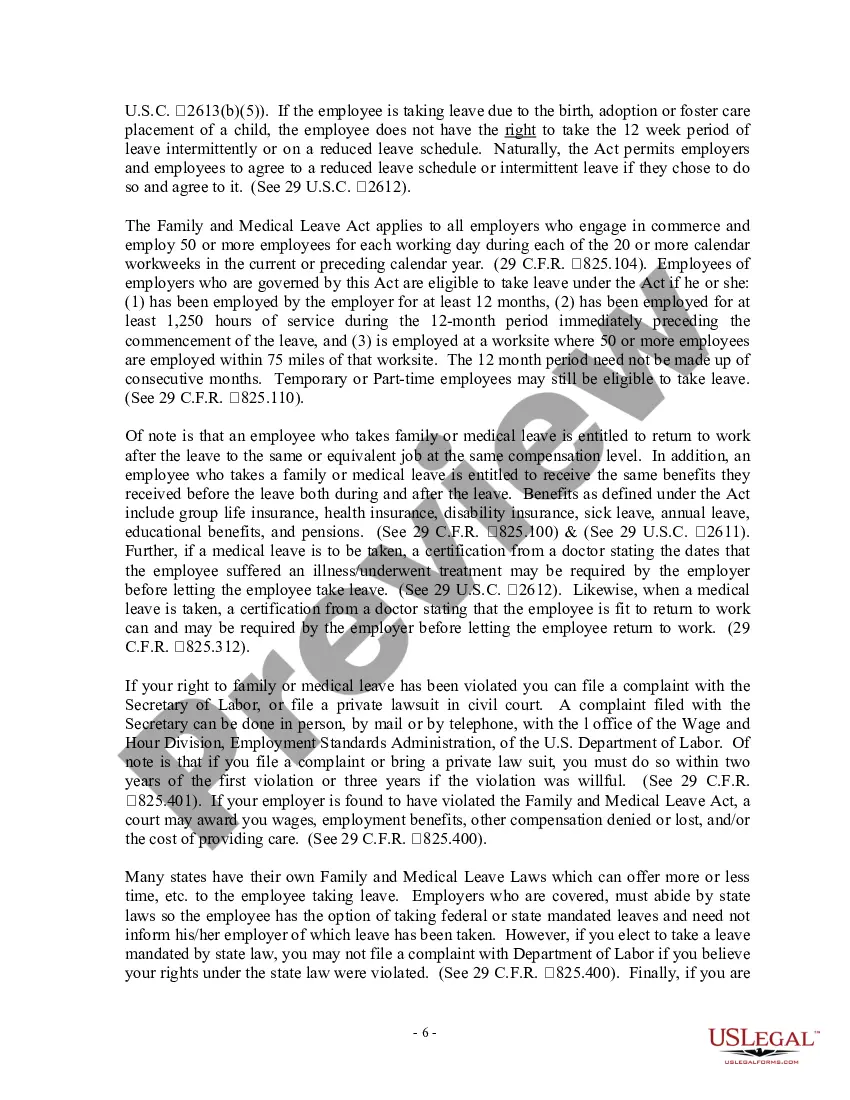

Get your form ready online
Our built-in tools help you complete, sign, share, and store your documents in one place.
Make edits, fill in missing information, and update formatting in US Legal Forms—just like you would in MS Word.
Download a copy, print it, send it by email, or mail it via USPS—whatever works best for your next step.
Sign and collect signatures with our SignNow integration. Send to multiple recipients, set reminders, and more. Go Premium to unlock E-Sign.
If this form requires notarization, complete it online through a secure video call—no need to meet a notary in person or wait for an appointment.
We protect your documents and personal data by following strict security and privacy standards.

Make edits, fill in missing information, and update formatting in US Legal Forms—just like you would in MS Word.

Download a copy, print it, send it by email, or mail it via USPS—whatever works best for your next step.

Sign and collect signatures with our SignNow integration. Send to multiple recipients, set reminders, and more. Go Premium to unlock E-Sign.

If this form requires notarization, complete it online through a secure video call—no need to meet a notary in person or wait for an appointment.

We protect your documents and personal data by following strict security and privacy standards.
Looking for another form?
Form popularity
FAQ
In North Carolina, salaried employees are classified as exempt and non-exempt to determine their eligibility for overtime compensation. Non-exempt employees are compensated 1.5 times for any hours worked beyond 40 in a workweek. Salaried employees in North Carolina can work up to 40 hours in one standard workweek.
Salaried employees in North Carolina can work up to 40 hours in one standard workweek. Any hours worked beyond 40 is compensated at 1.5 times. Employers who disregard overtime compensation may face penalties for violations.
The $7.25 per hour state minimum wage also applies to the state of North Carolina, to county and local governments and to instrumentalities of government.
The first stage of the FLSA salary level test revised effective July 1, 2024, requires that an employee's salary must be at least $43,888 annually to be considered exempt from the overtime provisions. An employee with a salary less than $43,888 annually must be classified as non-exempt.
Most full-time salaried employees work 40-hour weeks. Salaried employees might occasionally work between 45 and 50 hours, depending on the company's needs. Other weeks, they might put in less than 40 hours.
(1) An employer must not request or require an employee to work more than the following number of hours in a week unless the additional hours are reasonable: (a) for a full-time employee—38 hours; or (b) for an employee who is not a full-time employee—the lesser of: (i) 38 hours; and (ii) the employee's ordinary hours ...
Maximum hours an exempt employee can be required to work The law does not provide a maximum number of hours that an exempt worker can be required to work during a week. This means that an employer could require an exempt employee to work well beyond 40 hours a week without overtime compensation.
North Carolina does not require employees to give notice before resignation. However, providing a two-week notice period is considered a professional courtesy and can help ensure a smoother transition.
Finally, North Carolina's anti-blacklisting law prevents your former employer from interfering with your future employment. Your employer can report truthfully that you were discharged, and give the reason, but he or she cannot act to keep you from getting a job.
Salaried employees in North Carolina can work up to 40 hours in one standard workweek. Any hours worked beyond 40 is compensated at 1.5 times. Employers who disregard overtime compensation may face penalties for violations.
