Sublease Requirements In California
Description


Get your form ready online
Our built-in tools help you complete, sign, share, and store your documents in one place.
Make edits, fill in missing information, and update formatting in US Legal Forms—just like you would in MS Word.
Download a copy, print it, send it by email, or mail it via USPS—whatever works best for your next step.
Sign and collect signatures with our SignNow integration. Send to multiple recipients, set reminders, and more. Go Premium to unlock E-Sign.
If this form requires notarization, complete it online through a secure video call—no need to meet a notary in person or wait for an appointment.
We protect your documents and personal data by following strict security and privacy standards.

Make edits, fill in missing information, and update formatting in US Legal Forms—just like you would in MS Word.

Download a copy, print it, send it by email, or mail it via USPS—whatever works best for your next step.

Sign and collect signatures with our SignNow integration. Send to multiple recipients, set reminders, and more. Go Premium to unlock E-Sign.

If this form requires notarization, complete it online through a secure video call—no need to meet a notary in person or wait for an appointment.

We protect your documents and personal data by following strict security and privacy standards.
Looking for another form?







Form popularity
FAQ
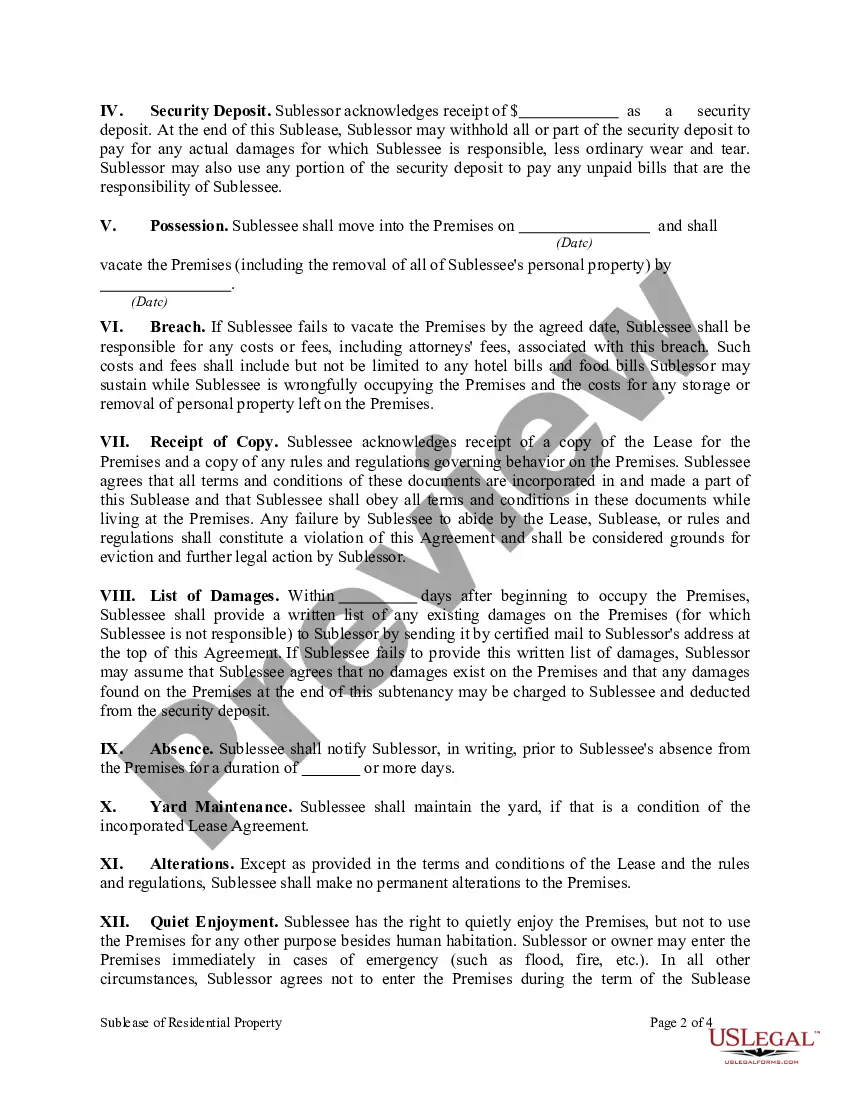
Subletting is when the original renter (the “sublessor”) remains responsible for a lease, and either lives with a sublessee (the new tenant), or has a sublessee take their place living in the home.
Subletting is when the original renter (the “sublessor”) remains responsible for a lease, and either lives with a sublessee (the new tenant), or has a sublessee take their place living in the home.
Under California civil code, tenants without leases maintain rights like limits on rent increases, proper notice before eviction, and requiring the landlord to maintain habitable living conditions. Be aware that without a lease, landlords only need to provide 30 days' notice to increase rent or terminate tenancy.
The Sublessee shall have the right to sublet the whole (but not less than the whole) of the Leased Premises, subject to the condition that the subletting of the Leased Premises shall be subject to the prior written consent of the Sublessor and the Minister, and any Sublease shall comply with the Bylaws.
A master tenant is considered a landlord in relation to his or her subtenant, meaning that a master tenant is able to evict a subtenant. Subtenants do not have the right to evict their master tenant or other subtenants or roommates. Similarly, roommates who are co-tenants cannot evict their fellow co-tenants.
