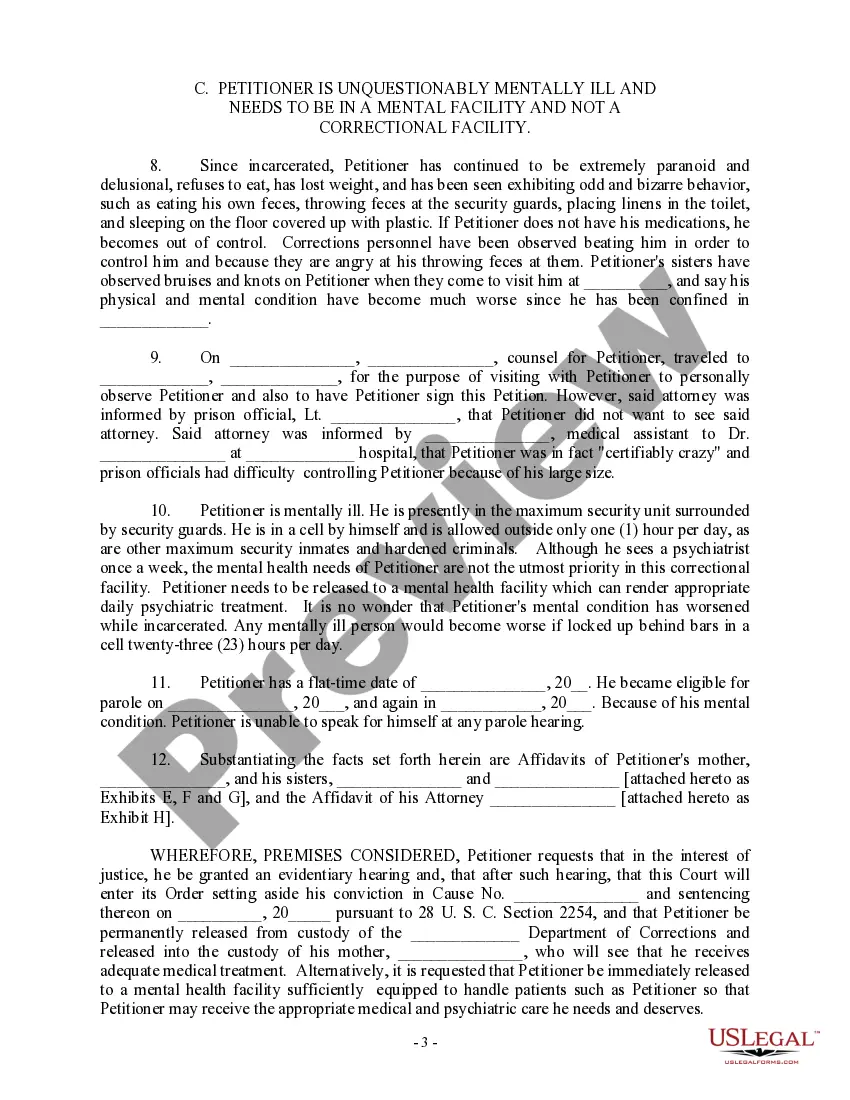
Federal Habeas Corpus Form 2241 In Wayne
Description

Get your form ready online
Our built-in tools help you complete, sign, share, and store your documents in one place.
Make edits, fill in missing information, and update formatting in US Legal Forms—just like you would in MS Word.
Download a copy, print it, send it by email, or mail it via USPS—whatever works best for your next step.
Sign and collect signatures with our SignNow integration. Send to multiple recipients, set reminders, and more. Go Premium to unlock E-Sign.
If this form requires notarization, complete it online through a secure video call—no need to meet a notary in person or wait for an appointment.
We protect your documents and personal data by following strict security and privacy standards.

Make edits, fill in missing information, and update formatting in US Legal Forms—just like you would in MS Word.

Download a copy, print it, send it by email, or mail it via USPS—whatever works best for your next step.

Sign and collect signatures with our SignNow integration. Send to multiple recipients, set reminders, and more. Go Premium to unlock E-Sign.

If this form requires notarization, complete it online through a secure video call—no need to meet a notary in person or wait for an appointment.

We protect your documents and personal data by following strict security and privacy standards.
Looking for another form?









Form popularity
FAQ
Habeas Corpus is a Latin word meaning which literally means 'to have the body of'. It is an order issued by the court to a person who has detained another person, to produce the body of the latter before it. The court then examines the cause and legality of detention. Further Reading: Types of Writs.
Examples of 'writ of habeas corpus' in a sentence A number of people arrested and detained throughout the country sought writs of habeas corpus before the courts. He wanted them released through writs of habeas corpus, a right hitherto granted only to human prisoners.
Habeas Corpus is a Latin word meaning which literally means 'to have the body of'. It is an order issued by the court to a person who has detained another person, to produce the body of the latter before it. The court then examines the cause and legality of detention. Further Reading: Types of Writs.
The Writ of Habeas Corpus As per definition, it is a law stating that an individual cannot be imprisoned or held in custody inside a prison cell unless he/she has first been brought before a court of law, which decides whether or not it is legal for the person to be kept in prison.
Habeas Corpus, a Latin term meaning “you shall have the body,” is a legal action or writ by which an individual can report an unlawful detention or imprisonment to a court and request that the court order the custodian to bring the detainee to court.
Definition and Legal Foundation Habeas Corpus, a Latin term meaning “you shall have the body,” is a legal action or writ by which an individual can report an unlawful detention or imprisonment to a court and request that the court order the custodian to bring the detainee to court.
Suspensions of the privilege of the writ of habeas corpus are statutes that vest very broad discretion in the executive to decide which individuals to hold in custody. Detention of combatants under the law of war need not rest on a valid suspension, whether the combatant is an alien or a citizen of the United States.
Once known as the Great Writ of Liberty, habeas corpus has been so extensively diminished that it is no longer a protection against unlawful imprisonment but rather an empty procedure that enables and may actually encourage state courts to disregard constitutional rights.