Federal Habeas Corpus Rules In Utah
Description

Get your form ready online
Our built-in tools help you complete, sign, share, and store your documents in one place.
Make edits, fill in missing information, and update formatting in US Legal Forms—just like you would in MS Word.
Download a copy, print it, send it by email, or mail it via USPS—whatever works best for your next step.
Sign and collect signatures with our SignNow integration. Send to multiple recipients, set reminders, and more. Go Premium to unlock E-Sign.
If this form requires notarization, complete it online through a secure video call—no need to meet a notary in person or wait for an appointment.
We protect your documents and personal data by following strict security and privacy standards.

Make edits, fill in missing information, and update formatting in US Legal Forms—just like you would in MS Word.

Download a copy, print it, send it by email, or mail it via USPS—whatever works best for your next step.

Sign and collect signatures with our SignNow integration. Send to multiple recipients, set reminders, and more. Go Premium to unlock E-Sign.

If this form requires notarization, complete it online through a secure video call—no need to meet a notary in person or wait for an appointment.

We protect your documents and personal data by following strict security and privacy standards.
Looking for another form?



Form popularity
FAQ
Any prisoner, or another person acting on their behalf, may petition the court, or a judge, for a writ of habeas corpus.
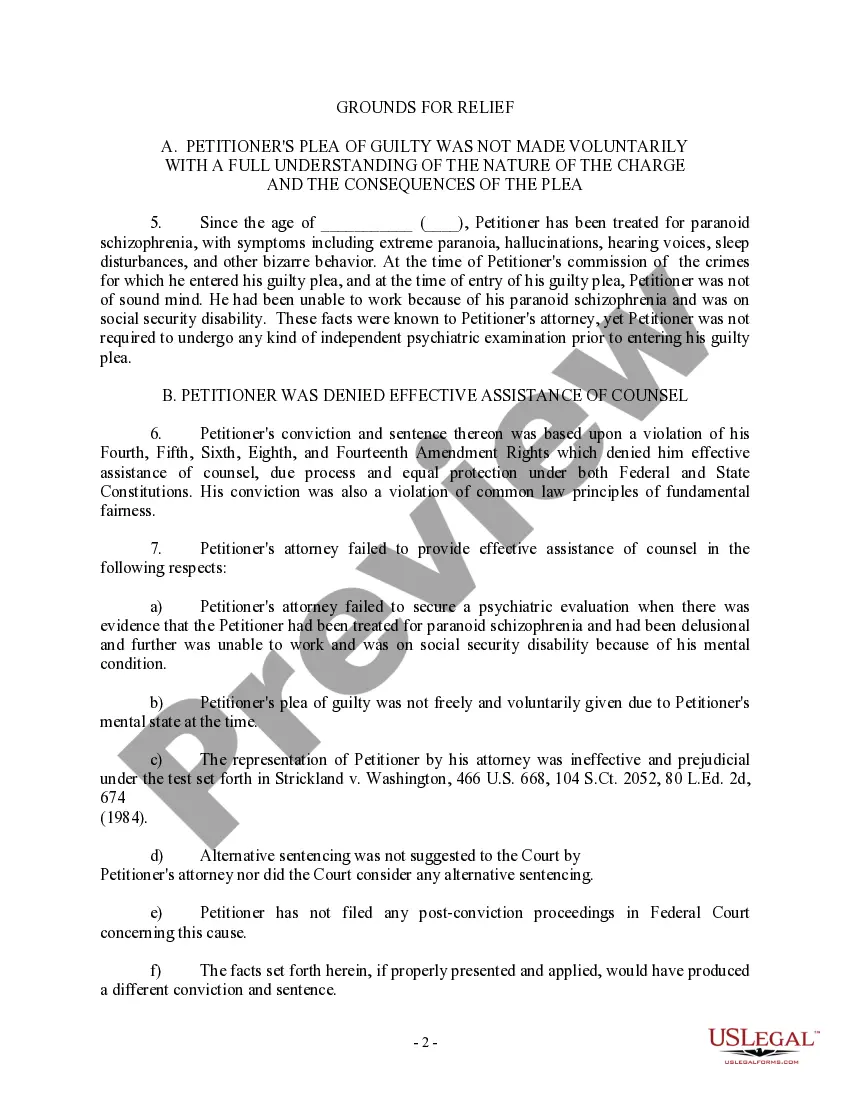
Typical examples where a court has granted a habeas corpus petition include claims of new evidence discovered in the case, ineffective assistance of counsel, prosecutorial misconduct, incompetence to stand trial, and challenging conditions of confinement.
The Privilege of the Writ of Habeas Corpus shall not be suspended, unless when in Cases of Rebellion or Invasion the public Safety may require it.
Writs of habeas corpus can be filed in state or federal court. A state-court writ of habeas corpus is brought pursuant to California law, whereas a federal writ is brought under prevailing federal law.
Whether you are a state or federal prisoner, a federal habeas petition claims that your imprisonment is illegal because your arrest, trial, or sentence violated federal law. This would be true if any aspect of your arrest, trial, or actual sentence violated a federal statute, treaty, or the U.S. Constitution.
Under 28 U.S.C. § 2254, a prisoner in custody pursuant to a state court judgment may seek relief in federal court by petitioning for a writ of habeas corpus.
The two exceptions—the situations in which “a new rule applies retroactively in a collateral proceeding”—are when “(1) the rule is substantive or (2) the rule is a 'watershed rule of criminal procedure' implicating the fundamental fairness and accuracy of the criminal proceeding.” 221 The first exception has also ...
In other words, the writ of habeas corpus only functions to test jurisdictional defects that may invalidate the legal authority to detain the person, and the reviewing court only examines the power and authority of the governmental authority to detain the person, and does not review the correctness of the authorities' ...
Gideon sought relief from his conviction by filing a petition for writ of habeas corpus in the Florida Supreme Court. In his petition, Gideon challenged his conviction and sentence on the ground that the trial judge's refusal to appoint counsel violated Gideon's constitutional rights.
State prisoners can petition Federal courts to review the validity of their convictions and sentences; these petitions, commonly called habeas corpus petitions, allege that criminal proceedings and resulting convictions and/or sentences violated the constitutional rights of prisoners.
