Habeas Corpus Petition Form With Motion In Tarrant
Description


Get your form ready online
Our built-in tools help you complete, sign, share, and store your documents in one place.
Make edits, fill in missing information, and update formatting in US Legal Forms—just like you would in MS Word.
Download a copy, print it, send it by email, or mail it via USPS—whatever works best for your next step.
Sign and collect signatures with our SignNow integration. Send to multiple recipients, set reminders, and more. Go Premium to unlock E-Sign.
If this form requires notarization, complete it online through a secure video call—no need to meet a notary in person or wait for an appointment.
We protect your documents and personal data by following strict security and privacy standards.

Make edits, fill in missing information, and update formatting in US Legal Forms—just like you would in MS Word.

Download a copy, print it, send it by email, or mail it via USPS—whatever works best for your next step.

Sign and collect signatures with our SignNow integration. Send to multiple recipients, set reminders, and more. Go Premium to unlock E-Sign.

If this form requires notarization, complete it online through a secure video call—no need to meet a notary in person or wait for an appointment.

We protect your documents and personal data by following strict security and privacy standards.
Looking for another form?



Form popularity
FAQ
It found that 3.2 percent of the petitions were granted in whole or in part, and only l. 8 percent resulted in any type of release of the petitioner. Successful habeas corpus claims in most cases do not produce a prisoner's release, but rather a requirement for further judicial review.
The Suspension Clause of the Constitution (Article I, Section 9, Clause 2) , states: “The Privileges of the Writ of Habeas Corpus shall not be suspended unless when in Cases of Rebellion or Invasion the public Safety may require it.”
A writ of habeas corpus is used to bring a prisoner or other detainee (e.g. institutionalized mental patient) before the court to determine if the person's imprisonment or detention is lawful. A habeas petition proceeds as a civil action against the State agent (usually a warden) who holds the defendant in custody.
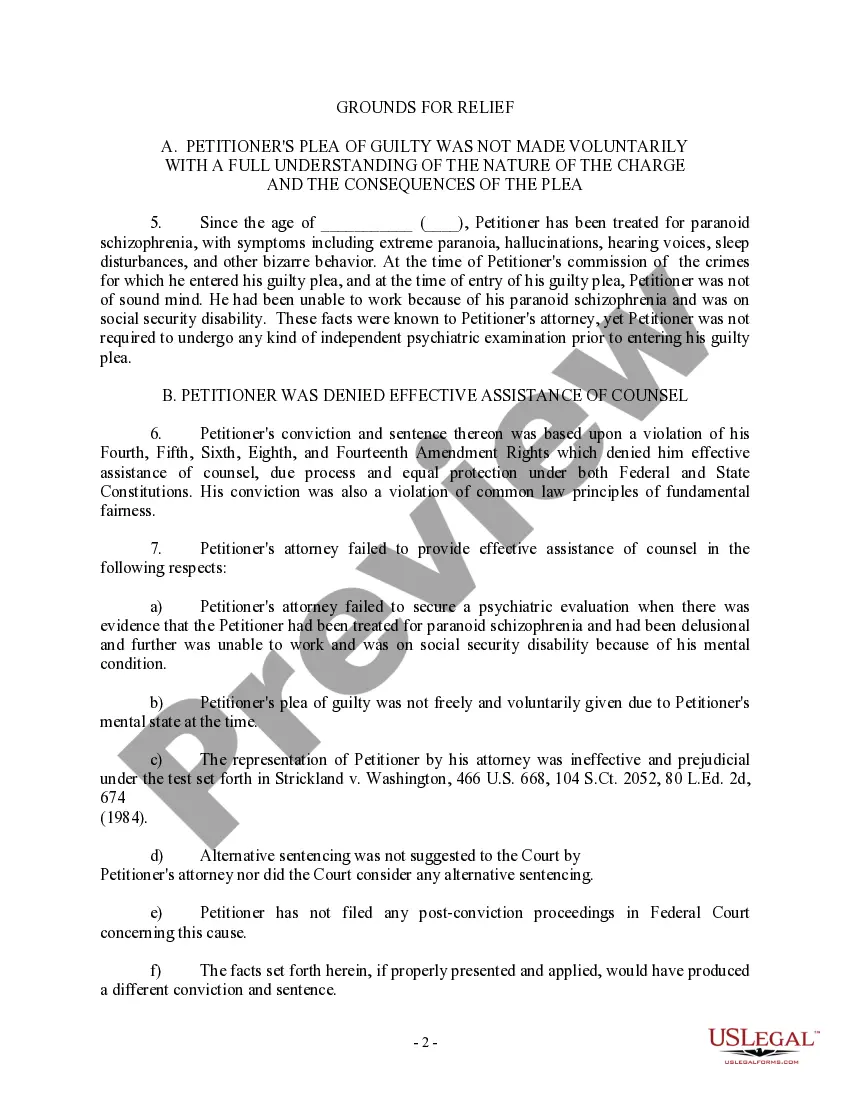
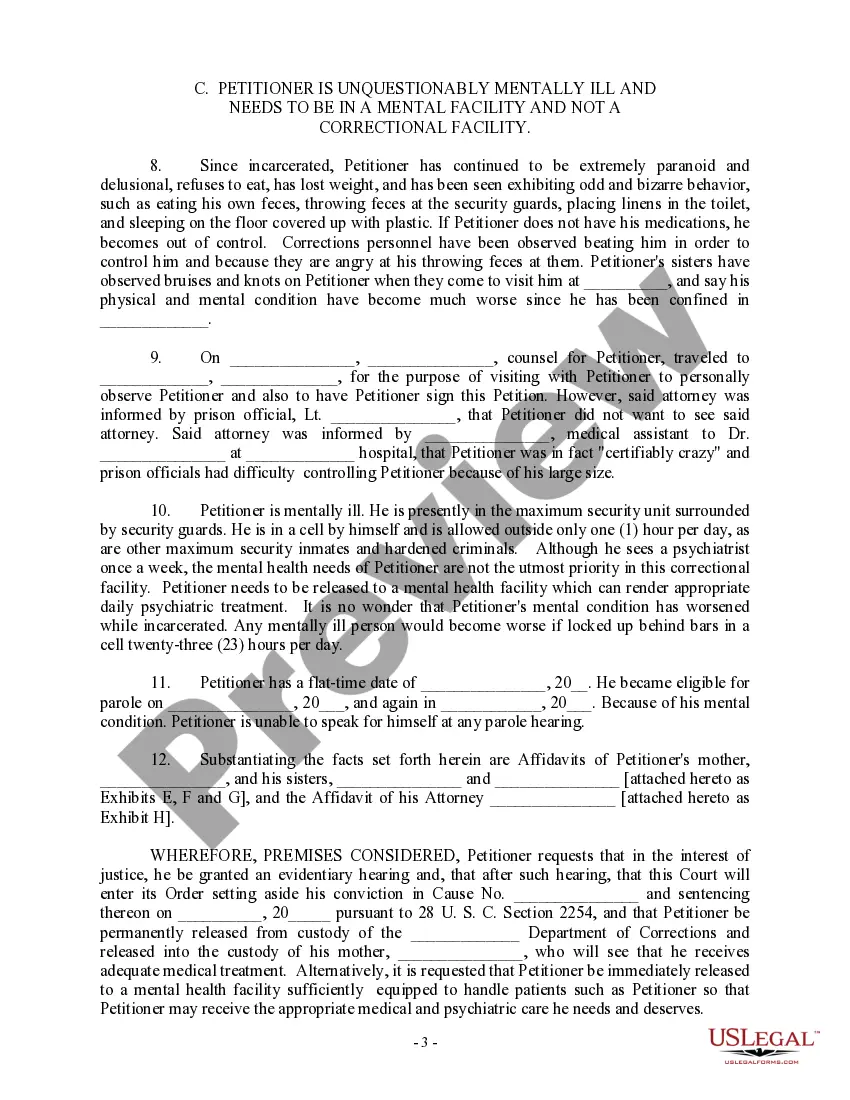
To initiate a state writ of habeas corpus in Texas, a person must first file a petition with the appropriate court. The petition should outline the grounds for the challenge, such as a violation of constitutional rights, newly discovered evidence, or ineffective assistance of counsel.
State every ground (reason) that supports your claim that you are being held in violation of the Constitution, laws, or treaties of the United States. Attach additional pages if you have more than four grounds. State the facts supporting each ground. Any legal arguments must be submitted in a separate memorandum.
Habeas Corpus is a Latin word meaning which literally means 'to have the body of'. It is an order issued by the court to a person who has detained another person, to produce the body of the latter before it. The court then examines the cause and legality of detention. Further Reading: Types of Writs.
Habeas corpus refers to “a writ employed to bring a person before a court, most frequently to ensure that the person's imprisonment or detention is not illegal.” It is also “may be used to obtain judicial review of (1) the regularity of the extradition process, (2) the right to or amount of bail, or (3) the ...
To enforce a court order, you must file a motion for enforcement. This motion must call out the specific provisions that were violated, as well as the relief you are requesting from the court. Given the penalties that can be imposed on violators, it's very important that the language in the motion is very precise.
Courts don't take custody order violations lightly, and the penalties can be severe. Violating parents may face fines, be held in contempt of court, or even serve jail time, depending on the gravity and recurrence of the violation.
As clerk of the three County Courts at Law, the County Clerk is responsible for the intake, processing and maintenance of civil cases with a jurisdictional limit up to $250,000; including debt, breach of contract, garnishments, temporary restraining orders, injunctions, automotive/personal injury cases and eminent ...
