Define Habeas Corpus In Law In Santa Clara
Description

Get your form ready online
Our built-in tools help you complete, sign, share, and store your documents in one place.
Make edits, fill in missing information, and update formatting in US Legal Forms—just like you would in MS Word.
Download a copy, print it, send it by email, or mail it via USPS—whatever works best for your next step.
Sign and collect signatures with our SignNow integration. Send to multiple recipients, set reminders, and more. Go Premium to unlock E-Sign.
If this form requires notarization, complete it online through a secure video call—no need to meet a notary in person or wait for an appointment.
We protect your documents and personal data by following strict security and privacy standards.

Make edits, fill in missing information, and update formatting in US Legal Forms—just like you would in MS Word.

Download a copy, print it, send it by email, or mail it via USPS—whatever works best for your next step.

Sign and collect signatures with our SignNow integration. Send to multiple recipients, set reminders, and more. Go Premium to unlock E-Sign.

If this form requires notarization, complete it online through a secure video call—no need to meet a notary in person or wait for an appointment.

We protect your documents and personal data by following strict security and privacy standards.
Looking for another form?






Form popularity
FAQ
Traditionally, the writ of habeas corpus is an order issued by a court directing a person detaining another to produce the physical body of the detainee at a designated time and place, and to explain the reason for the detention. HABEAS CORPUS HAS ONLY ONE OBJECTIVE: to inquire into the cause of the detention.
1 Habeas Corpus translates to “produce the body”. 2 A habeas corpus application is used by persons who feel they are being wrongfully detained. Upon application, the individual is brought before a judge who will determine whether the detainment is lawful. Provincial courts must hear these applications quickly.
(a) A person unlawfully imprisoned or restrained of their liberty, under any pretense, may prosecute a writ of habeas corpus to inquire into the cause of the imprisonment or restraint.
A Writ of Habeas Corpus is one of the primary ways of obtaining a client's freedom based on his or her actual innocence. Actual innocence Writs of Habeas Corpus can include witness statements, affidavits, and other external evidence that shows how the client has been wrongfully convicted.
Habeas Corpus is a Latin word meaning which literally means 'to have the body of'. It is an order issued by the court to a person who has detained another person, to produce the body of the latter before it. The court then examines the cause and legality of detention. Further Reading: Types of Writs.
Thus, to effectively file a writ of habeas corpus in California state court, an inmate must have been convicted and either serving a sentence of incarceration, probation or parole. They must have also filed a direct appeal to the appellate court and then to the California Supreme Court.
The "Great Writ" of habeas corpus is a fundamental right in the Constitution that protects against unlawful and indefinite imprisonment. Translated from Latin it means "show me the body." Habeas corpus has historically been an important instrument to safeguard individual freedom against arbitrary executive power.
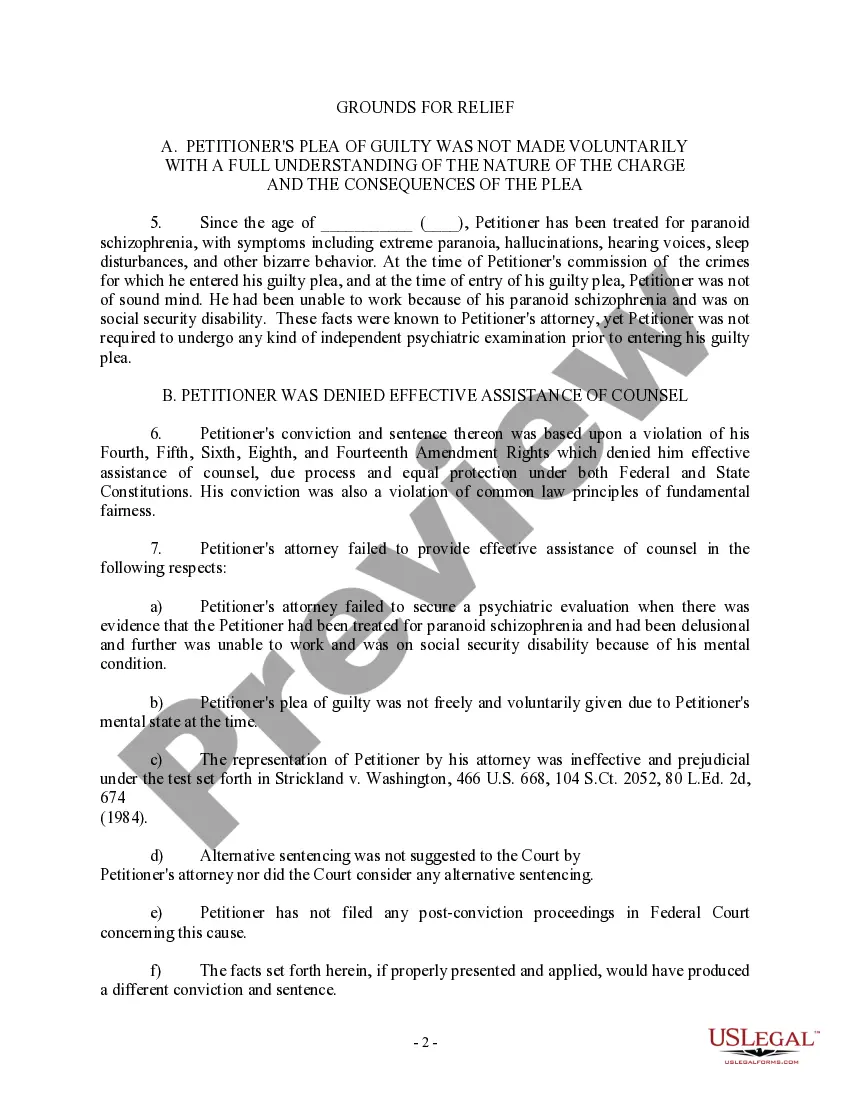
Typical examples where a court has granted a habeas corpus petition include claims of new evidence discovered in the case, ineffective assistance of counsel, prosecutorial misconduct, incompetence to stand trial, and challenging conditions of confinement.
The Writ of Habeas Corpus is an outstanding post-conviction remedy available to you. Through it, you can attain many kinds of successes in your case, including immediate release from custody, reduction of your sentence, stop illegal conditions to your incarceration, and even potentially seek a new trial.
