Federal Habeas Corpus Practice And Procedure In Riverside
Description

Get your form ready online
Our built-in tools help you complete, sign, share, and store your documents in one place.
Make edits, fill in missing information, and update formatting in US Legal Forms—just like you would in MS Word.
Download a copy, print it, send it by email, or mail it via USPS—whatever works best for your next step.
Sign and collect signatures with our SignNow integration. Send to multiple recipients, set reminders, and more. Go Premium to unlock E-Sign.
If this form requires notarization, complete it online through a secure video call—no need to meet a notary in person or wait for an appointment.
We protect your documents and personal data by following strict security and privacy standards.

Make edits, fill in missing information, and update formatting in US Legal Forms—just like you would in MS Word.

Download a copy, print it, send it by email, or mail it via USPS—whatever works best for your next step.

Sign and collect signatures with our SignNow integration. Send to multiple recipients, set reminders, and more. Go Premium to unlock E-Sign.

If this form requires notarization, complete it online through a secure video call—no need to meet a notary in person or wait for an appointment.

We protect your documents and personal data by following strict security and privacy standards.
Looking for another form?


Form popularity
FAQ
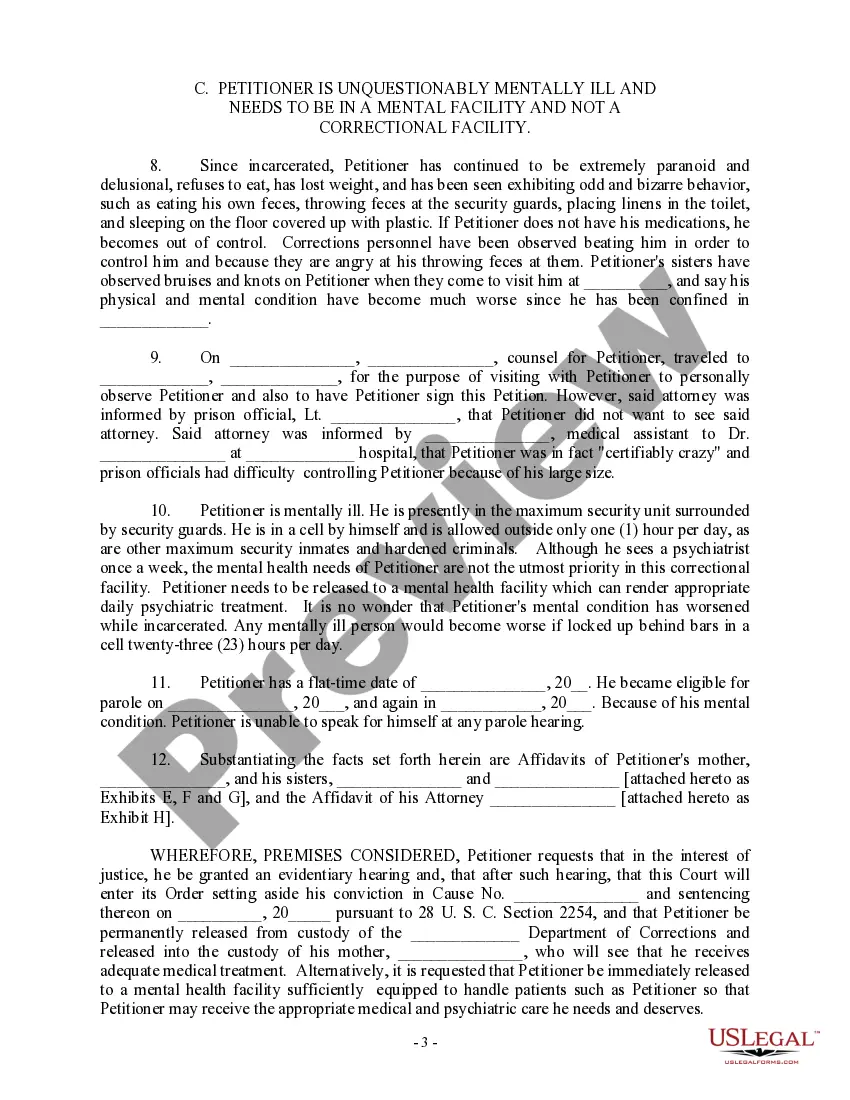
A Writ of Habeas Corpus is usually filed by submitting a Petition, a Memorandum of Points and Authorities, a Declaration from the defendant, and other evidence which supports the Writ of Habeas Corpus. The Memorandum of Points of Authorities is a legal memorandum, which contains the legal arguments of the defendant.
Typical examples where a court has granted a habeas corpus petition include claims of new evidence discovered in the case, ineffective assistance of counsel, prosecutorial misconduct, incompetence to stand trial, and challenging conditions of confinement.
Habeas review now plays a far more central role in the complex regulation of detention than scholars predicted, because habeas review does not depend on underlying due process rights. A judge instead focuses on whether a detention is authorized.
A Writ of Habeas Corpus is usually filed by submitting a Petition, a Memorandum of Points and Authorities, a Declaration from the defendant, and other evidence which supports the Writ of Habeas Corpus. The Memorandum of Points of Authorities is a legal memorandum, which contains the legal arguments of the defendant.
As a fundamental instrument for safeguarding individual's freedom against arbitrary and lawless state action, the writ of habeas corpus serves as a procedural device, by which executive, judicial, or other governmental restraints on personal liberty are subjected to judicial scrutiny.
Today, habeas corpus is mainly used as a post-conviction remedy for state or federal prisoners who challenge the legality of the application of federal laws that were used in the judicial proceedings that resulted in their detention.
The court must rule on a petition for writ of habeas corpus within 60 days after the petition is filed. (B) If the court fails to rule on the petition within 60 days of its filing, the petitioner may file a notice and request for ruling.
If an inmate meets all the requirements to file a petition for writ of habeas corpus, they will file their petition in the superior court in the court of conviction. Within 60 days, the court will review the petition to determine if the inmate raised a prima facie case entitling them to relief.
The right to file a petition for writ of habeas corpus is guaranteed by the California constitution. In order to be eligible to petition for such relief, the petitioner must be “in custody,” either actually or constructively.
The court must rule on a petition for writ of habeas corpus within 60 days after the petition is filed. (B) If the court fails to rule on the petition within 60 days of its filing, the petitioner may file a notice and request for ruling.