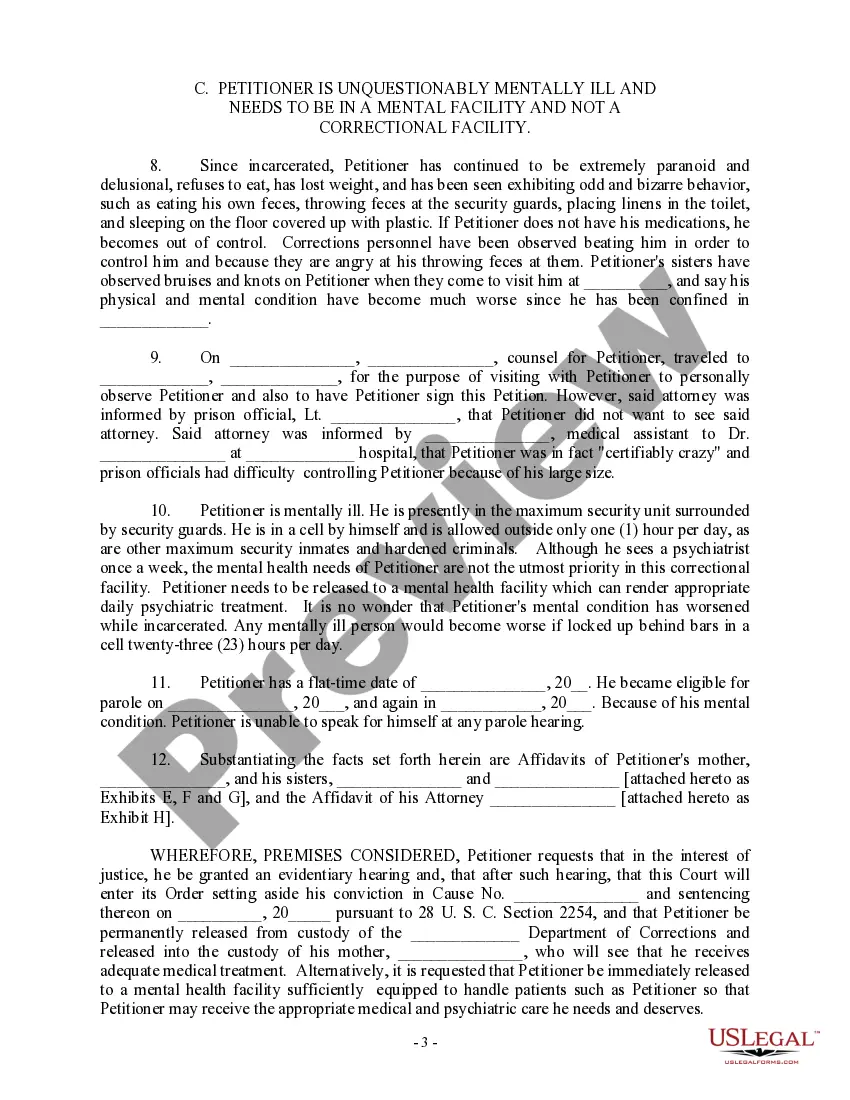
Federal Habeas Corpus Time Limit In Michigan
Description

Get your form ready online
Our built-in tools help you complete, sign, share, and store your documents in one place.
Make edits, fill in missing information, and update formatting in US Legal Forms—just like you would in MS Word.
Download a copy, print it, send it by email, or mail it via USPS—whatever works best for your next step.
Sign and collect signatures with our SignNow integration. Send to multiple recipients, set reminders, and more. Go Premium to unlock E-Sign.
If this form requires notarization, complete it online through a secure video call—no need to meet a notary in person or wait for an appointment.
We protect your documents and personal data by following strict security and privacy standards.

Make edits, fill in missing information, and update formatting in US Legal Forms—just like you would in MS Word.

Download a copy, print it, send it by email, or mail it via USPS—whatever works best for your next step.

Sign and collect signatures with our SignNow integration. Send to multiple recipients, set reminders, and more. Go Premium to unlock E-Sign.

If this form requires notarization, complete it online through a secure video call—no need to meet a notary in person or wait for an appointment.

We protect your documents and personal data by following strict security and privacy standards.
Looking for another form?



Form popularity
FAQ
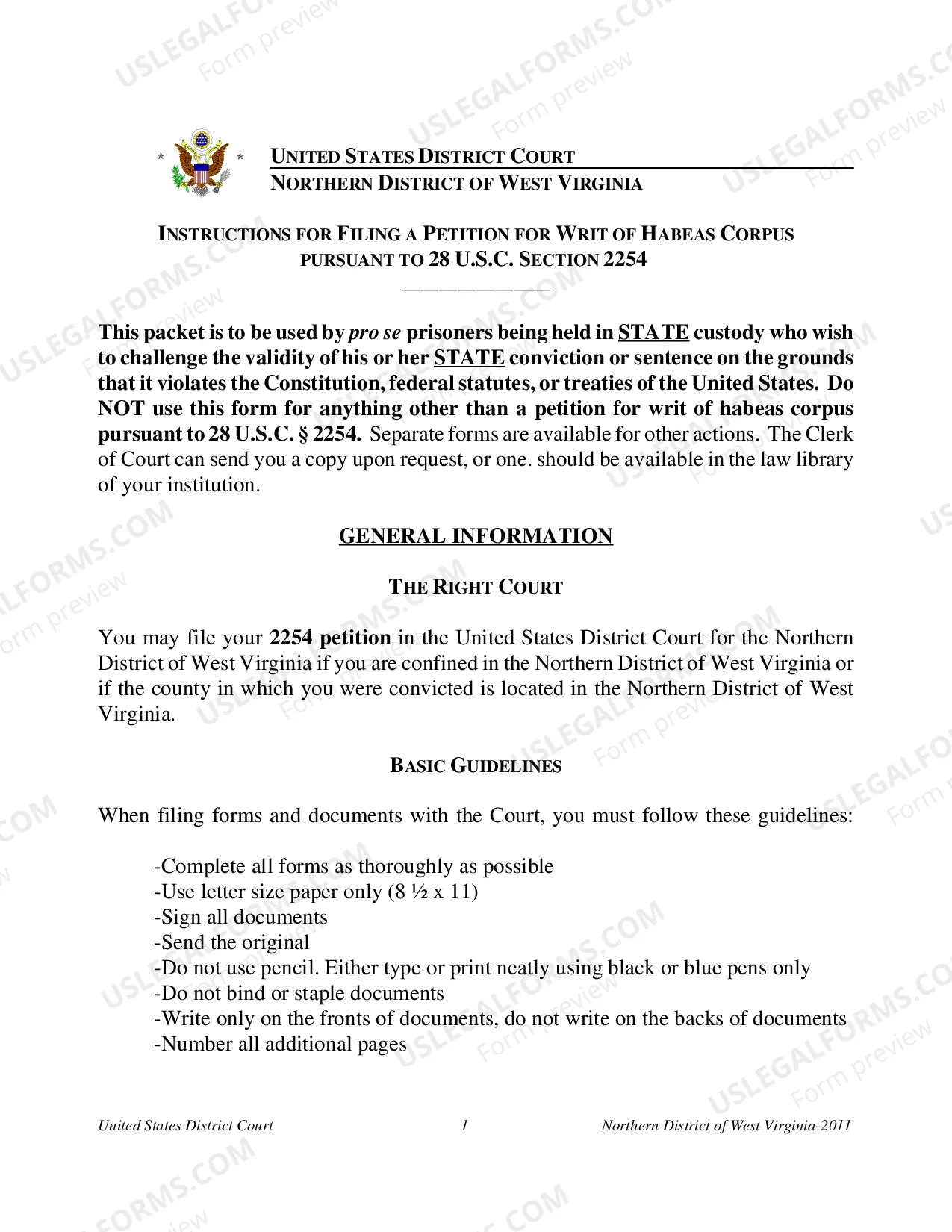
A federal petition for writ of habeas corpus under 28 U.S.C. § 2254 is used by a (1) state prisoner (2) being held in state custody (3) to challenge the validity of a state criminal conviction or sentence (4) for the purpose of obtaining release from custody.
Sec. 4385. (1) The judges of every court of record have the power to issue a writ of habeas corpus for the purpose of bringing before that court, or another court or body authorized to examine witnesses, any prisoner who may be detained in any jail or prison within this state, to be examined as a witness.
Unlike capital cases, there is no prescribed, fixed time period in which to seek state habeas corpus relief in a non-capital criminal case. Instead, the general rule is that such relief must be sought in a “timely fashion,” “reasonably promptly.”
Any person aggrieved by any decision or order of the Appellate Tribunal, may, file an appeal to the Supreme Court within sixty days from the date of communication of the decision or order of the Appellate Tribunal, to him, on any one or more of the grounds specified in section 100 of the Code of Civil Procedure, 1908 ( ...
You must file your petition for a writ of certiorari within 90 days from the date of the entry of the final judgment in the United States court of appeals or highest state appellate court or 90 days from the denial of a timely filed petition for rehearing.
An appeal of right means that Michigan law gives the defendant the right to appeal the judgment of the trial court, and the appellate court must hear the appeal so long as the defendant follows all the rules for filing the appeal.
Filing Notice/Application the prosecutor, the attorney general, and any other parties involved in your case. The deadline for filing notice/application varies depending on whether it is an appeal by right or an appeal by leave, but generally it ranges from 21 days to 6 months after entry of judgment/sentence.
To apply for leave to appeal, a party must file: (1) 1 signed copy of an application for leave to appeal prepared in conformity with MCR 7.212(B) and consisting of the following: (a) a statement identifying the judgment or order appealed and the date of its entry; (b) the questions presented for review related in ...
After the Michigan Court of Appeals issues its decision, you usually have 56 days (about two months) to file an Application for Leave to Appeal with the Supreme Court. During this time, your attorney will review the Court of Appeals' decision, gather legal arguments, and draft your application.
Time limits For most civil cases, 21 days is the key time limit. A claim of appeal must be filed with 21 days from the final order. MCR 7.204(A)(1). An application for leave to appeal must be filed within 21 days from the order being challenged.