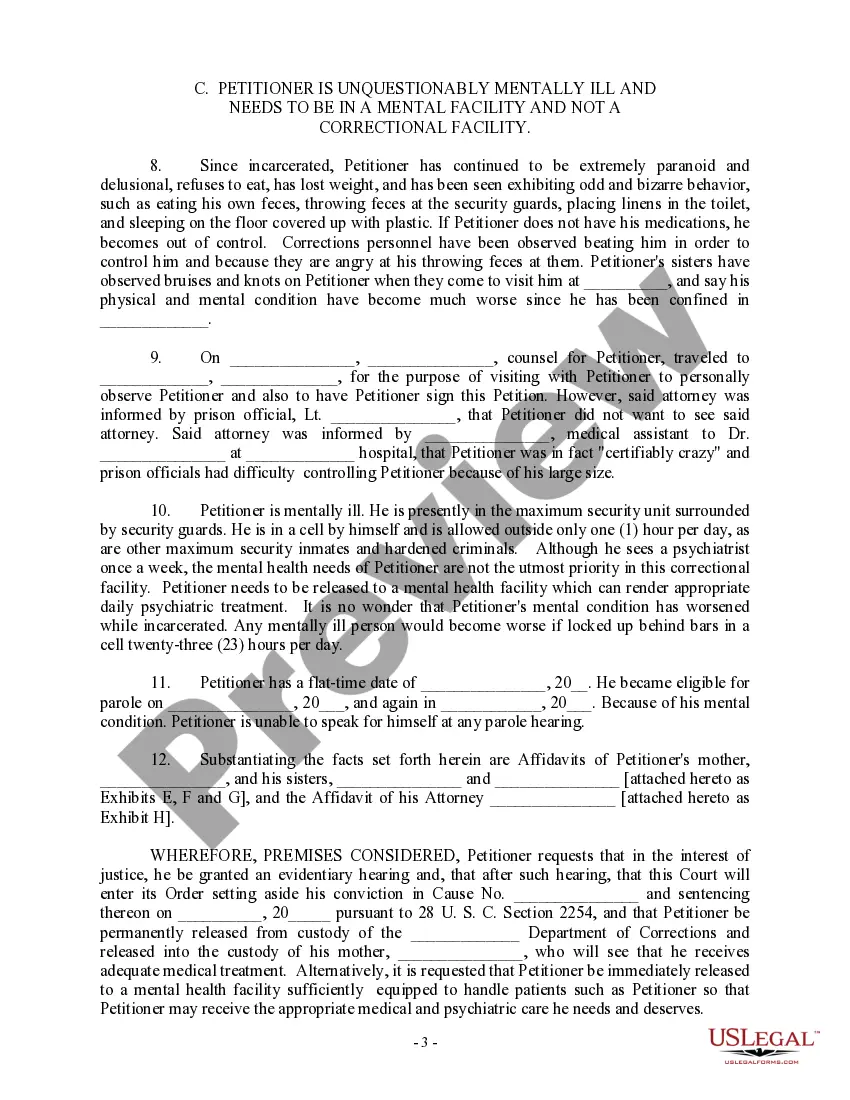
Federal Habeas Corpus Form 2241 In Miami-Dade
Description

Get your form ready online
Our built-in tools help you complete, sign, share, and store your documents in one place.
Make edits, fill in missing information, and update formatting in US Legal Forms—just like you would in MS Word.
Download a copy, print it, send it by email, or mail it via USPS—whatever works best for your next step.
Sign and collect signatures with our SignNow integration. Send to multiple recipients, set reminders, and more. Go Premium to unlock E-Sign.
If this form requires notarization, complete it online through a secure video call—no need to meet a notary in person or wait for an appointment.
We protect your documents and personal data by following strict security and privacy standards.

Make edits, fill in missing information, and update formatting in US Legal Forms—just like you would in MS Word.

Download a copy, print it, send it by email, or mail it via USPS—whatever works best for your next step.

Sign and collect signatures with our SignNow integration. Send to multiple recipients, set reminders, and more. Go Premium to unlock E-Sign.

If this form requires notarization, complete it online through a secure video call—no need to meet a notary in person or wait for an appointment.

We protect your documents and personal data by following strict security and privacy standards.
Looking for another form?



Form popularity
FAQ
Because the courts have many cases, a petition for habeas corpus can take a long time. In general, habeas petitions take at least 6 months, and in most cases you will not receive a final decision for at least 10 months.
§2241. Power to grant writ. (a) Writs of habeas corpus may be granted by the Supreme Court, any justice thereof, the district courts and any circuit judge within their respective jurisdictions.
Section 2241 of Title 28 of the United States Code (“28 U.S.C. § 2241”) permits courts to issue writs of habeas corpus where a prisoner establishes that he is in custody in violation of the Constitution or laws or treaties of the United States.
Today, habeas corpus is mainly used as a post-conviction remedy for state or federal prisoners who challenge the legality of the application of federal laws that were used in the judicial proceedings that resulted in their detention.
Ask the court for a writ of habeas corpus (a court order telling a public official, like a prison warden, to bring you to the court and show a legal reason for holding you) to challenge your criminal conviction or commitment to another facility or the conditions under which you are being held.
' 2241 usually involve one of the following situations: a. A federal prisoner believes that the Bureau of Prisons (“BOP”) has wrongly computed his or her release date; b. A federal prisoner believes that the BOP has wrongly taken away some of his or her “goodtime credits” to extend the duration of confinement; c.
A Writ of Habeas Corpus is usually filed by submitting a Petition, a Memorandum of Points and Authorities, a Declaration from the defendant, and other evidence which supports the Writ of Habeas Corpus.
A legal action demanding that a prisoner be brought before a judge to make sure that he or she is not being held illegally. (Definition of habeas corpus from the Cambridge Academic Content Dictionary © Cambridge University Press)
Like most legalese, habeas corpus is Latin, literally "You should have the person," and it means a person can't be locked up without explanation or trial — they must be brought before a judge. Definitions of habeas corpus. noun. a writ ordering a prisoner to be brought before a judge. synonyms: writ of habeas corpus.
Habeas Corpus is a Latin word meaning which literally means 'to have the body of'. It is an order issued by the court to a person who has detained another person, to produce the body of the latter before it. The court then examines the cause and legality of detention. Further Reading: Types of Writs.