Define Habeas Corpus In In Houston
Description


Get your form ready online
Our built-in tools help you complete, sign, share, and store your documents in one place.
Make edits, fill in missing information, and update formatting in US Legal Forms—just like you would in MS Word.
Download a copy, print it, send it by email, or mail it via USPS—whatever works best for your next step.
Sign and collect signatures with our SignNow integration. Send to multiple recipients, set reminders, and more. Go Premium to unlock E-Sign.
If this form requires notarization, complete it online through a secure video call—no need to meet a notary in person or wait for an appointment.
We protect your documents and personal data by following strict security and privacy standards.

Make edits, fill in missing information, and update formatting in US Legal Forms—just like you would in MS Word.

Download a copy, print it, send it by email, or mail it via USPS—whatever works best for your next step.

Sign and collect signatures with our SignNow integration. Send to multiple recipients, set reminders, and more. Go Premium to unlock E-Sign.

If this form requires notarization, complete it online through a secure video call—no need to meet a notary in person or wait for an appointment.

We protect your documents and personal data by following strict security and privacy standards.
Looking for another form?







Form popularity
FAQ
The Court of Criminal Appeals will review these recommendations and make the final decision about whether to deny or grant relief. If an application for a writ of habeas corpus is denied at the state level, the defendant may be able to apply for a federal writ and challenge this decision.
Commutations of sentence will be granted only upon written recommendation of a majority of the applicant's trial officials in the county of conviction, stating that the penalty now appears to be excessive and recommending a definite term, based on new information not before the judge or jury at trial or a statutory ...
The first type of appeal is a “direct appeal” after a conviction. This has a very short deadline, described below. A second type of appeal (called a Writ of Habeas Corpus) can often be filed much later, potentially even many years after a conviction.
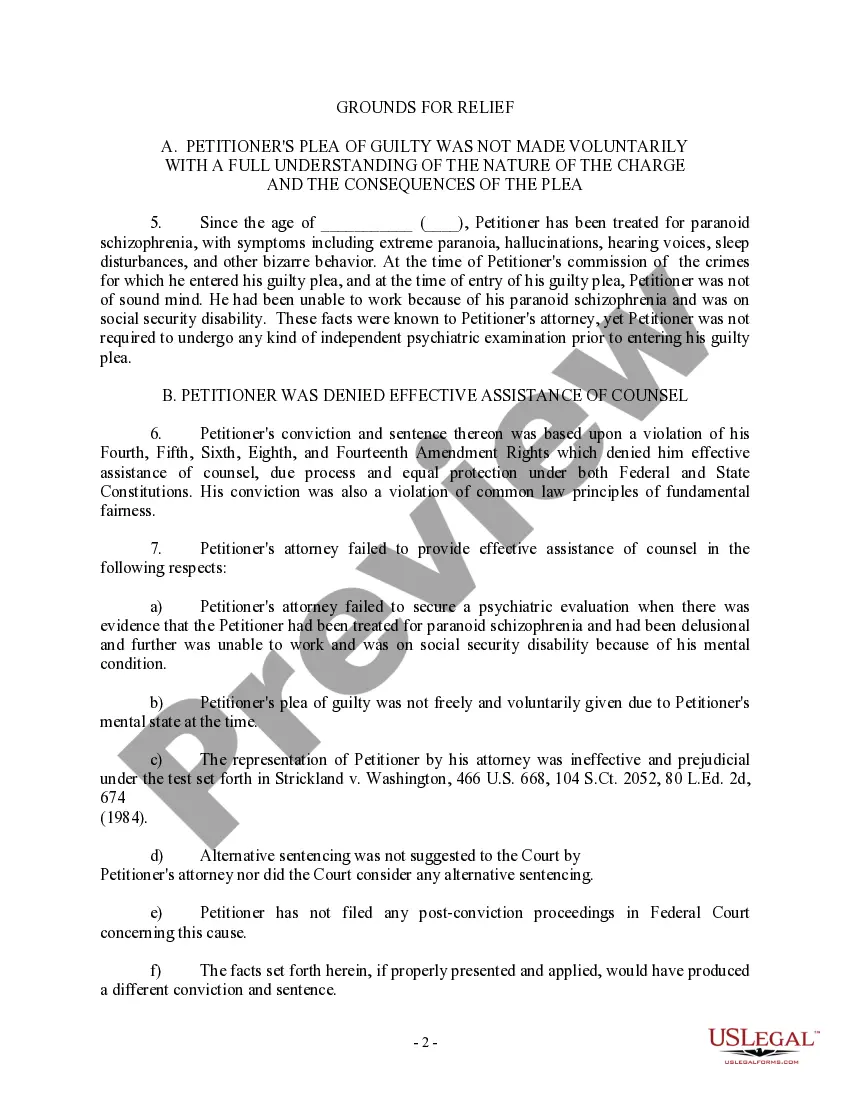
Post-conviction relief in Texas usually takes the form of an application for a writ of habeas corpus. In a habeas corpus proceeding, a defendant may raise claims such as ineffective assistance of counsel, illegal sentencing, or newly discovered evidence that exonerates the defendant.
Direct Appeal: The most common form of post-conviction relief is the direct appeal, which involves challenging the conviction or sentence through the appellate court system. Appellate attorneys review the trial record for errors of law or procedure and argue the case before a panel of appellate judges.
In a Texas child custody case, a writ of Habeas Corpus may be used to challenge the custody or visitation rights of a parent or guardian and seek the return of a child who has been unlawfully removed or detained by another party.
(b) An application for writ of habeas corpus filed after final conviction in a felony case, other than a case in which the death penalty is imposed, must be filed with the clerk of the court in which the conviction being challenged was obtained, and the clerk shall assign the application to that court.
Examples of 'writ of habeas corpus' in a sentence A number of people arrested and detained throughout the country sought writs of habeas corpus before the courts. He wanted them released through writs of habeas corpus, a right hitherto granted only to human prisoners.
(b) An application for writ of habeas corpus filed after final conviction in a felony case, other than a case in which the death penalty is imposed, must be filed with the clerk of the court in which the conviction being challenged was obtained, and the clerk shall assign the application to that court.
