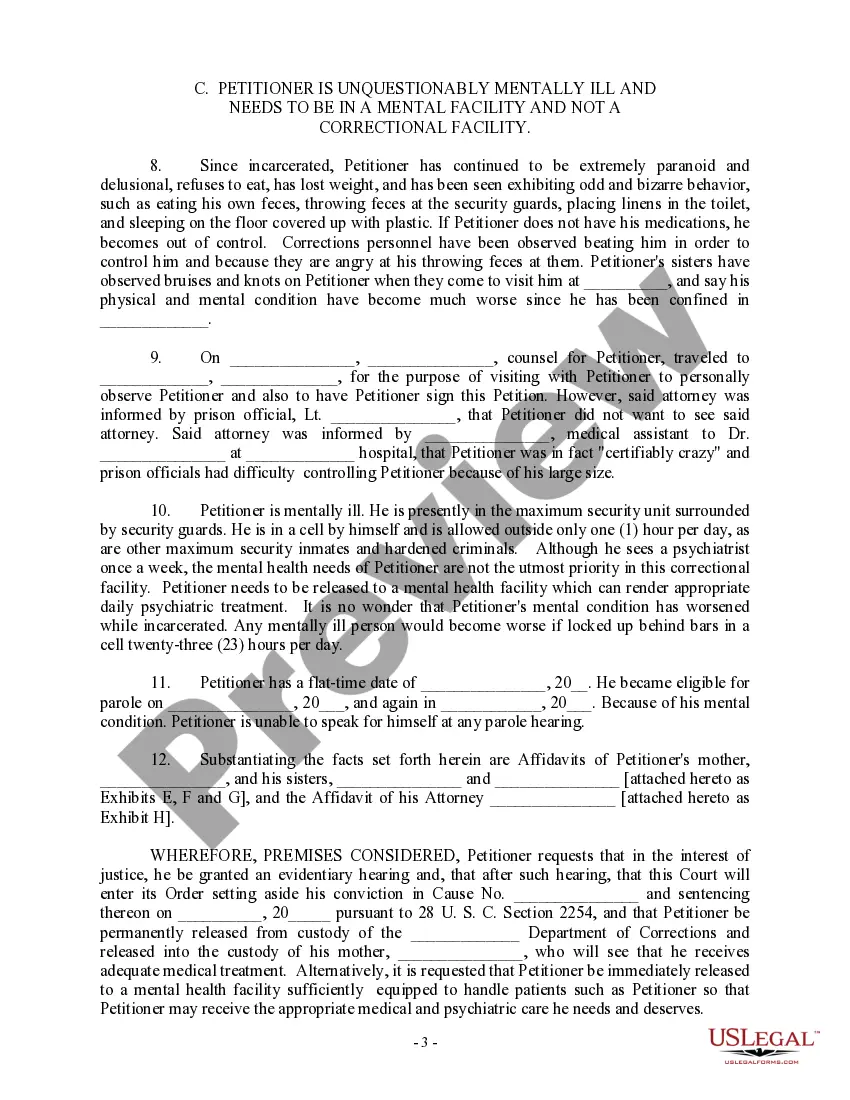
Habeas Corpus Petition Form With Two Points In Georgia
Description

Get your form ready online
Our built-in tools help you complete, sign, share, and store your documents in one place.
Make edits, fill in missing information, and update formatting in US Legal Forms—just like you would in MS Word.
Download a copy, print it, send it by email, or mail it via USPS—whatever works best for your next step.
Sign and collect signatures with our SignNow integration. Send to multiple recipients, set reminders, and more. Go Premium to unlock E-Sign.
If this form requires notarization, complete it online through a secure video call—no need to meet a notary in person or wait for an appointment.
We protect your documents and personal data by following strict security and privacy standards.

Make edits, fill in missing information, and update formatting in US Legal Forms—just like you would in MS Word.

Download a copy, print it, send it by email, or mail it via USPS—whatever works best for your next step.

Sign and collect signatures with our SignNow integration. Send to multiple recipients, set reminders, and more. Go Premium to unlock E-Sign.

If this form requires notarization, complete it online through a secure video call—no need to meet a notary in person or wait for an appointment.

We protect your documents and personal data by following strict security and privacy standards.
Looking for another form?





Form popularity
FAQ
Habeas Corpus is a Latin word meaning which literally means 'to have the body of'. It is an order issued by the court to a person who has detained another person, to produce the body of the latter before it. The court then examines the cause and legality of detention. Further Reading: Types of Writs.
He and others have applied for writs of habeas corpus. By our legislation we have made a mockery of habeas corpus. There does not seem to be any provision for the law of habeas corpus. They are entitled to challenge the lawfulness of their detention by applying for a writ of habeas corpus or by seeking judicial review.
In Georgia, you must file a petition for a Writ of Habeas Corpus within four years of your felony convictions having become final (within one year for misdemeanor convictions). When a conviction becomes final depends on what other steps you took to appeal your conviction, if any.
The rules for filing a federal writ of habeas corpus are codified in 28 U.S.C. §§ 2241-2256. Generally, one cannot file a writ of habeas corpus unless they show the government has detained them. State prisoners cannot file a federal writ unless they exhaust all available state remedies.
Habeas petitions are generally filed in superior court in the county where the inmate is being held. However, a federal inmate is required to file a petition in the sentencing court. After pleadings have been filed, the court generally sets a hearing date.
Brazil: The 1988 Brazilian constitution stipulates that: "habeas data shall be granted: a) to ensure the knowledge of information related to the person of the petitioner, contained in records or databanks of government agencies or of agencies of a public character; b) for the correction of data, when the petitioner ...
Federal habeas corpus is a procedure under which a federal court may review the legality of an individual's incarceration. It is most often the stage of the criminal appellate process that follows direct appeal and any available state collateral review. The law in the area is an intricate weave of statute and case law.
Habeas Corpus is a Latin word meaning which literally means 'to have the body of'. It is an order issued by the court to a person who has detained another person, to produce the body of the latter before it. The court then examines the cause and legality of detention. Further Reading: Types of Writs.
Permissible procedural restriction. Rather, the statute provides that in a narrowly defined class of cases - those in which a petitioner who is not in custody seeks habeas relief from a misdemeanor traffic conviction - the petition for habeas corpus must be filed within 180 days of conviction.
In Georgia, you have the ability to sue for property damage within 4 years of the damage, regardless of whether it is personal or commercial property. The person who owned the property is the only one who is allowed to bring it to court. Property damage of a car has a statute of limitations of 4 years as well.
