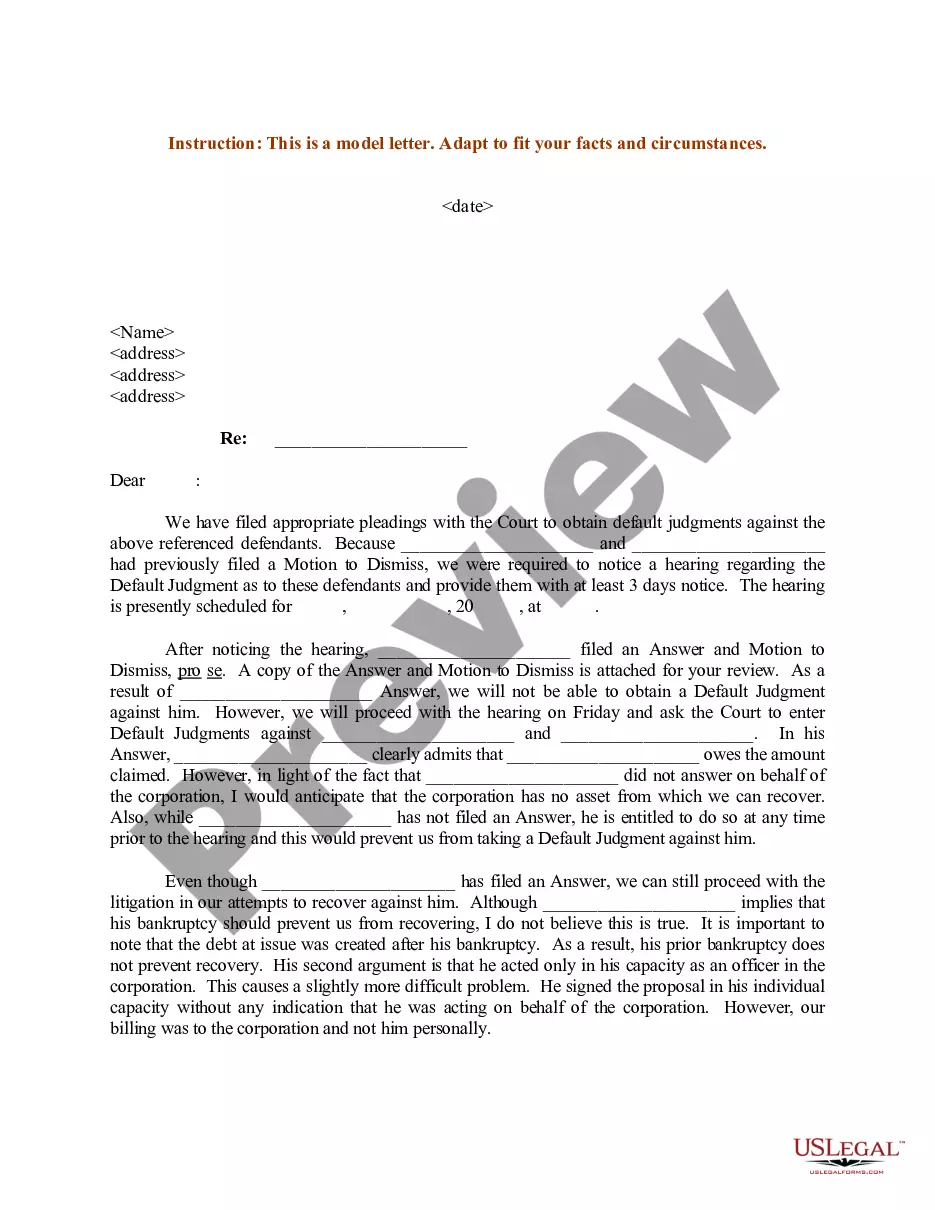
Letter For Judgment In Los Angeles
Description




Get your form ready online
Our built-in tools help you complete, sign, share, and store your documents in one place.
Make edits, fill in missing information, and update formatting in US Legal Forms—just like you would in MS Word.
Download a copy, print it, send it by email, or mail it via USPS—whatever works best for your next step.
Sign and collect signatures with our SignNow integration. Send to multiple recipients, set reminders, and more. Go Premium to unlock E-Sign.
If this form requires notarization, complete it online through a secure video call—no need to meet a notary in person or wait for an appointment.
We protect your documents and personal data by following strict security and privacy standards.

Make edits, fill in missing information, and update formatting in US Legal Forms—just like you would in MS Word.

Download a copy, print it, send it by email, or mail it via USPS—whatever works best for your next step.

Sign and collect signatures with our SignNow integration. Send to multiple recipients, set reminders, and more. Go Premium to unlock E-Sign.

If this form requires notarization, complete it online through a secure video call—no need to meet a notary in person or wait for an appointment.

We protect your documents and personal data by following strict security and privacy standards.
Looking for another form?








Form popularity
FAQ
(b) Notice of entry of judgment Promptly upon entry of the award as a judgment, the clerk must serve notice of entry of judgment on all parties who have appeared in the case and must execute a certificate of service and place it in the court's file in the case. (Subd (b) amended effective January 1, 2016.)
Steps to ask a judge to set aside an order Figure out if you have a legal reason. You need to give the judge a legal reason why they should set aside the order or judgment. Fill out and file forms. Fill out and file forms with the court. Serve the other side. Go to the court date.
The person assigning the judgment (the seller) to you (the buyer) must sign the form in the presence of a notary. The form must be signed and stamped by the notary. Once this is done, the form becomes the original that the court needs.
If the court sent a Notice of Entry of Default If the court has your address, the clerk mails you a Notice of Entry of Default. If they sent this, you must file and serve the request to set aside within 180 days from the date you were served that notice.
By definition, when there is an assignment of a judgment, the assignee becomes the party in interest and the assignor has no further interest in the action or the enforcement of the judgment.
(c) The acknowledgment of assignment of judgment shall be: (1) Made in the manner of an acknowledgment of a conveyance of real property. (2) Executed and acknowledged by the judgment creditor or by the prior assignee of record if there is one.
To do this, fill out an EJ-001 Abstract of Judgment form and take it to the clerk's office. After the clerk stamps it, record it at the County Recorder's Office in the county where the property is located. Place a lien on a business.
Write the name and last known address of the judgment debtor in the space provided. You may also include any known aliases used by the judgment debtor. Fill in the last 4 digits of the judgment debtor's driver license number and state where it was issued, if you know them.
Members of the public who wanted to see the electronic case record would have to visit the courthouse to do so. For a complete list of case types in which the public may only view electronic records at the courthouse, see rule 2.503 of the California Rules of Court.

