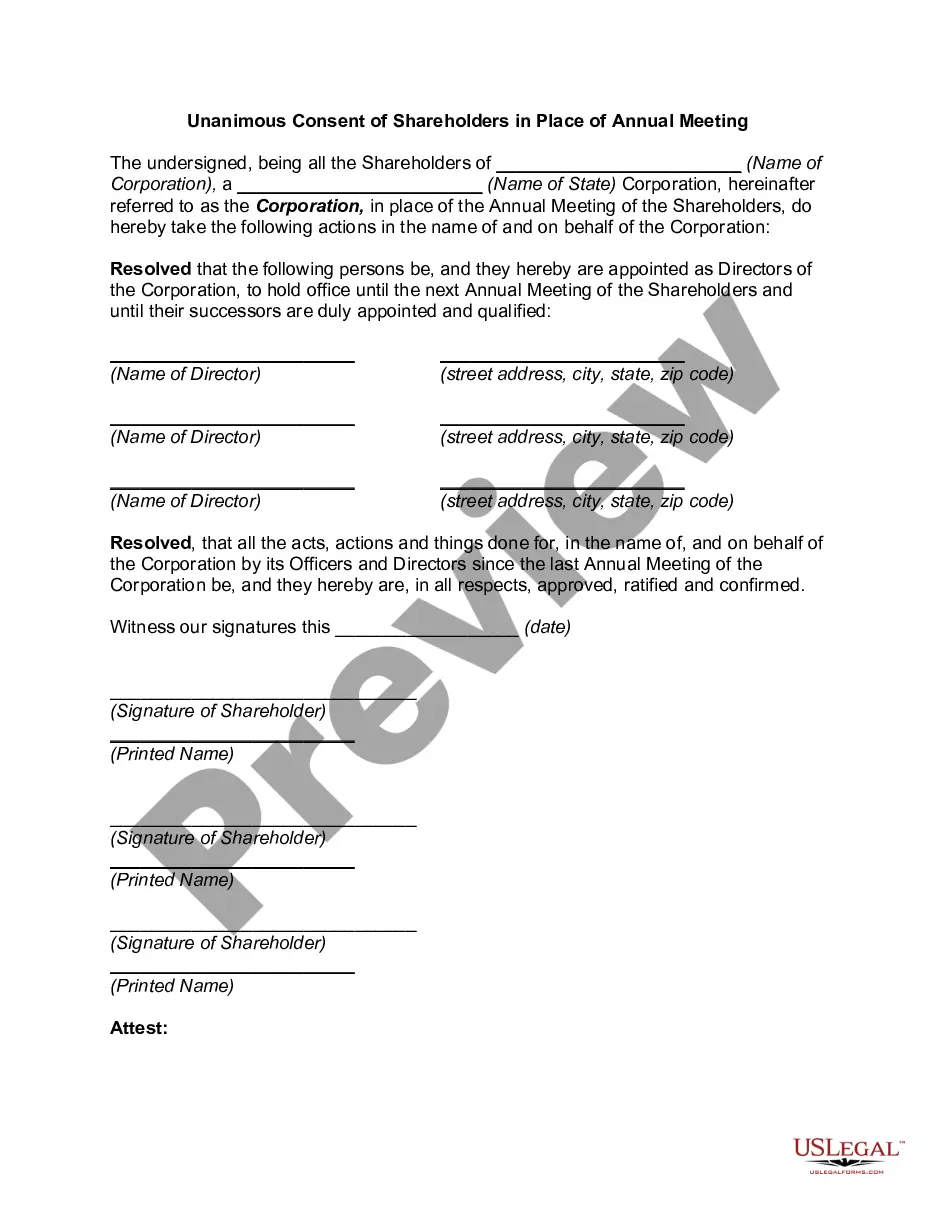
Annual Meeting For Corporations In Harris
Description



Get your form ready online
Our built-in tools help you complete, sign, share, and store your documents in one place.
Make edits, fill in missing information, and update formatting in US Legal Forms—just like you would in MS Word.
Download a copy, print it, send it by email, or mail it via USPS—whatever works best for your next step.
Sign and collect signatures with our SignNow integration. Send to multiple recipients, set reminders, and more. Go Premium to unlock E-Sign.
If this form requires notarization, complete it online through a secure video call—no need to meet a notary in person or wait for an appointment.
We protect your documents and personal data by following strict security and privacy standards.

Make edits, fill in missing information, and update formatting in US Legal Forms—just like you would in MS Word.

Download a copy, print it, send it by email, or mail it via USPS—whatever works best for your next step.

Sign and collect signatures with our SignNow integration. Send to multiple recipients, set reminders, and more. Go Premium to unlock E-Sign.

If this form requires notarization, complete it online through a secure video call—no need to meet a notary in person or wait for an appointment.

We protect your documents and personal data by following strict security and privacy standards.
Looking for another form?




Form popularity
FAQ
Both California Corporations and California S-Corps are required to hold an annual meeting for shareholders. These meetings are pivotal for fostering transparency, discussing business strategy, and making essential corporate decisions.
Corporate meeting minutes typically include: The meeting's date, time and location. A list of attendees and absentees, including any present board members or officers. Agenda items. Summaries of all discussion points. Details of all activities completed or agreed upon. Results of any votes or motions.
There are many types of general meetings in a company, which are – Annual general meeting, Extra Ordinary general meeting, meetings of members, meetings of creditors or debenture holders.
Annual shareholder meetings require a notice period of at least 21 days. The notice period can be shortened with the expressed consent of all shareholders. The notice should include all the basic meeting details and other important pieces of documentation, such as the meeting agenda.
The terms “Annual General Meeting” and “annual meeting” are frequently used interchangeably, though they can have distinct meanings. An AGM specifically refers to a formal meeting held by organizations, such as corporations or nonprofits, where key issues are discussed.
At the annual general meeting, the president or chairman of the organization presides over the meeting and may give an overall status of the organization. The secretary prepares the minutes and may be asked to read important papers.
The general meeting called within six months of the end of the previous fiscal year is known as the “annual” general meeting (or “AGM”). If a general meeting is held outside that time frame, it is “extraordinary” (“EGM”) and meant to address urgent or pressing matters that couldn't be settled at the AGM.
For example, an annual general meeting (AGM) provides an opportunity for the board of directors and shareholders to come together, review the company's performance, and discuss its future direction.
An AGM (also known as an annual shareholder meeting) is a yearly meeting between shareholders and board members where they gather to: Discuss business matters. Review financial statements. Address resolutions.
AGM Meeting Minutes Template Meeting Title: Annual General Meeting. Date: Insert Date Time: Insert Time Location: Insert Venue/Virtual Platform Attendees: List names of attendees, including Board members and key personnel

