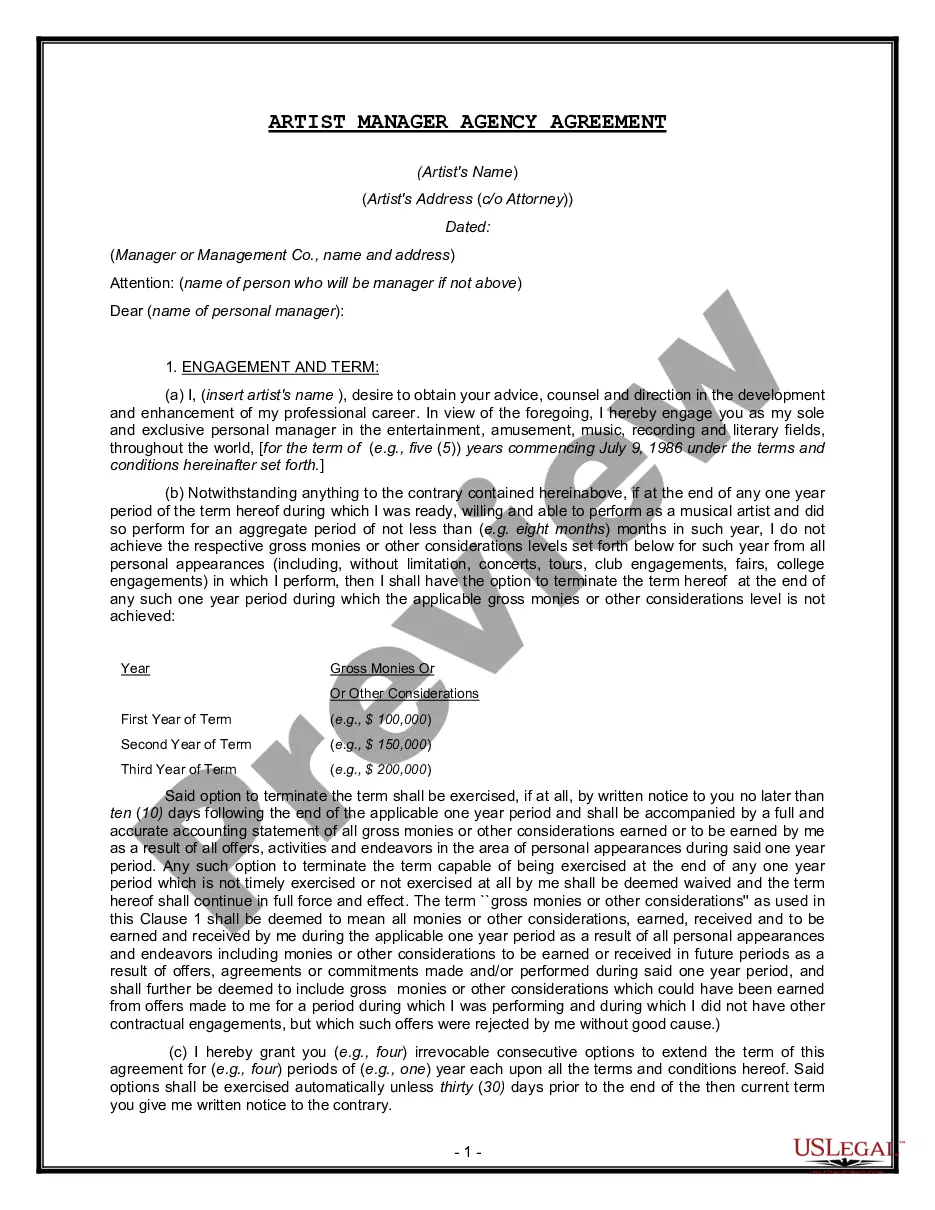
Talent Management Contract For The Twenty-first Century In Tarrant
Description











Get your form ready online
Our built-in tools help you complete, sign, share, and store your documents in one place.
Make edits, fill in missing information, and update formatting in US Legal Forms—just like you would in MS Word.
Download a copy, print it, send it by email, or mail it via USPS—whatever works best for your next step.
Sign and collect signatures with our SignNow integration. Send to multiple recipients, set reminders, and more. Go Premium to unlock E-Sign.
If this form requires notarization, complete it online through a secure video call—no need to meet a notary in person or wait for an appointment.
We protect your documents and personal data by following strict security and privacy standards.

Make edits, fill in missing information, and update formatting in US Legal Forms—just like you would in MS Word.

Download a copy, print it, send it by email, or mail it via USPS—whatever works best for your next step.

Sign and collect signatures with our SignNow integration. Send to multiple recipients, set reminders, and more. Go Premium to unlock E-Sign.

If this form requires notarization, complete it online through a secure video call—no need to meet a notary in person or wait for an appointment.

We protect your documents and personal data by following strict security and privacy standards.
Looking for another form?





Form popularity
FAQ
The 3 Cs - Competency, Commitment, and Contribution - are inseparable in the realm of talent management. By prioritizing these elements, organizations can build high-performing teams and establish a culture of continuous growth and innovation.
The talent management process usually includes the following steps: Planning. Attracting talent. Selecting. Developing. Retaining. Transitioning.
A typical talent management framework may include the following areas: Talent strategy and planning. Talent acquisition. Employee performance management. Training and development. Succession planning and identifying. Total rewards.
Performance evaluations need to be impactful Have your managers focus on the Three Cs — Candor, Communication, and Consistency — to get the most out of your performance evaluations.
There are at least three generally accepted components of a basic talent management strategy: learning and development, employee engagement/retention and talent mobility.
The 3C's of HR is focused on three essential elements: culture, competence (capacity), and alignment (capability). The cultural element emphasizes creating an environment that supports employee development and well-being.
Promoting or hiring the wrong leaders can expose your company to risk and create a toxic work environment, leading to lost productivity, low morale and high turnover. Character, competence and communication — the “three C's” of leadership — are essential traits to look for in potential leaders.
Skilled talent planners pair workforce data with strategic requirements and market trends. Top tip: Example: A retail company needs to hire seasonal staff every year for the holiday rush. They analyze past hiring data and market trends to forecast how many employees they'll need, in what roles, and with what skills.
