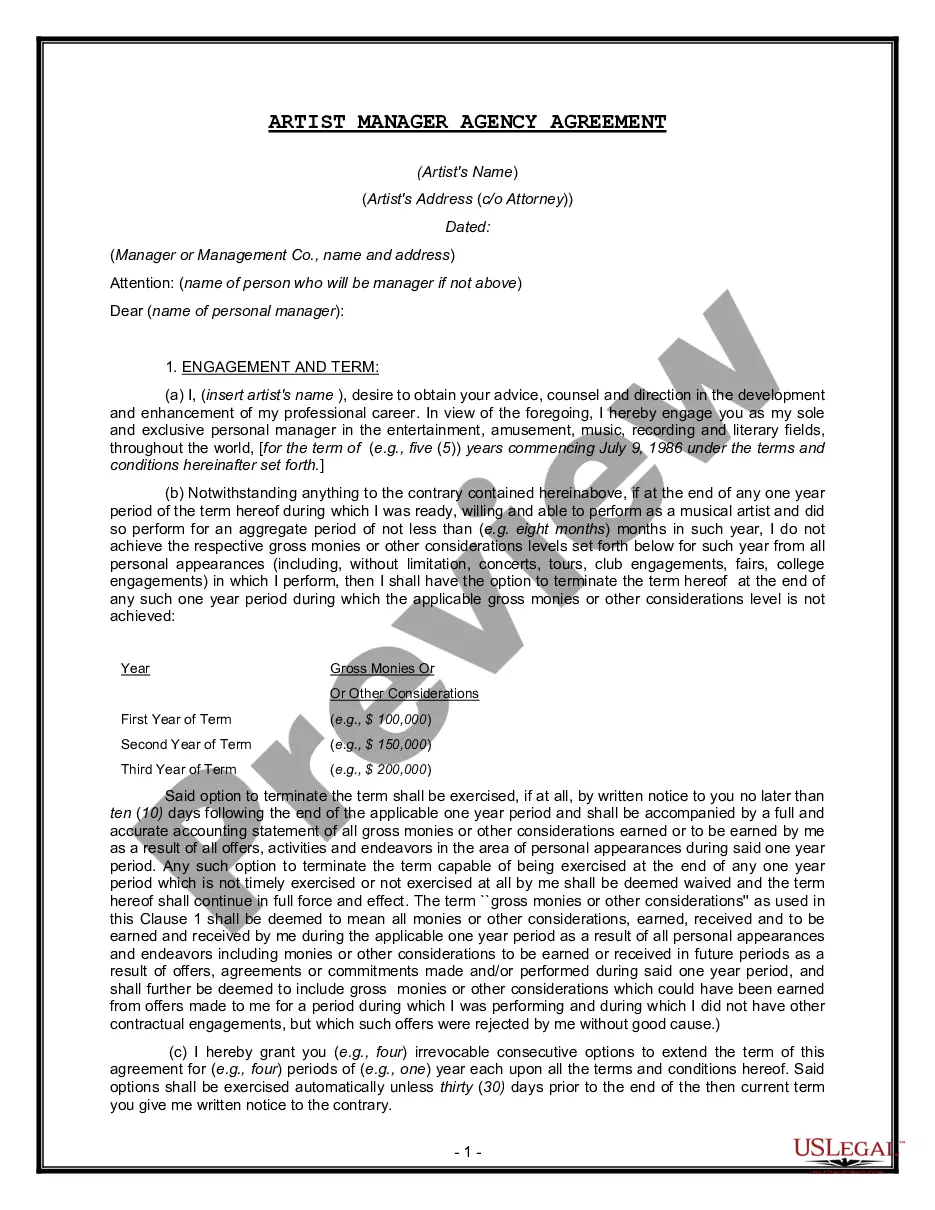
Talent Management Contract For Artist In Oakland
Description











Get your form ready online
Our built-in tools help you complete, sign, share, and store your documents in one place.
Make edits, fill in missing information, and update formatting in US Legal Forms—just like you would in MS Word.
Download a copy, print it, send it by email, or mail it via USPS—whatever works best for your next step.
Sign and collect signatures with our SignNow integration. Send to multiple recipients, set reminders, and more. Go Premium to unlock E-Sign.
If this form requires notarization, complete it online through a secure video call—no need to meet a notary in person or wait for an appointment.
We protect your documents and personal data by following strict security and privacy standards.

Make edits, fill in missing information, and update formatting in US Legal Forms—just like you would in MS Word.

Download a copy, print it, send it by email, or mail it via USPS—whatever works best for your next step.

Sign and collect signatures with our SignNow integration. Send to multiple recipients, set reminders, and more. Go Premium to unlock E-Sign.

If this form requires notarization, complete it online through a secure video call—no need to meet a notary in person or wait for an appointment.

We protect your documents and personal data by following strict security and privacy standards.
Looking for another form?






Form popularity
FAQ
As a general rule, managers take a percentage of all income generated by the artist in exchange for their management services. Commission rates typically range from 15-25% of the artist's gross income from: Recording royalties: Sales, streaming and licensing of recorded music.
A Music Recording Contract is a legal agreement between a music recording company and an artist or group that creates music. Recording companies use the contract to outline the terms for creating recorded music with the artist. Your Music Recording Contract should cover details like: Compensation and royalties.
Managers' commissions are typically between 15 to 20% of an artist's gross income. Whether it's 15% or 20% really depends on the level of the band and the bargaining power of each party. I've seen some net deals, but they are extremely rare. That being said, I always push for a net commission on merchandise.
The only way to get noticed by any agency is to be actively involved, at a professional level, in doing the exact kind of work that you want them to represent you for. You have to show them that you are capable of getting work by auditioning for it, because that's what you want them to represent you for.
It can take years to get signed by a top-tier agent (even if you have a strong resume and lots of experience). It's most difficult to get an agent when you're between the age of 22 and 30 because so many actors are around that age.
The only way to get noticed by any agency is to be actively involved, at a professional level, in doing the exact kind of work that you want them to represent you for. You have to show them that you are capable of getting work by auditioning for it, because that's what you want them to represent you for.
Who Needs a License? Any person or entity involved in arranging employment for an artist in the entertainment field must get a license to operate as a talent agency.
Talk to actor friends, join acting groups on social media, or talk to fellow students from classes to get recommendations or referrals to the best agents. You may want to start with smaller boutique agencies to get a foothold in the industry.
- Write a concise and engaging cover letter introducing yourself. - Mention your passion for the industry, any relevant skills or training, and your eagerness to learn and work hard. - Identify talent agents who represent individuals with little or no experience, as some agents specialize in developing new talent.
How to Get Noticed by an Acting Agent—ing to an Agent Submit your material. Participate in workshops and showcases. Create your own content. Perform onstage as often as possible.
