Artist Agreement Form Document Format In Los Angeles
Description









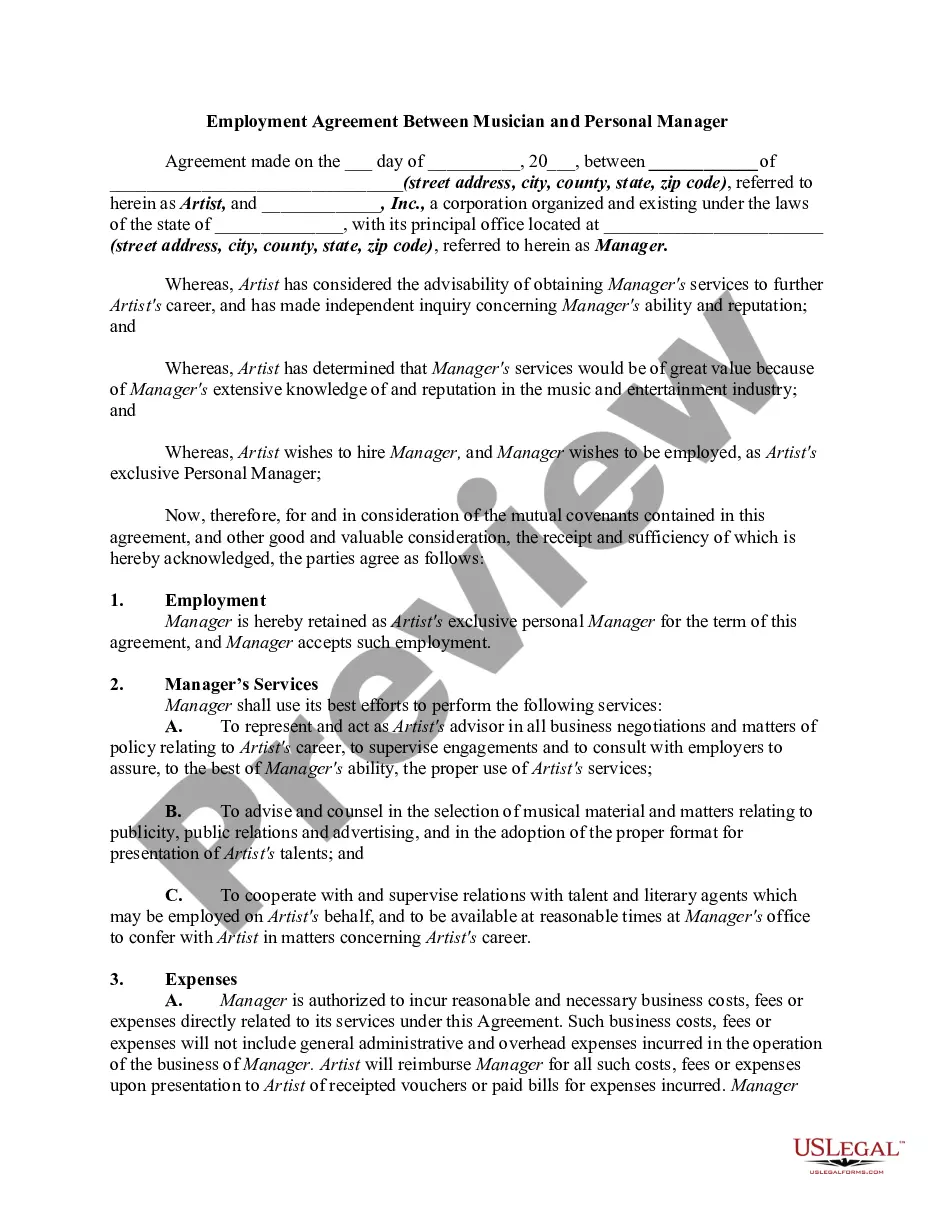


Get your form ready online
Our built-in tools help you complete, sign, share, and store your documents in one place.
Make edits, fill in missing information, and update formatting in US Legal Forms—just like you would in MS Word.
Download a copy, print it, send it by email, or mail it via USPS—whatever works best for your next step.
Sign and collect signatures with our SignNow integration. Send to multiple recipients, set reminders, and more. Go Premium to unlock E-Sign.
If this form requires notarization, complete it online through a secure video call—no need to meet a notary in person or wait for an appointment.
We protect your documents and personal data by following strict security and privacy standards.

Make edits, fill in missing information, and update formatting in US Legal Forms—just like you would in MS Word.

Download a copy, print it, send it by email, or mail it via USPS—whatever works best for your next step.

Sign and collect signatures with our SignNow integration. Send to multiple recipients, set reminders, and more. Go Premium to unlock E-Sign.

If this form requires notarization, complete it online through a secure video call—no need to meet a notary in person or wait for an appointment.

We protect your documents and personal data by following strict security and privacy standards.
Looking for another form?









Form popularity
FAQ
Here are a few tips for documenting your works and creating your own archive. Title your works. Even if it is just a number. Date your work. This may not seem very important in the short term. Sign your work. Include a certificate of authenticity for prints and photographs. Keep a photographic record.
Many artists use “write-ups” and other text-based storytelling to document work. These artists find it to be more beneficial to the work to describe the project rather than represent one moment in time through a photograph.
You have a copyright in your artwork as soon as it has been created and fixed in a tangible object. It does not need to be registered with the copyright office or have a copyright notice attached to receive copyright protection. A copyright lasts for the life of the artist, plus 70 years after the artist's death.
Artwork labels indicate the title, the artist, the date, and often the location. Some labels will also include background information, which could be about the piece itself, about the artist, or a combination of both.
Here are a few tips for documenting your works and creating your own archive. Title your works. Even if it is just a number. Date your work. This may not seem very important in the short term. Sign your work. Include a certificate of authenticity for prints and photographs. Keep a photographic record.
To turn your art into physical prints, first digitize your artwork using a high-quality scanner or camera. Edit the digital image for color accuracy and resolution, preferably 300 dpi for fine prints. Then, choose a reliable print-on-demand service or a professional printing company when making prints of artwork.
How to write an agreement letter Title your document. Provide your personal information and the date. Include the recipient's information. Address the recipient and write your introductory paragraph. Write a detailed body. Conclude your letter with a paragraph, closing remarks, and a signature. Sign your letter.
Drafting of an Effective Agreement or Contract Intention of the parties. Reasons why the parties are entering the agreement. Subject matter of the Agreement, eg. Consideration. Time period of the agreement. Termination of the agreement and its consequences. Exit options of the parties. Important timelines, if any.
How to write a contract agreement in 7 steps. Determine the type of contract required. Confirm the necessary parties. Choose someone to draft the contract. Write the contract with the proper formatting. Review the written contract with a lawyer. Send the contract agreement for review or revisions.
It is a legal agreement that binds the Artist and the Company to fulfill all the terms and conditions contained in it. All Individual Artist Agreements must be in compliance with the respective Collective Bargaining Agreement.
