Letter Requesting Motion To Vacate Order Of Default Form In Santa Clara
Description

Get your form ready online
Our built-in tools help you complete, sign, share, and store your documents in one place.
Make edits, fill in missing information, and update formatting in US Legal Forms—just like you would in MS Word.
Download a copy, print it, send it by email, or mail it via USPS—whatever works best for your next step.
Sign and collect signatures with our SignNow integration. Send to multiple recipients, set reminders, and more. Go Premium to unlock E-Sign.
If this form requires notarization, complete it online through a secure video call—no need to meet a notary in person or wait for an appointment.
We protect your documents and personal data by following strict security and privacy standards.

Make edits, fill in missing information, and update formatting in US Legal Forms—just like you would in MS Word.

Download a copy, print it, send it by email, or mail it via USPS—whatever works best for your next step.

Sign and collect signatures with our SignNow integration. Send to multiple recipients, set reminders, and more. Go Premium to unlock E-Sign.

If this form requires notarization, complete it online through a secure video call—no need to meet a notary in person or wait for an appointment.

We protect your documents and personal data by following strict security and privacy standards.
Looking for another form?





Form popularity
FAQ
Notice of Default (NOD) It is a public notice that the borrower has defaulted on their mortgage. In California, the lender must wait at least 30 days after contacting the borrower to discuss foreclosure alternatives before filing a NOD. Once the NOD is filed, the borrower has 90 days to bring their mortgage current.
File the original and both copies with the Clerk. Complete the rest of this guide when you are ready to request the judgment. Your deadline is within 45 days after entry of default, unless you ask the court for an extension.
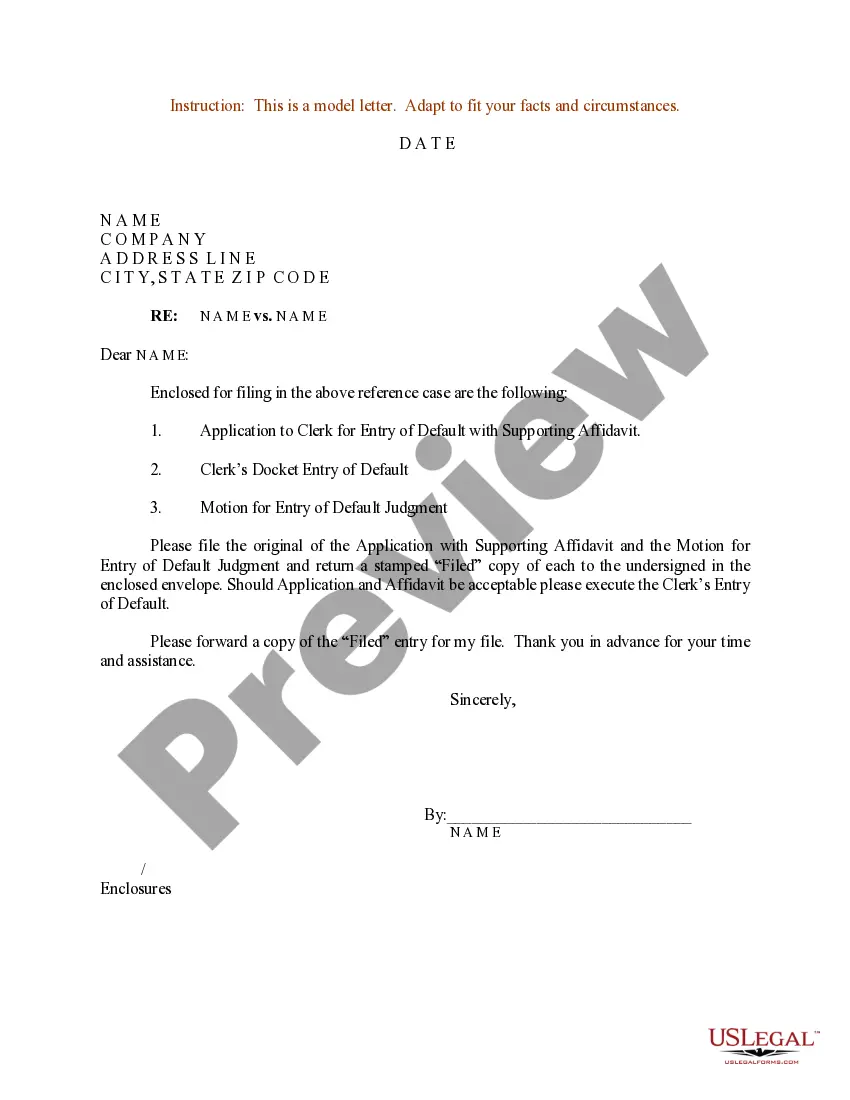
Request for Entry of Default (Application to Enter Default) (CIV-100) Asks the court to enter a "default" against the defendant or cross-defendant because they failed to file an Answer or other responsive document in the case. Can be used to ask for a default alone, or also a default judgment. Get form CIV-100.
Under CCP § 473(b), the court may set aside a default and default judgment if the defendant asking for the set aside presents enough evidence to the court to demonstrate that the default was entered by inadvertence, mistake, surprise, or excusable neglect.
If you do not think the default judgment was appropriately entered against you, you must file a motion with the court asking the judge to “set aside” (void or nullify) the judgment. If the judge grants your motion, the case starts back up again.
A clerk default judgment may be obtained when the defendant fails to file a response to the summons and complaint within the time specified on the summons.
(g) Request for entry of default If a responsive pleading is not served within the time limits specified in this rule and no extension of time has been granted, the plaintiff must file a request for entry of default within 10 days after the time for service has elapsed.
If you don't file an Answer or you miss a court date, the party suing you will ask the court for a default judgment against you. You can ask the court to vacate (undo) the default judgment. If the judgment is vacated and the case is put back on the court's calendar and the case will continue.
In California, a debtor has the right to file an “order to show cause” in court, which can be used to contest the renewal of judgment and ask the court to set it aside if the creditor failed to follow the proper procedures, or if the judgment is no longer enforceable.
