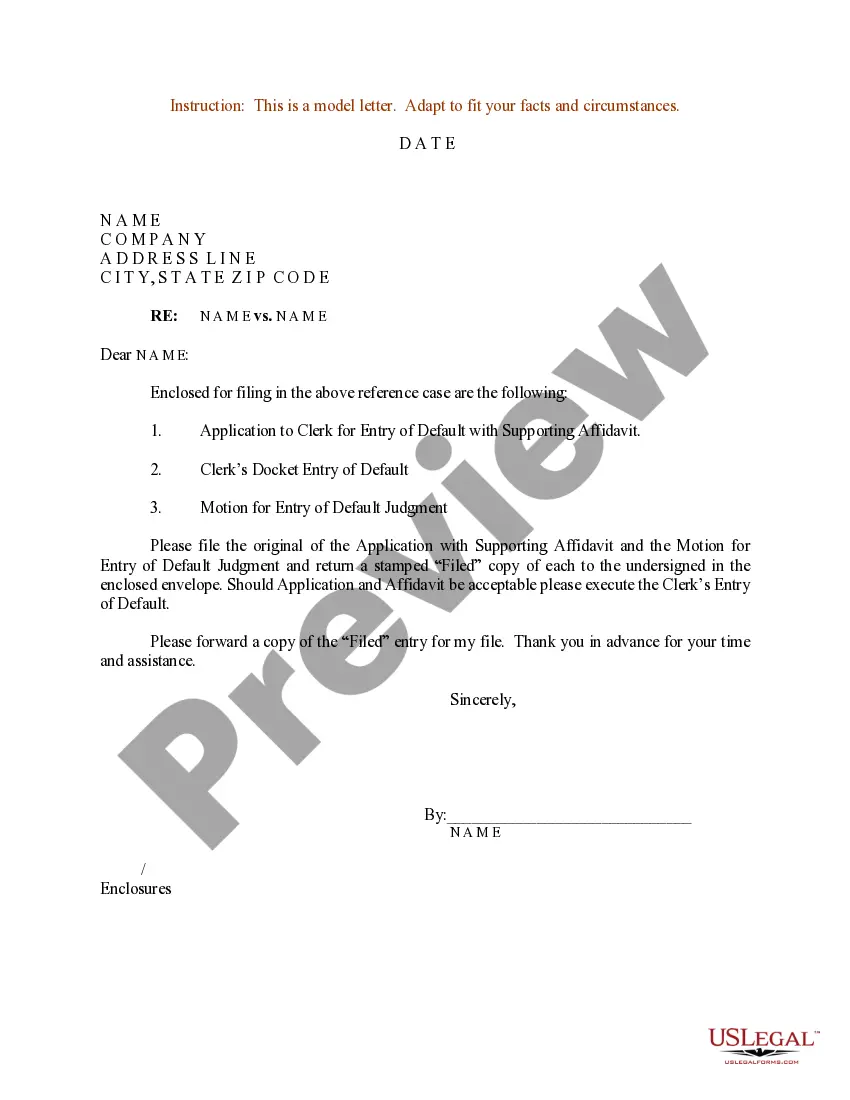
Letter Requesting Motion To Vacate Order Of Default Form In Broward
Description

Get your form ready online
Our built-in tools help you complete, sign, share, and store your documents in one place.
Make edits, fill in missing information, and update formatting in US Legal Forms—just like you would in MS Word.
Download a copy, print it, send it by email, or mail it via USPS—whatever works best for your next step.
Sign and collect signatures with our SignNow integration. Send to multiple recipients, set reminders, and more. Go Premium to unlock E-Sign.
If this form requires notarization, complete it online through a secure video call—no need to meet a notary in person or wait for an appointment.
We protect your documents and personal data by following strict security and privacy standards.

Make edits, fill in missing information, and update formatting in US Legal Forms—just like you would in MS Word.

Download a copy, print it, send it by email, or mail it via USPS—whatever works best for your next step.

Sign and collect signatures with our SignNow integration. Send to multiple recipients, set reminders, and more. Go Premium to unlock E-Sign.

If this form requires notarization, complete it online through a secure video call—no need to meet a notary in person or wait for an appointment.

We protect your documents and personal data by following strict security and privacy standards.
Looking for another form?








Form popularity
FAQ
How long does the eviction process take in Florida? On average, it takes 20 - 37 days to evict a resident of your rental property in Florida. If the eviction is not contested and the process runs smoothly, it could take as little as 7 - 15 days.
Generally, a default allows you to obtain an earlier final hearing to finish your case. Once the default is signed by the clerk, you can request a trial or final hearing in your case. To obtain a default, you will need to complete Motion for Default, Florida Supreme Court Approved Family Law Form 12.922(a).
Reversing an eviction judgment Tenants may file a motion to vacate the judgment, asking the court to withdraw its ruling. Grounds for a motion to vacate can include: Fraud, misrepresentation, or misconduct by the landlord in obtaining the judgment. New evidence coming to light that you couldn't previously present.
After a judgment for possession is entered, your landlord must file a writ of restitution in order to evict you. Your landlord must wait 2 days after the judgment is entered to file the writ. The U.S. Marshals Service can schedule your eviction as soon as 3 days after your landlord files the writ.
The Tenant will have five days, after service, to file a written response to a Complaint for eviction, and 20 days, after service, to file a written response to a complaint for back rent and damages. If the Tenant fails to file a written response in that time the Landlord is entitled to a judgment by default.
—An appellate court may, in reversing a judgment of a lower court brought before it for review by appeal, by the order of reversal, if the error for which reversal is sought is such as to require a new trial, direct that a new trial be had on all the issues shown by the record or upon a part of such issues only.
The purpose of a Motion to Vacate is to ask the Circuit Judge to set aside an order or judgment if the Judge finds it is improper. 2. Filing a Motion to Vacate is proper when a party wishes to contest the Circuit Judge's final order approving the recommendations of the Child Support Enforcement Hearing Officer. Fla.
Overturning a Default Judgment Under Florida law, a person can seek relief from a default judgment for the following reasons: mistake, inadvertence, surprise, or excusable neglect. newly discovered evidence which by due diligence could not have been discovered in time to move for a new trial or rehearing.
In Florida “no judgment, order, or decree of any court shall be a lien upon real or personal property within the state after the expiration of 20 years from the date of the entry of such judgment.”18 In order to retain a lien for the maximum period of 20 years, the certified copy of the judgment must be recorded ...
For that purpose the judgment debtor should approach the plaintiff/judgment creditor or his/her/its attorney to obtain the written consent to rescission of judgment. There is however no requirement in law that obliges a plaintiff/judgment creditor to give a consent to rescission of judgment.
