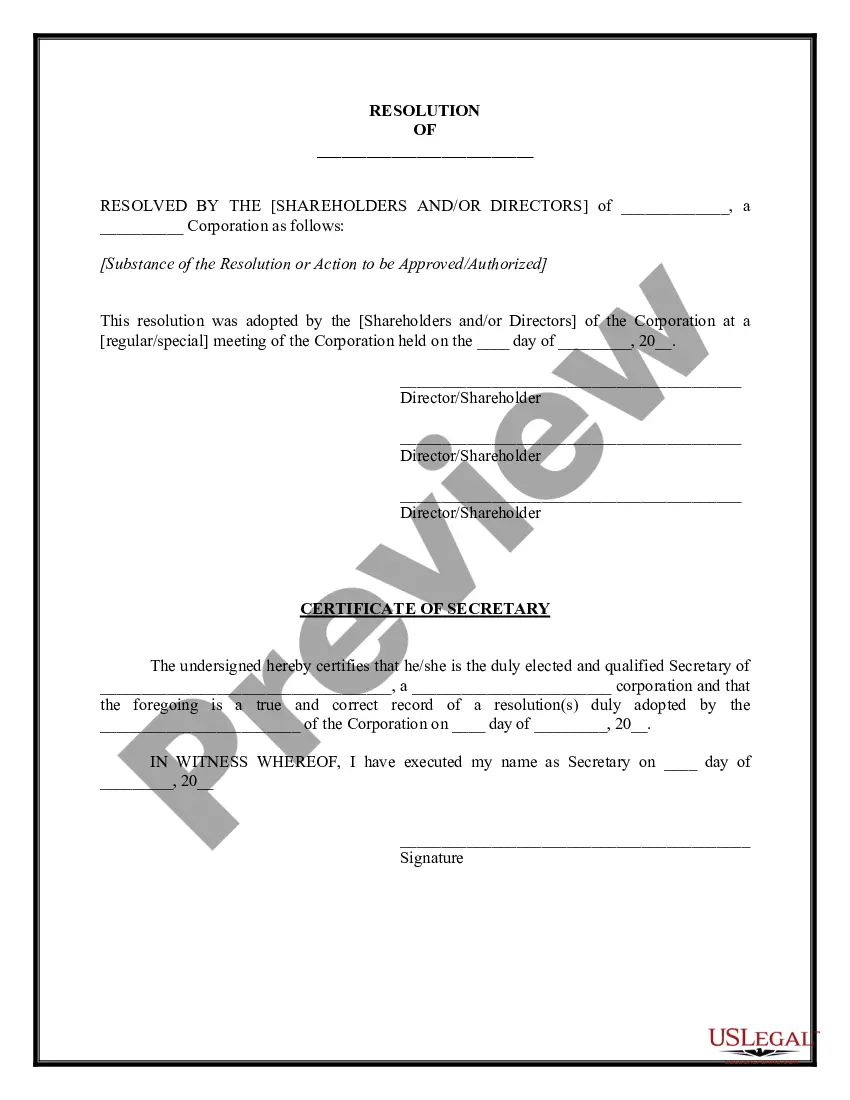
Board Directors Resolutions With Board Members In Alameda
Description




Get your form ready online
Our built-in tools help you complete, sign, share, and store your documents in one place.
Make edits, fill in missing information, and update formatting in US Legal Forms—just like you would in MS Word.
Download a copy, print it, send it by email, or mail it via USPS—whatever works best for your next step.
Sign and collect signatures with our SignNow integration. Send to multiple recipients, set reminders, and more. Go Premium to unlock E-Sign.
If this form requires notarization, complete it online through a secure video call—no need to meet a notary in person or wait for an appointment.
We protect your documents and personal data by following strict security and privacy standards.

Make edits, fill in missing information, and update formatting in US Legal Forms—just like you would in MS Word.

Download a copy, print it, send it by email, or mail it via USPS—whatever works best for your next step.

Sign and collect signatures with our SignNow integration. Send to multiple recipients, set reminders, and more. Go Premium to unlock E-Sign.

If this form requires notarization, complete it online through a secure video call—no need to meet a notary in person or wait for an appointment.

We protect your documents and personal data by following strict security and privacy standards.
Looking for another form?







Form popularity
FAQ
A resolution is generally only signed by one director if a formal meeting does not take place – but that's rare. ing to , the resolution of the board of directors must be signed by all directors if the board meets formally to discuss the topics contained within minutes of the meeting.
Passing a special resolution without holding a meeting Where a partnership holds shares together, each member must sign. The resolution is considered as 'passed' when the last member signs (i.e. 100% of voting members agree to pass the resolution.)
The Board Resolution is duly signed by the directors present in the meeting. There is no requirement that a Board Resolution be notarized. However, when Board Resolutions are used as evidence in court trials, notarization gives more credence to the document.
A board resolution is a document that formalises important decisions made by the board of directors and the actions relating to them. It is legally binding and functions as a compliance record to provide evidence of decisions made by the board regarding pivotal company matters.
Instead of the resolution being passed at a meeting, it is passed in writing, usually with all shareholders signing a document confirming their approval of a set of resolutions.
All eligible directors must either sign copies of the written resolution, or otherwise agree to it in writing. A sole director will usually make decisions by written resolution.
Once the meeting has been completed and all necessary decisions have been approved, all present directors will sign the resolution, which makes the decisions official. Alternatively, during meetings, directors can record decisions (i.e., resolutions) directly in the Meeting Minutes.
How to fill out a resolution of the board of directors? Date, time, and location of the meeting. Title that describes the board's decision to be made. Statement of majority or unanimous decision. Resolution of the decision, including any necessary actions. Officers responsible for carrying out the resolution.
The Sunshine Ordinance is codified in the Alameda Municipal Code and serves as the City's "public policy concerning participation in the deliberations of the City's legislative bodies and to clarify and supplement the Ralph M. Brown Act and the California Public Records Act."
In the California State Assembly, Alameda County is split between five districts: the 15th Assembly District, represented by Democrat Anamarie Avila Farias. the 16th Assembly District, represented by Democrat Rebecca Bauer-Kahan. the 18th Assembly District, represented by Democrat Mia Bonta.
