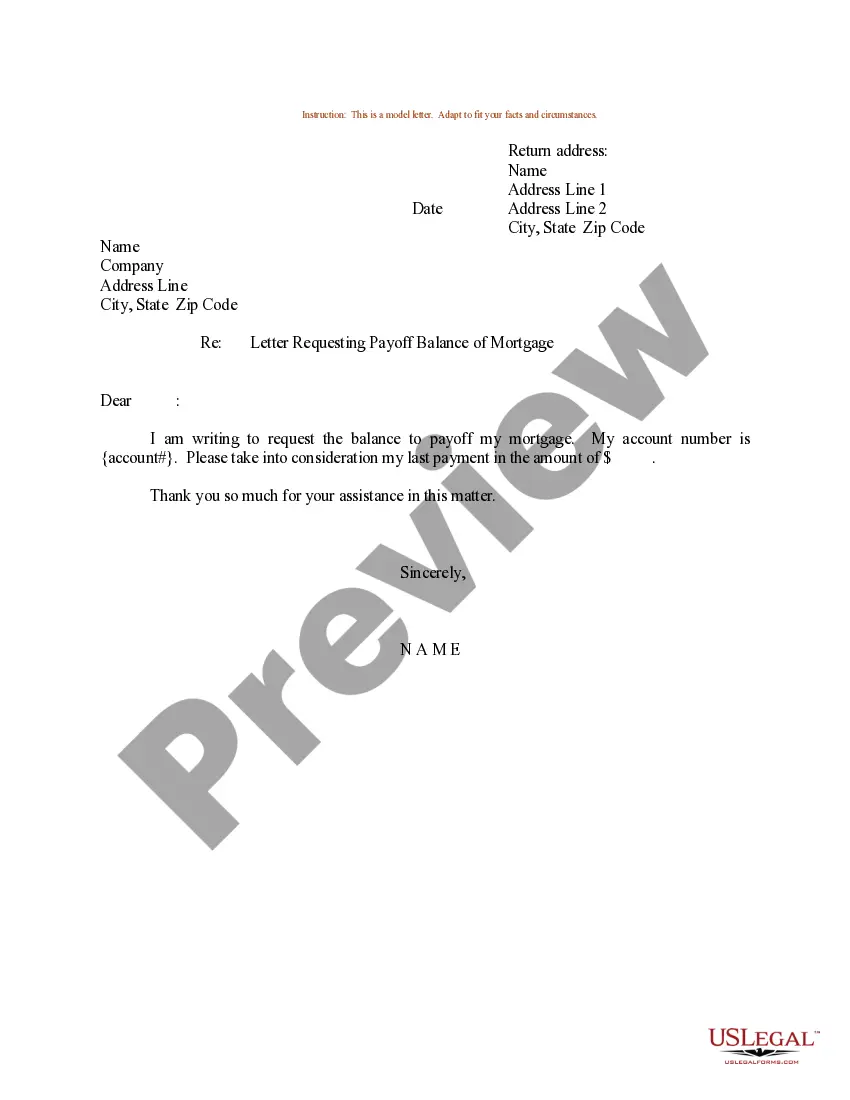
Payoff Letter Example In Sacramento
Description
Get your form ready online
Our built-in tools help you complete, sign, share, and store your documents in one place.
Make edits, fill in missing information, and update formatting in US Legal Forms—just like you would in MS Word.
Download a copy, print it, send it by email, or mail it via USPS—whatever works best for your next step.
Sign and collect signatures with our SignNow integration. Send to multiple recipients, set reminders, and more. Go Premium to unlock E-Sign.
If this form requires notarization, complete it online through a secure video call—no need to meet a notary in person or wait for an appointment.
We protect your documents and personal data by following strict security and privacy standards.

Make edits, fill in missing information, and update formatting in US Legal Forms—just like you would in MS Word.

Download a copy, print it, send it by email, or mail it via USPS—whatever works best for your next step.

Sign and collect signatures with our SignNow integration. Send to multiple recipients, set reminders, and more. Go Premium to unlock E-Sign.

If this form requires notarization, complete it online through a secure video call—no need to meet a notary in person or wait for an appointment.

We protect your documents and personal data by following strict security and privacy standards.
Looking for another form?
Form popularity
FAQ
How to Write a Payoff Letter: Step-by-Step Guide Step 1: Gather necessary information. Step 2: Format your letter. Step 3: Clearly state your intentions. Step 4: Detail the necessary information. Step 5: Request written confirmation. Step 6: Offer contact information. Step 7: Proofread and submit.
It is possible to obtain an official payoff letter from the IRS. To request this, you can use the IRS's Form 12277 (Application for the Withdrawal of Filed Form 668(Y), Notice of Federal Tax Lien) or contact the IRS directly for the payoff amount, as it can vary depending on your case.
Under federal law, the servicer must generally send you a payoff statement within seven business days of your request, subject to a few exceptions. (12 C.F.R. § 1026.36.)
Typically, lenders can provide a payoff letter within seven to ten business days upon request. However, processing times may vary depending on the specific lender and their workload.
First, you'll need to contact your lender and let them know you want the information. Depending on your lender, you may have to sign in to an online account, call a helpline, or send a formal letter to start the request process.
The Franchise Tax Board will send a notice or letter to personal taxpayers and business entities for issues that may include but not limited to: You have a balance due. You are due a larger or smaller refund. We need to notify you of delays in processing your return.
A bank confirmation letter serves to assure all concerned parties in a business transaction that the bank's customer (the borrower) has, or has available, the necessary financial resources to conclude the transaction.
Under federal law, the servicer must generally send you a payoff statement within seven business days of your request, subject to a few exceptions. (12 C.F.R. § 1026.36.)
You received this form because both of the following happened: You claimed state income tax payments as an itemized deduction on Schedule A of your Federal Income Tax Return for the tax year listed in Box 3. You received a refund, credit, or offset of $10 or more.
The California Filing Compliance Bureau MS F151 ensures taxpayers adhere to state tax regulations. By identifying discrepancies such as underreported income or unfiled returns, the bureau uses advanced data-matching techniques to cross-reference information from multiple sources, safeguarding the state's revenue.

