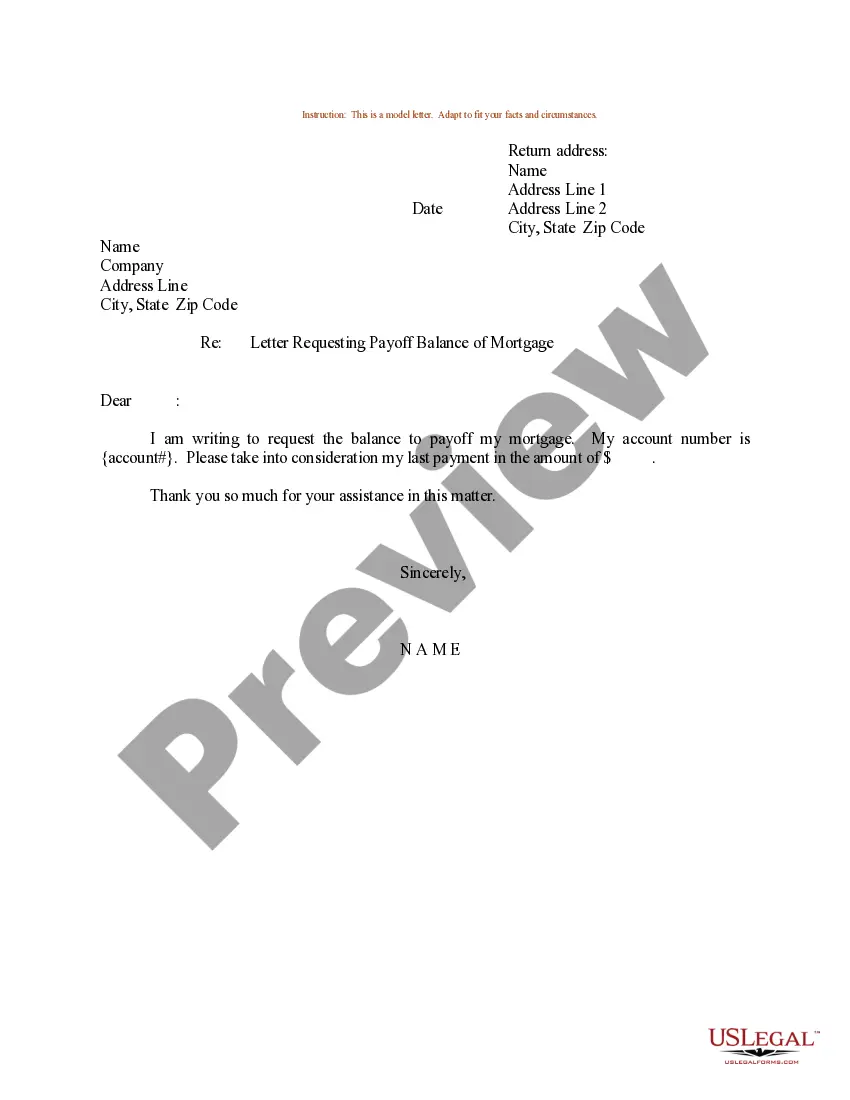
Loan Payoff Letter Example With Interest In Los Angeles
Description
Get your form ready online
Our built-in tools help you complete, sign, share, and store your documents in one place.
Make edits, fill in missing information, and update formatting in US Legal Forms—just like you would in MS Word.
Download a copy, print it, send it by email, or mail it via USPS—whatever works best for your next step.
Sign and collect signatures with our SignNow integration. Send to multiple recipients, set reminders, and more. Go Premium to unlock E-Sign.
If this form requires notarization, complete it online through a secure video call—no need to meet a notary in person or wait for an appointment.
We protect your documents and personal data by following strict security and privacy standards.

Make edits, fill in missing information, and update formatting in US Legal Forms—just like you would in MS Word.

Download a copy, print it, send it by email, or mail it via USPS—whatever works best for your next step.

Sign and collect signatures with our SignNow integration. Send to multiple recipients, set reminders, and more. Go Premium to unlock E-Sign.

If this form requires notarization, complete it online through a secure video call—no need to meet a notary in person or wait for an appointment.

We protect your documents and personal data by following strict security and privacy standards.
Looking for another form?








Form popularity
FAQ
Example: If your judgment is $5,000: $5,000 (total judgment) x 0.10 (10% interest) = $500 (yearly interest) Divide by 365: $500 (yearly interest) ÷ 365 (days in a year) = $1.37 (daily interest) Multiply the daily interest by the number of days since the court entered the judgment.
§ 3289.) If the prejudgment interest rate is not specified in the contract, the rate is ten percent per annum from the date of the breach. (Id.) For tort and other non-contractual claims, the interest rate is seven percent per annum from the date the claim arose.
The formula for calculating simple interest is: Interest = P R T. P = Principal amount (the beginning balance). R = Interest rate (usually per year, expressed as a decimal). T = Number of time periods (generally one-year time periods).
A brief history of California Usury Law With some constitutional amendments, most notably the 1979 constitutional amendment, Article XV, Section 1, California's usury limit is now generally 10% per year with a broader range of exemptions.
First, you'll need to contact your lender and let them know you want the information. Depending on your lender, you may have to sign in to an online account, call a helpline, or send a formal letter to start the request process.

