Payoff Letter Template With Interest In Franklin
Description
Get your form ready online
Our built-in tools help you complete, sign, share, and store your documents in one place.
Make edits, fill in missing information, and update formatting in US Legal Forms—just like you would in MS Word.
Download a copy, print it, send it by email, or mail it via USPS—whatever works best for your next step.
Sign and collect signatures with our SignNow integration. Send to multiple recipients, set reminders, and more. Go Premium to unlock E-Sign.
If this form requires notarization, complete it online through a secure video call—no need to meet a notary in person or wait for an appointment.
We protect your documents and personal data by following strict security and privacy standards.

Make edits, fill in missing information, and update formatting in US Legal Forms—just like you would in MS Word.

Download a copy, print it, send it by email, or mail it via USPS—whatever works best for your next step.

Sign and collect signatures with our SignNow integration. Send to multiple recipients, set reminders, and more. Go Premium to unlock E-Sign.

If this form requires notarization, complete it online through a secure video call—no need to meet a notary in person or wait for an appointment.

We protect your documents and personal data by following strict security and privacy standards.
Looking for another form?







Form popularity
FAQ
We're all familiar with the basic concept of setup and payoffs: early on in your screenplay, you set up some detail/scenario that may seem irrelevant, but later on will yield a result that hopefully your audience wasn't anticipating (the payoff).
Purpose, Process, Payoff Having a purpose, process, and payoff statement prepared beforehand can enable you to immediately articulate the benefit of holding a quick conversation and/or capture the attention of everyone participating. It's also a good idea to send this information in the agenda (see point 3).
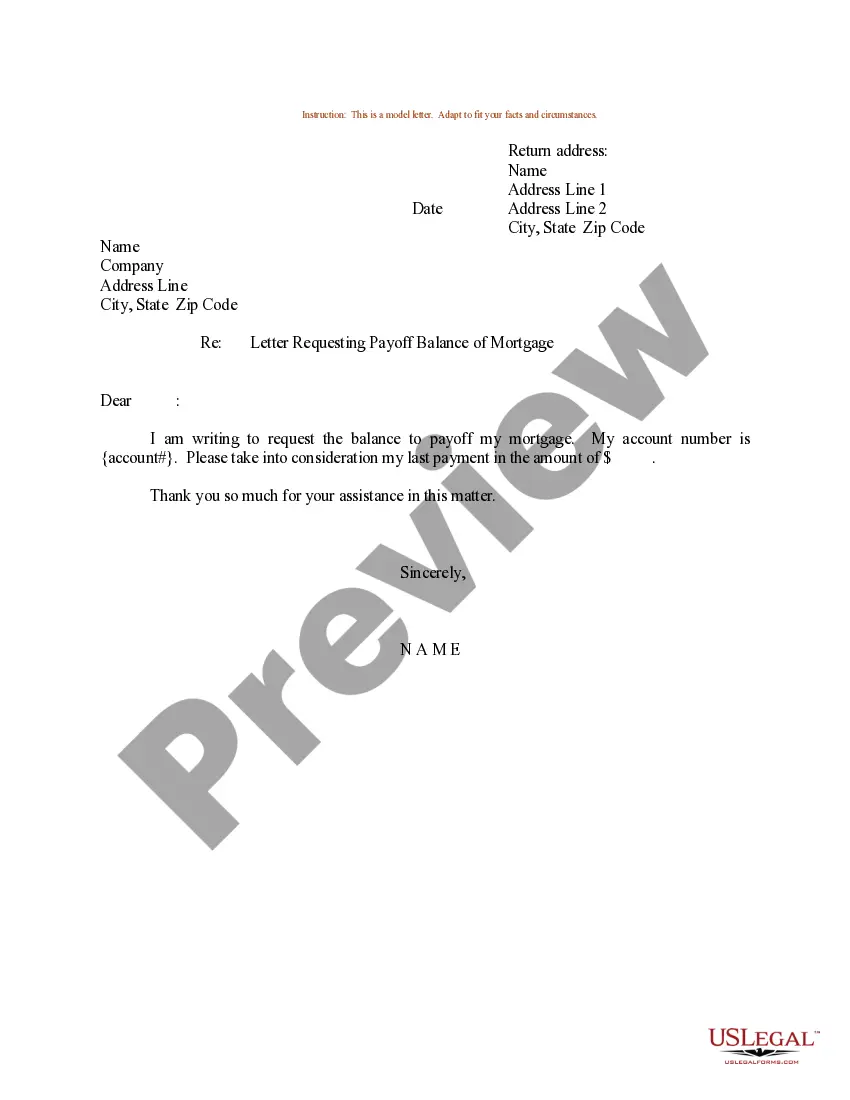
This is a standard form of mortgage payout statement provided by a lender to a borrower. This mortgage payout statement sets out the monies owed by the borrower to the lender as of the date of the statement. This Standard Document has integrated notes with important explanations and drafting and negotiating tips.
The payment of a salary, debt, wager, etc. the time at which such payment is made. the consequence, outcome, or final sequence in a series of events, actions, or circumstances: The payoff was when they fired him.
Under federal law, the servicer must generally send you a payoff statement within seven business days of your request, subject to a few exceptions. (12 C.F.R. § 1026.36.)
The statement is provided by the mortgage servicer and can be requested at any time. Accurate payoff information is crucial for managing financial decisions related to property ownership.
First, you'll need to contact your lender and let them know you want the information. Depending on your lender, you may have to sign in to an online account, call a helpline, or send a formal letter to start the request process.
Lenders multiply your outstanding balance by your annual interest rate but divide by 12 because you're making monthly payments. So if you owe $300,000 on your mortgage and your rate is 4%, you'll initially owe $1,000 in interest per month ($300,000 x 0.04 ÷ 12).
Broadly speaking a letter of direction (letter of instruction)1 is any letter that gives instruction and guidance to a recipient. Letters of direction are also common in situations when somebody has passed away, and the executor requires documentation to prove they are in control of the deceased's estate.

