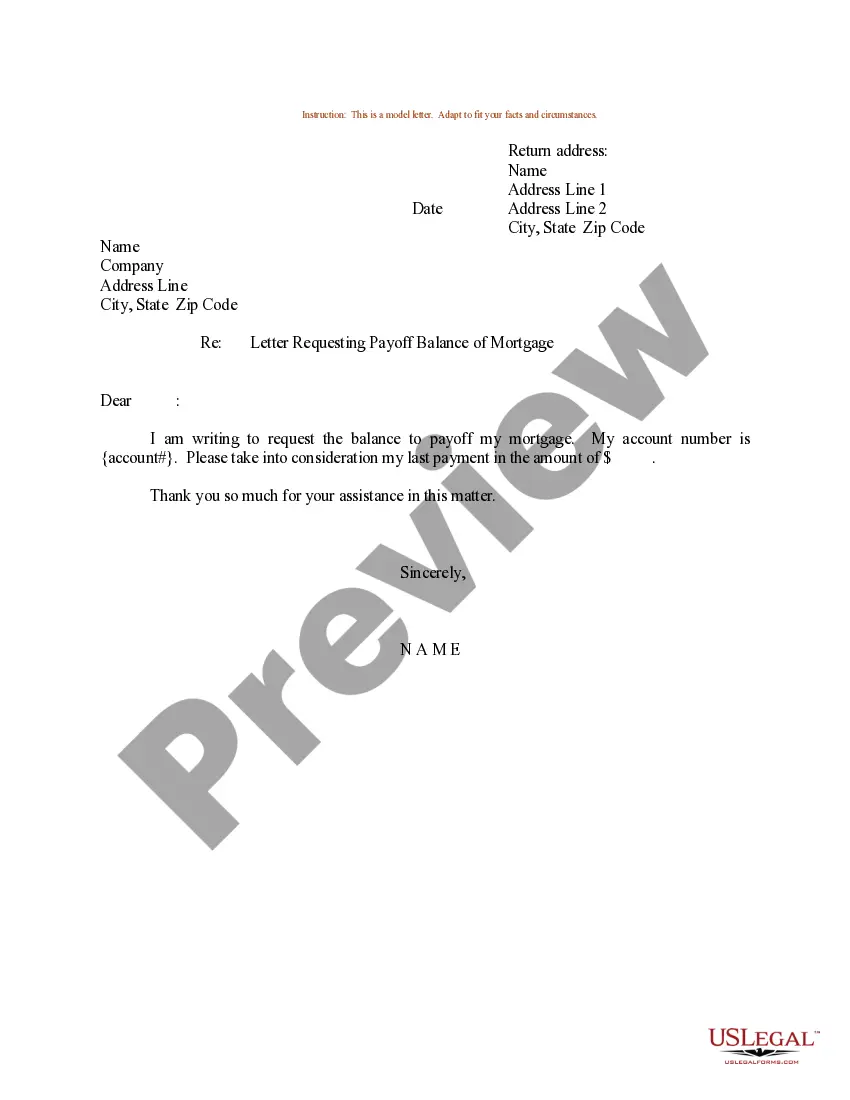
Sample Letter Payoff Mortgage File For Bankruptcies In California
Description
Get your form ready online
Our built-in tools help you complete, sign, share, and store your documents in one place.
Make edits, fill in missing information, and update formatting in US Legal Forms—just like you would in MS Word.
Download a copy, print it, send it by email, or mail it via USPS—whatever works best for your next step.
Sign and collect signatures with our SignNow integration. Send to multiple recipients, set reminders, and more. Go Premium to unlock E-Sign.
If this form requires notarization, complete it online through a secure video call—no need to meet a notary in person or wait for an appointment.
We protect your documents and personal data by following strict security and privacy standards.

Make edits, fill in missing information, and update formatting in US Legal Forms—just like you would in MS Word.

Download a copy, print it, send it by email, or mail it via USPS—whatever works best for your next step.

Sign and collect signatures with our SignNow integration. Send to multiple recipients, set reminders, and more. Go Premium to unlock E-Sign.

If this form requires notarization, complete it online through a secure video call—no need to meet a notary in person or wait for an appointment.

We protect your documents and personal data by following strict security and privacy standards.
Looking for another form?







Form popularity
FAQ
There's a process to getting the mortgage payoff statement. First, you'll need to contact your lender and let them know you want the information. Depending on your lender, you may have to sign in to an online account, call a helpline, or send a formal letter to start the request process.
What are the parts of a formal letter? Header (date/address/return address) Date: When you write a formal letter, it's crucial to include the date on which you wrote it. Salutation. In a formal letter, the standard salutation is “Dear” followed by the recipient's title and last name. Body. Closing. Signature.
How to Write a Hardship Letter Explain Your Hardship. Provide Documentation to Back Up Your Claim. List Steps You've Taken to Alleviate Your Financial Burden. Clearly State Your Request. State Your Commitment to Paying Your Debt.
Quickly state the fact of the matter and proceed. Briefly explain the circumstance: Keep your letter as concise as possible. After you state the problem, provide a short explanation of the circumstances around your issue.
To begin writing this type of letter, you might explain the situation or circumstance and any contributing factors. Consider including information to answer questions like: What happened? How did it happen?
The letter should include an explanation regarding the negative event, the date it happened, the name of the creditor and your account number. It should also include an explanation of why you don't see this problem happening again.
Here are some key steps you must consider: Start with a Professional Salutation. Provide a Clear and Concise Opening. Describe the Problem. Include Supporting Evidence. State Your Desired Resolution. Express Your Expectations. Maintain a Professional Tone. Proofread and Revise.
Briefly explain the circumstance: Keep your letter as concise as possible. After you state the problem, provide a short explanation of the circumstances around your issue.
Under federal law, the servicer must generally send you a payoff statement within seven business days of your request, subject to a few exceptions. (12 C.F.R. § 1026.36.)
There's a process to getting the mortgage payoff statement. First, you'll need to contact your lender and let them know you want the information. Depending on your lender, you may have to sign in to an online account, call a helpline, or send a formal letter to start the request process.

