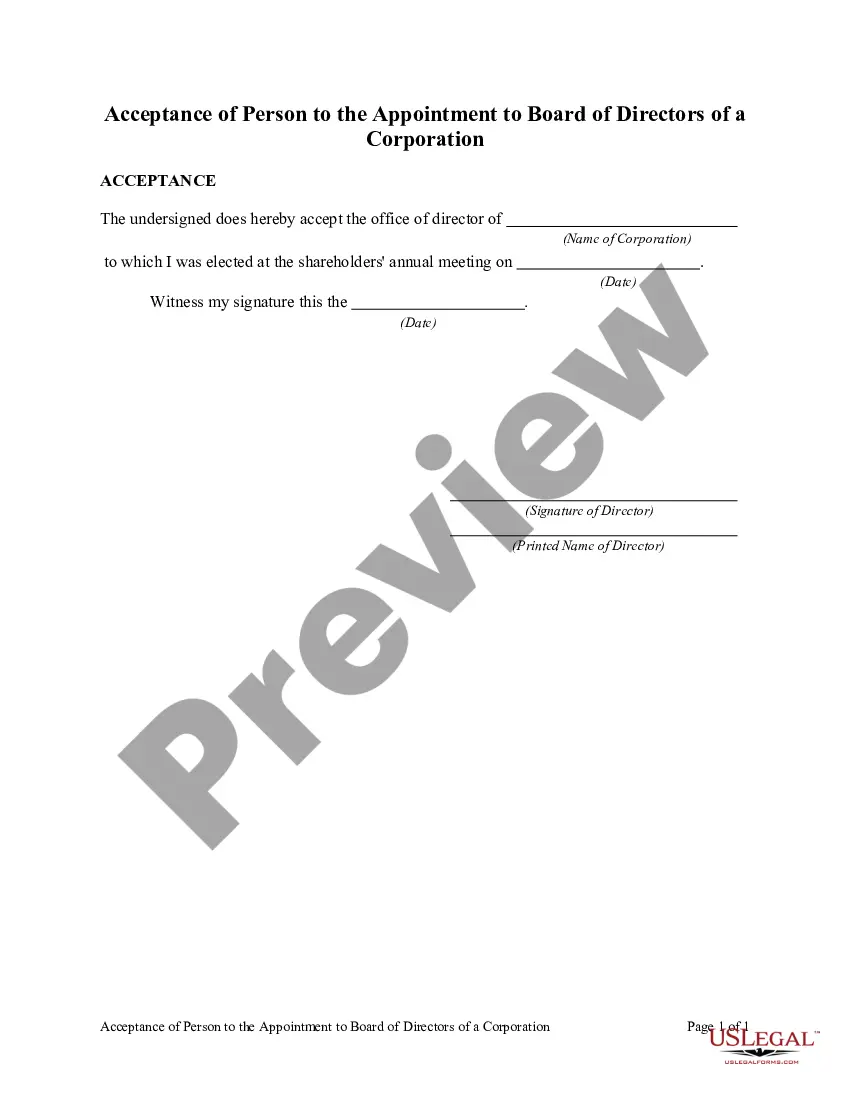
Director Appointment In Private Company In Wayne
Description



Get your form ready online
Our built-in tools help you complete, sign, share, and store your documents in one place.
Make edits, fill in missing information, and update formatting in US Legal Forms—just like you would in MS Word.
Download a copy, print it, send it by email, or mail it via USPS—whatever works best for your next step.
Sign and collect signatures with our SignNow integration. Send to multiple recipients, set reminders, and more. Go Premium to unlock E-Sign.
If this form requires notarization, complete it online through a secure video call—no need to meet a notary in person or wait for an appointment.
We protect your documents and personal data by following strict security and privacy standards.

Make edits, fill in missing information, and update formatting in US Legal Forms—just like you would in MS Word.

Download a copy, print it, send it by email, or mail it via USPS—whatever works best for your next step.

Sign and collect signatures with our SignNow integration. Send to multiple recipients, set reminders, and more. Go Premium to unlock E-Sign.

If this form requires notarization, complete it online through a secure video call—no need to meet a notary in person or wait for an appointment.

We protect your documents and personal data by following strict security and privacy standards.
Looking for another form?








Form popularity
FAQ
Clearly state that the document is a Letter of Appointment. In this section, you'll need to include the company's name, address and registration details. You'll then need to create a section for the appointed director's details, such as their name, address and job title.
Every company shall file webform DIR-12 detailing particulars of the Directors and Key Managerial Personnel ('KMP') of the company with the Registrar, within 30 days from the date of appointment, cessation and changes taken place in their designations.
After incorporation, director appointments need to be carried out using a formal process. For this, the director should sign a letter of consent confirming they wish to act as director for the company, and a majority of members must approve the appointment of a new company director by passing an ordinary resolution.
What steps are involved in adding a director? The process includes reviewing AOA, holding a general meeting, obtaining DIN and DSC, director's consent, issuing an appointment letter, regulatory filings, updating the Register of Directors, and tax records.
What steps are involved in adding a director? The process includes reviewing AOA, holding a general meeting, obtaining DIN and DSC, director's consent, issuing an appointment letter, regulatory filings, updating the Register of Directors, and tax records.
Appointment process of independent directors shall be independent of the company management; while selecting independent directors the Board shall ensure that there is appropriate balance of skills, experience and knowledge in the Board so as to enable the Board to discharge its functions and duties effectively.
Usually, the shareholder will approach the chair of the board and then the matter is discussed by the board as a whole. The board can appoint the proposed director and then endorse his or her election at the next annual general meeting.
Who appoints directors? Most commonly, directors are appointed by the shareholders at the Annual General Meeting (AGM), or in extreme circumstances, at an Extraordinary General Meeting (EGM). A resolution for the appointment is put to a vote, and passed if a majority of shares are voted in favour.