Special Meeting Sample For Nonprofit In Orange
Description



Get your form ready online
Our built-in tools help you complete, sign, share, and store your documents in one place.
Make edits, fill in missing information, and update formatting in US Legal Forms—just like you would in MS Word.
Download a copy, print it, send it by email, or mail it via USPS—whatever works best for your next step.
Sign and collect signatures with our SignNow integration. Send to multiple recipients, set reminders, and more. Go Premium to unlock E-Sign.
If this form requires notarization, complete it online through a secure video call—no need to meet a notary in person or wait for an appointment.
We protect your documents and personal data by following strict security and privacy standards.

Make edits, fill in missing information, and update formatting in US Legal Forms—just like you would in MS Word.

Download a copy, print it, send it by email, or mail it via USPS—whatever works best for your next step.

Sign and collect signatures with our SignNow integration. Send to multiple recipients, set reminders, and more. Go Premium to unlock E-Sign.

If this form requires notarization, complete it online through a secure video call—no need to meet a notary in person or wait for an appointment.

We protect your documents and personal data by following strict security and privacy standards.
Looking for another form?




Form popularity
FAQ
The notice must provide directors with the date, time, and location of the meeting. Although technically, the purpose of the meeting does not have to be provided, it is generally a good idea to include an agenda or similar information so directors know what to expect and why it is important to attend.
Minutes are not supposed to be verbatim and including too much detail may only provide ammunition that may be used against the board in a lawsuit. However, with too little detail the minutes may be useless and may leave an impression that the board did not adequately consider one or more matters.
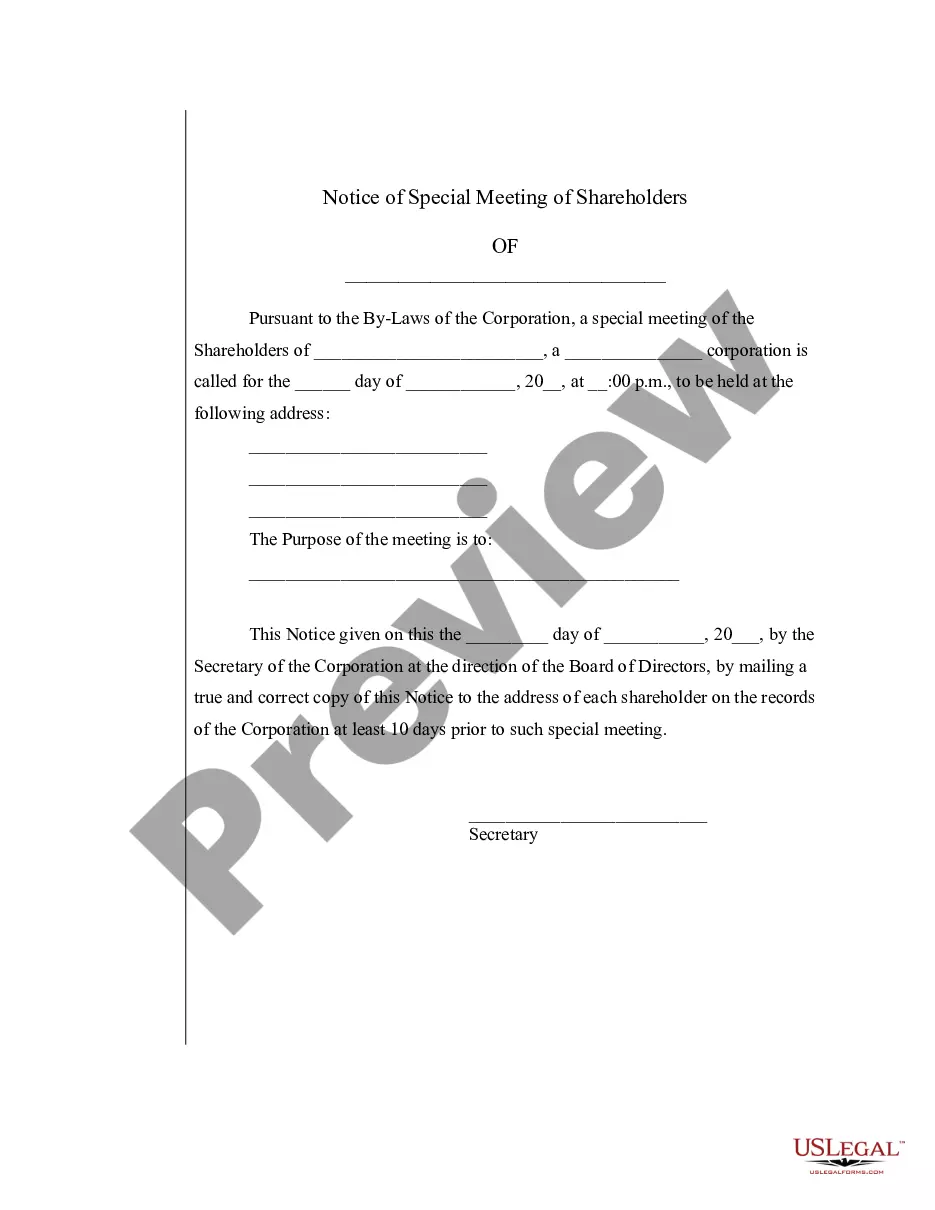
Sample of a previous notice for a meeting ing to section () of the bylaws of the organization, the board of directors hereby gives notice of a special meeting which will take place on (date) at (time) at (meeting location). Board members are encouraged to attend.
Document decisions and votes The minutes should contain a comprehensive record of the decisions that the participants make during the meeting. This means listing who proposed the motion and who seconded it. List the outcome of the vote, including who voted either way, and state clearly the decision made.
Meeting minutes don't need to capture discussions word by word, but they should effectively summarize key items and decisions to provide a clear and concise record of the meeting. Know that it's perfectly acceptable to write “a discussion of the options ensued.” If you need clarification on anything, be sure to ask.
Robert's Rules (Section -16) state that “the minutes should contain mainly a record of what was done at the meeting, not what was said by the members.” Minutes are not transcripts of meetings; rather, the document contains a record of actions taken by the body, organized by the meeting's order of business (agenda).
A concise summary of the action taken by the board. The names of the persons making and seconding motions. A summary of votes, indicating when motions were adopted by unanimous votes or the breakdown in yeas and nays and abstentions.
Special meetings are typically called for matters of some urgency—topics that can't wait until an annual or other regularly scheduled meeting. For instance, a special meeting might be called if the LLC received an offer to merge with another company or if members disagreed on the interpretation of a key policy.
At a special meeting, members can discuss only the business that was stated in the notification (which is referred to as the call to the meeting). If some emergency business is transacted for which no notice was given, the organization must ratify that business at a regular meeting or at another special meeting.

