Special Meeting Sample For School In Michigan
Description



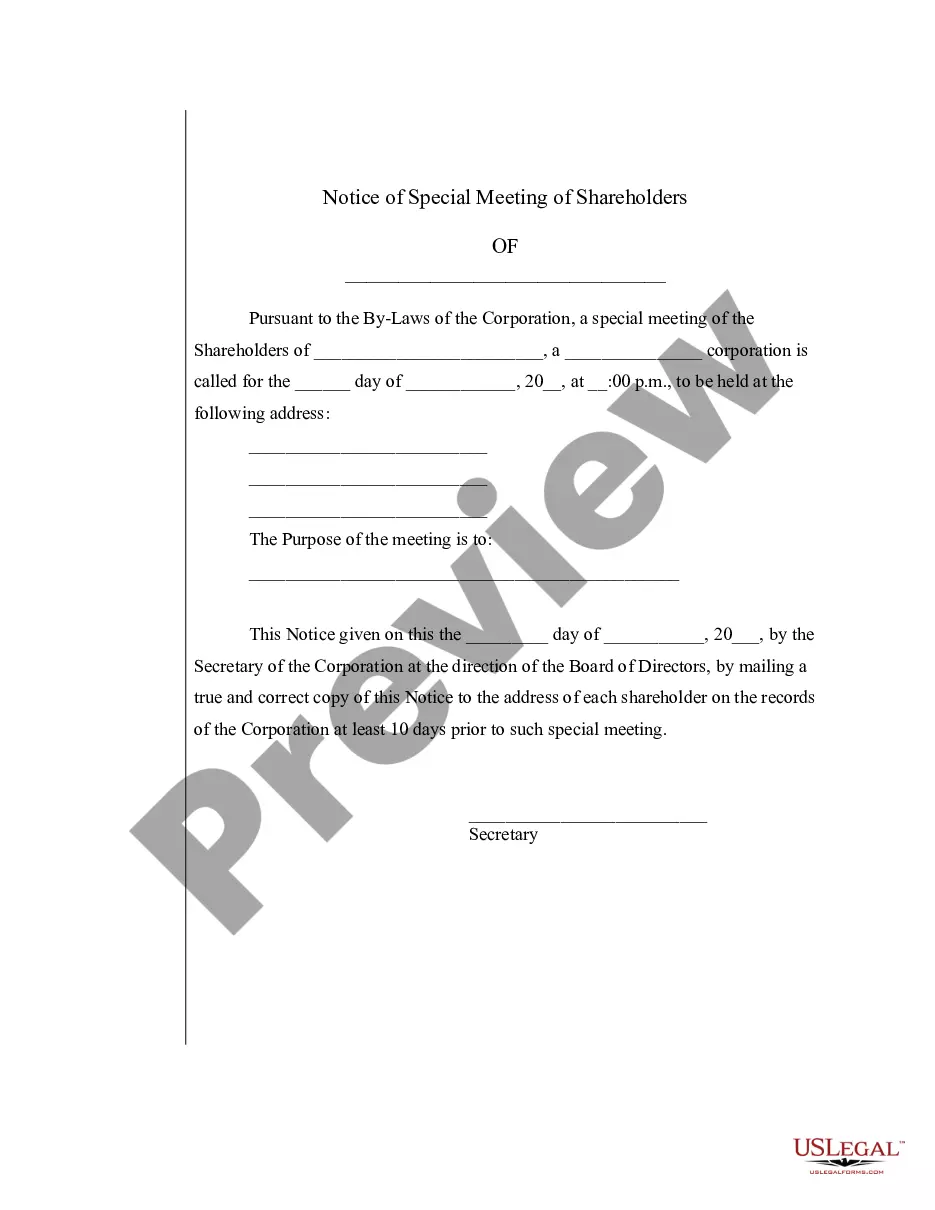
Get your form ready online
Our built-in tools help you complete, sign, share, and store your documents in one place.
Make edits, fill in missing information, and update formatting in US Legal Forms—just like you would in MS Word.
Download a copy, print it, send it by email, or mail it via USPS—whatever works best for your next step.
Sign and collect signatures with our SignNow integration. Send to multiple recipients, set reminders, and more. Go Premium to unlock E-Sign.
If this form requires notarization, complete it online through a secure video call—no need to meet a notary in person or wait for an appointment.
We protect your documents and personal data by following strict security and privacy standards.

Make edits, fill in missing information, and update formatting in US Legal Forms—just like you would in MS Word.

Download a copy, print it, send it by email, or mail it via USPS—whatever works best for your next step.

Sign and collect signatures with our SignNow integration. Send to multiple recipients, set reminders, and more. Go Premium to unlock E-Sign.

If this form requires notarization, complete it online through a secure video call—no need to meet a notary in person or wait for an appointment.

We protect your documents and personal data by following strict security and privacy standards.
Looking for another form?
Form popularity
FAQ
The evaluation process involves more than just giving your child a test. It looks at your child's overall performance in school. This includes observing your child in the classroom and talking with your child. It also involves looking at school and medical records and speaking with you and your child's teachers.
Recommended: Complete the student's initial IEP in its entirety within 60 days unless one of the exceptions above applies. Notice of procedural safeguards. Inform parents of procedural safeguards “at each” IEP meeting.
The district has seven calendar days to respond to a request for an IEE. The school may not unreasonably delay an IEE, and it must consider the results of the IEE when determining eligibility or developing your child's IEP.
The purpose of an IEP meeting is for the IEP team to work collaboratively to identify the special education services and supports that will be delivered to the student, based on her unique needs. This process produces a written record, the IEP itself, which formalizes these services and supports.
Michigan's Open Meetings Act (OMA), 1976 PA 267, MCL 15.261 et seq. requires public bodies to hold public meetings if a quorum of the board is present. In addition, any decisions or discussions on matters that could pertain to a decision must also be conducted in a public meeting.
An individualized education program (IEP) is a written document for students with disabilities ages 3 through 25 that outlines the student's educational needs and goals and any programs and services the intermediate school district (ISD) and/or its member district will provide to help the student make educational ...
Under the Individuals with Disabilities Education Act (IDEA) as well as California law, a reevaluation of a student and their IEP is necessary every three years. ing to California State University, Sacramento, these reevaluations are meant to: Review the IEP and see how the child meets the goals.
Meetings must: Be noticed in advance; Include only business described in the agenda; Take place within agency boundaries; Be completely accessible by the public. Notice and agenda for regular meeting must be: Posted 72 hours in advance; Posted in an accessible location; Mailed to persons who request notice.
It is different from a regular meeting, which is held on a regular schedule. For example, a company may call a special meeting to discuss a major decision, such as a merger or acquisition. A school board may call a special meeting to address a specific issue, such as a budget shortfall.
The basic intent of the Michigan Open Meetings Act is to require public bodies to conduct business at open meetings. The Act applies to any local governing body (including a board, commission, committee, subcommittee, or authority).

