Special Meeting Sample For School In Franklin
Description



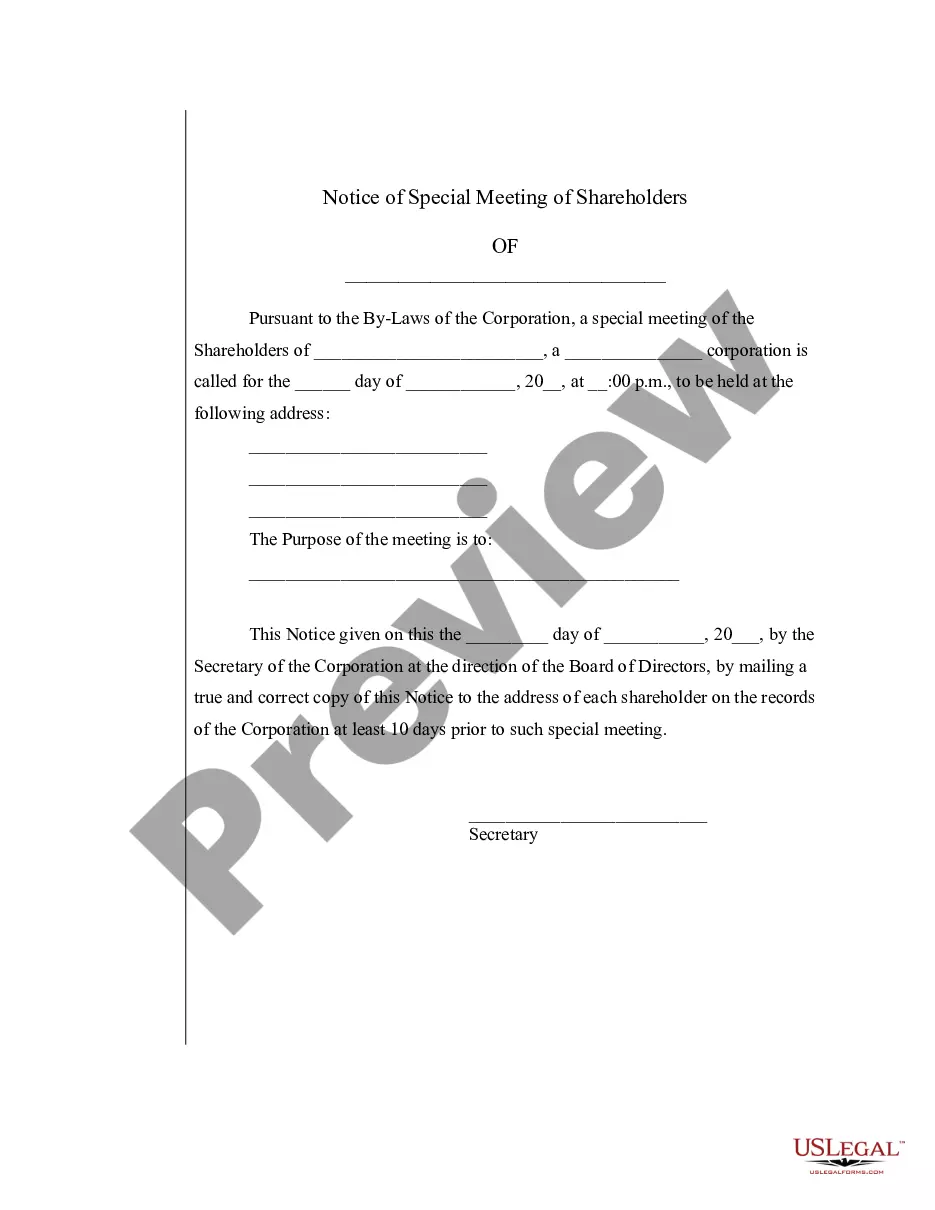
Get your form ready online
Our built-in tools help you complete, sign, share, and store your documents in one place.
Make edits, fill in missing information, and update formatting in US Legal Forms—just like you would in MS Word.
Download a copy, print it, send it by email, or mail it via USPS—whatever works best for your next step.
Sign and collect signatures with our SignNow integration. Send to multiple recipients, set reminders, and more. Go Premium to unlock E-Sign.
If this form requires notarization, complete it online through a secure video call—no need to meet a notary in person or wait for an appointment.
We protect your documents and personal data by following strict security and privacy standards.

Make edits, fill in missing information, and update formatting in US Legal Forms—just like you would in MS Word.

Download a copy, print it, send it by email, or mail it via USPS—whatever works best for your next step.

Sign and collect signatures with our SignNow integration. Send to multiple recipients, set reminders, and more. Go Premium to unlock E-Sign.

If this form requires notarization, complete it online through a secure video call—no need to meet a notary in person or wait for an appointment.

We protect your documents and personal data by following strict security and privacy standards.
Looking for another form?








Form popularity
FAQ
5 Tips to Conduct a School Board Meeting Enforce School Board Meeting Policies. School boards usually contain policies to guide each board meeting. Invest in Meeting Management Software. Distribute Meeting Agenda. Collaborate with Board Members. Distribute Post-Meeting Action Items.
These topics range from new facility projects to curriculum changes and testing requirements. While some of these topics may seem straightforward, others can be quite complex. It is important to remember that each topic is important and has the potential to impact students in a positive or negative way.
At the start of each session, the host should state the purpose of the meeting, quickly review the agenda, and ask participants if they have any questions. One way leaders can learn how to address a meeting is by incorporating the IEEI framework into each group session.
Here's what you can say to formally start the meeting: 'Hey Team! It's great to have you all here. I'd like to welcome everyone. ' Once the discussions are over, you can end the meeting by saying: 'Thank you all for your time.
? Phrases for welcoming and introducing meeting participants Thank you all for coming. I appreciate everyone being here. First, I'd like to welcome you all. I would like to thank you for being here on time. I wish to thank you all for coming on such short notice.
When called, stand and face/speak to the Board members. Do not turn and speak to the audience. State your name and keep your comments as concise as possible (generally three minutes). Speakers are expected to treat others with respect, confining their remarks to School District issues.
How to Run an Effective School Meeting Create teams. Set team norms. Develop a meeting agenda. Take notes! Develop a goal. Create and assign tasks to accomplish your goal. Track tasks and follow up. Acknowledge accomplishments.
Here are 8 steps that will help you have effective school meetings, from start to finish: Create teams. Set team norms. Develop a meeting agenda. Take notes! Develop a goal. Create and assign tasks to accomplish your goal. Track tasks and follow up. Acknowledge accomplishments.
These are things like defining the rules of governance, e.g., bylaws, policies, recruitment and election of board members. Defining the performance expectations of board members. Hiring, appraising, and setting compensation for the executive director.

