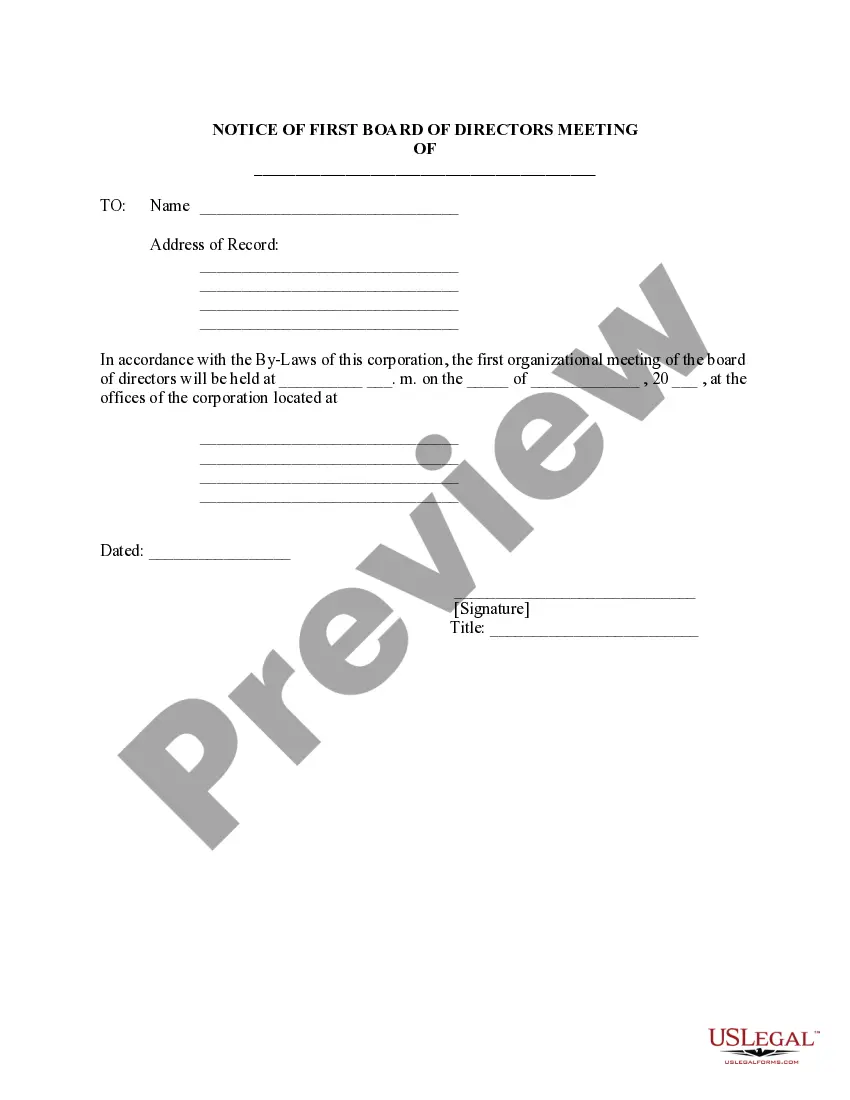
Notice Stockholders Meeting Format In Michigan
Description


Get your form ready online
Our built-in tools help you complete, sign, share, and store your documents in one place.
Make edits, fill in missing information, and update formatting in US Legal Forms—just like you would in MS Word.
Download a copy, print it, send it by email, or mail it via USPS—whatever works best for your next step.
Sign and collect signatures with our SignNow integration. Send to multiple recipients, set reminders, and more. Go Premium to unlock E-Sign.
If this form requires notarization, complete it online through a secure video call—no need to meet a notary in person or wait for an appointment.
We protect your documents and personal data by following strict security and privacy standards.

Make edits, fill in missing information, and update formatting in US Legal Forms—just like you would in MS Word.

Download a copy, print it, send it by email, or mail it via USPS—whatever works best for your next step.

Sign and collect signatures with our SignNow integration. Send to multiple recipients, set reminders, and more. Go Premium to unlock E-Sign.

If this form requires notarization, complete it online through a secure video call—no need to meet a notary in person or wait for an appointment.

We protect your documents and personal data by following strict security and privacy standards.
Looking for another form?









Form popularity
FAQ
There are three types of shareholders' meetings: an ordinary meeting, an extraordinary meeting and a special meeting.
(i) Date, time and place of meeting; (ii) Purpose of the meeting; (iii) Notice of any special business to be conducted; (iv) Nature of special business in sufficient details; (v) The text of any special resolution or by-law to be submitted to the meeting; and (vi) Any additional details required by the by-laws or ...
Shareholders occasionally hold special meetings outside of normal annual meetings—and these should be recorded with meeting minutes. Special meetings are typically held when urgent or sudden changes occur to the corporation.
An extraordinary general meeting can be called by either a: committee member (if approved by the majority of voting committee members) written request signed by owners of at least 25% of lots or their representatives.
Section 601 - Notice of shareholders' meeting or report (a) Whenever shareholders are required or permitted to take any action at a meeting a written notice of the meeting shall be given not less than 10 (or, if sent by third-class mail, 30) nor more than 60 days before the date of the meeting to each shareholder ...
In general, companies require a letter or similar notification from investors having a sufficient number of shares, demanding a special meeting and stating the purpose for that meeting. The company can then set the date for the meeting, typically within a 30 to 90 day time period after receipt of the demand.
In general, companies require a letter or similar notification from investors having a sufficient number of shares, demanding a special meeting and stating the purpose for that meeting. The company can then set the date for the meeting, typically within a 30 to 90 day time period after receipt of the demand.
All shareholders must be notified of the format, date, time, and place of the meeting. How far in advance notices should be distributed may depend on your state, but generally, they should be sent out more than 10 days prior to the meeting, but less than 60 days.
Most Michigan HR professionals know something about the Bullard Plawecki Employee Right to Know Act. It has been around since 1978 (PA 397) and permits current and former employees the right to review what is in their personnel file. This type of law is often referred to as a sunshine law.

