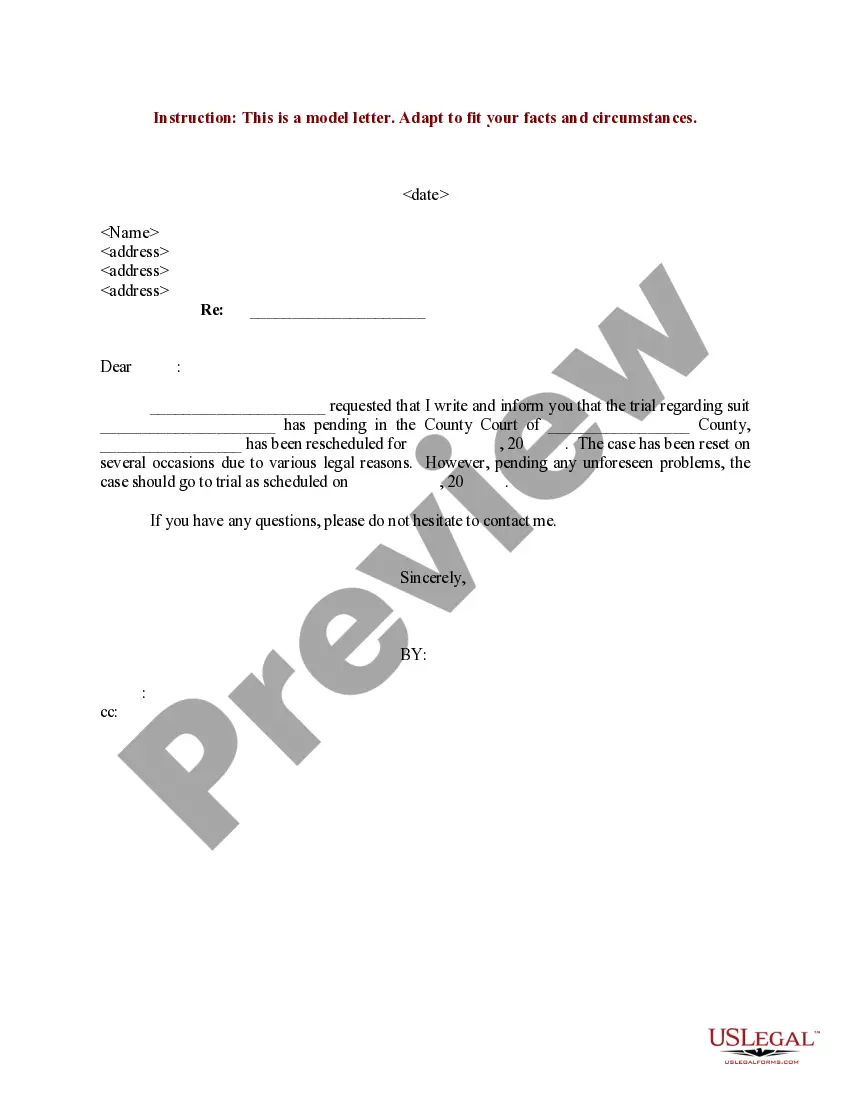
Court Letter Template With Reference In Cook
Description




Get your form ready online
Our built-in tools help you complete, sign, share, and store your documents in one place.
Make edits, fill in missing information, and update formatting in US Legal Forms—just like you would in MS Word.
Download a copy, print it, send it by email, or mail it via USPS—whatever works best for your next step.
Sign and collect signatures with our SignNow integration. Send to multiple recipients, set reminders, and more. Go Premium to unlock E-Sign.
If this form requires notarization, complete it online through a secure video call—no need to meet a notary in person or wait for an appointment.
We protect your documents and personal data by following strict security and privacy standards.

Make edits, fill in missing information, and update formatting in US Legal Forms—just like you would in MS Word.

Download a copy, print it, send it by email, or mail it via USPS—whatever works best for your next step.

Sign and collect signatures with our SignNow integration. Send to multiple recipients, set reminders, and more. Go Premium to unlock E-Sign.

If this form requires notarization, complete it online through a secure video call—no need to meet a notary in person or wait for an appointment.

We protect your documents and personal data by following strict security and privacy standards.
Looking for another form?






Form popularity
FAQ
The letter should be sincere. The writer should answer who they are, how they know you, what they have seen you accomplish (specific situations), the character traits that they have witnessed, and what they expect you to accomplish in the future.
You might say something like: ``I'm exploring some new opportunities and would like to ask if you would be willing to provide me with a reference letter.'' Briefly explain why you're looking for new opportunities, focusing on your career goals rather than any negative aspects of your current job.
Person's name has always been a loving and caring friend/family member/co-worker since we first met. That is why I am writing this letter to defend person's name, because he/she has always been a respected person in the community, and a genuine person to everyone he/she has come across.
Ask in person first. Before you send a formal, written request for a letter of recommendation, speak with each individual in person. Send a formal letter of recommendation request. Follow up before the due date. Say a final thank you.
Aim for at least one page but no more than two. Focus on the most important qualifications. Discuss two or three of the candidate's most relevant achievements in the job description for the highest impact and provide specific examples to illustrate their fitness for the role. Follow the request instructions.
How to structure a character reference: Introduce yourself, state what your occupation is and any qualifications you hold. In what capacity do you know them the defendant? Tell the court that you're aware of the proceedings. Give some background surrounding your relationship with the defendant.
The letter should be addressed to the Judge, but mailed to the defendant's attorney. Who are you? ... Make it personal when describing the defendant's characteristics. Only talk about what you know. Be truthful. Never attack the victims or law enforcement. Never allow the defendant to write the letter for you.
The letters should be addressed to ``To Whom It May Concern'' and be concise, ideally 2-5 paragraphs, focusing on sincerity. The content should highlight how the writer knows the defendant, the defendant's positive characteristics, obstacles overcome, potential as a valuable citizen, and future goals.
You can address the judge to “The Honorable First Name Last Name” or “Judge First Name Last Name” or “Judge Last Name.” It is redundant to say “Honorable Judge” so use either “Judge” or “Honorable.”
If the judge's name is "John Smith," then in references to him that would be read by others (e.g., the mailing address on a letter) you would refer to him "The Honorable John Smith" (or some might just use "Hon."). In directly communicating with him in writing, I would start with "Dear Judge Smith."

