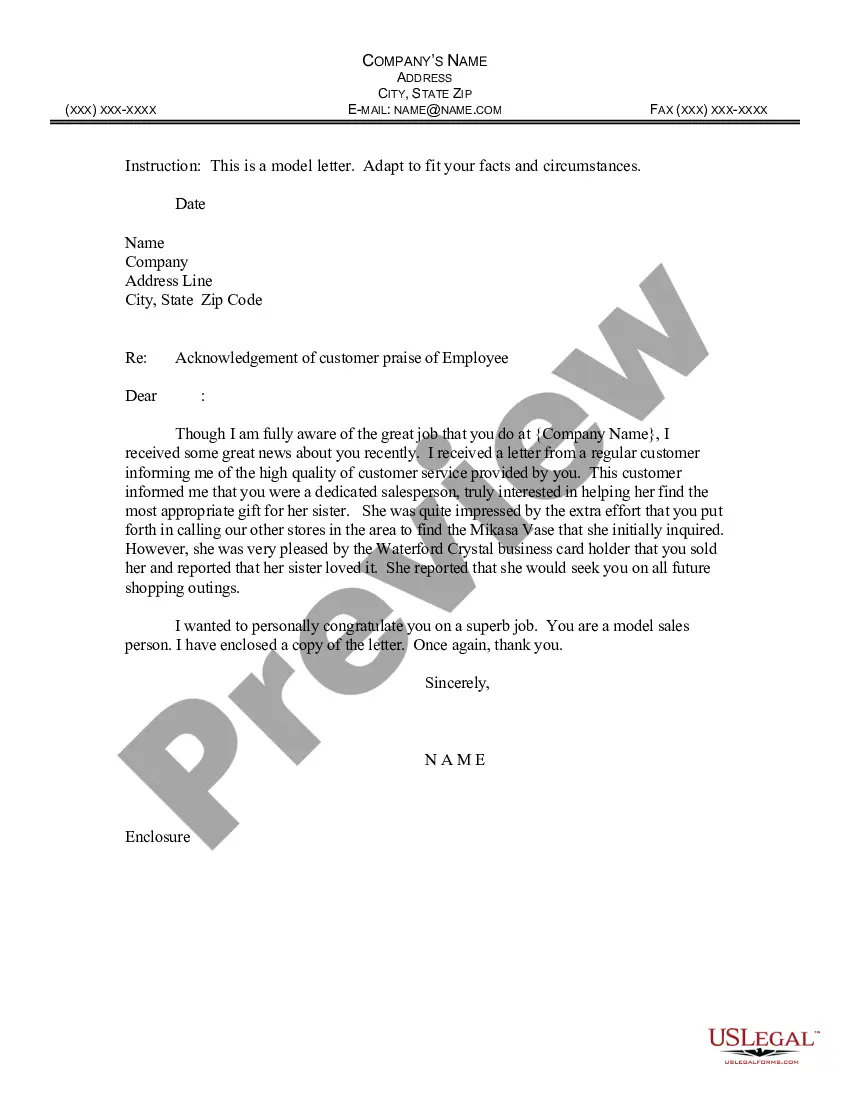
Employee Praise Letter With No Experience In Salt Lake
Description

Get your form ready online
Our built-in tools help you complete, sign, share, and store your documents in one place.
Make edits, fill in missing information, and update formatting in US Legal Forms—just like you would in MS Word.
Download a copy, print it, send it by email, or mail it via USPS—whatever works best for your next step.
Sign and collect signatures with our SignNow integration. Send to multiple recipients, set reminders, and more. Go Premium to unlock E-Sign.
If this form requires notarization, complete it online through a secure video call—no need to meet a notary in person or wait for an appointment.
We protect your documents and personal data by following strict security and privacy standards.

Make edits, fill in missing information, and update formatting in US Legal Forms—just like you would in MS Word.

Download a copy, print it, send it by email, or mail it via USPS—whatever works best for your next step.

Sign and collect signatures with our SignNow integration. Send to multiple recipients, set reminders, and more. Go Premium to unlock E-Sign.

If this form requires notarization, complete it online through a secure video call—no need to meet a notary in person or wait for an appointment.

We protect your documents and personal data by following strict security and privacy standards.
Looking for another form?
Form popularity
FAQ
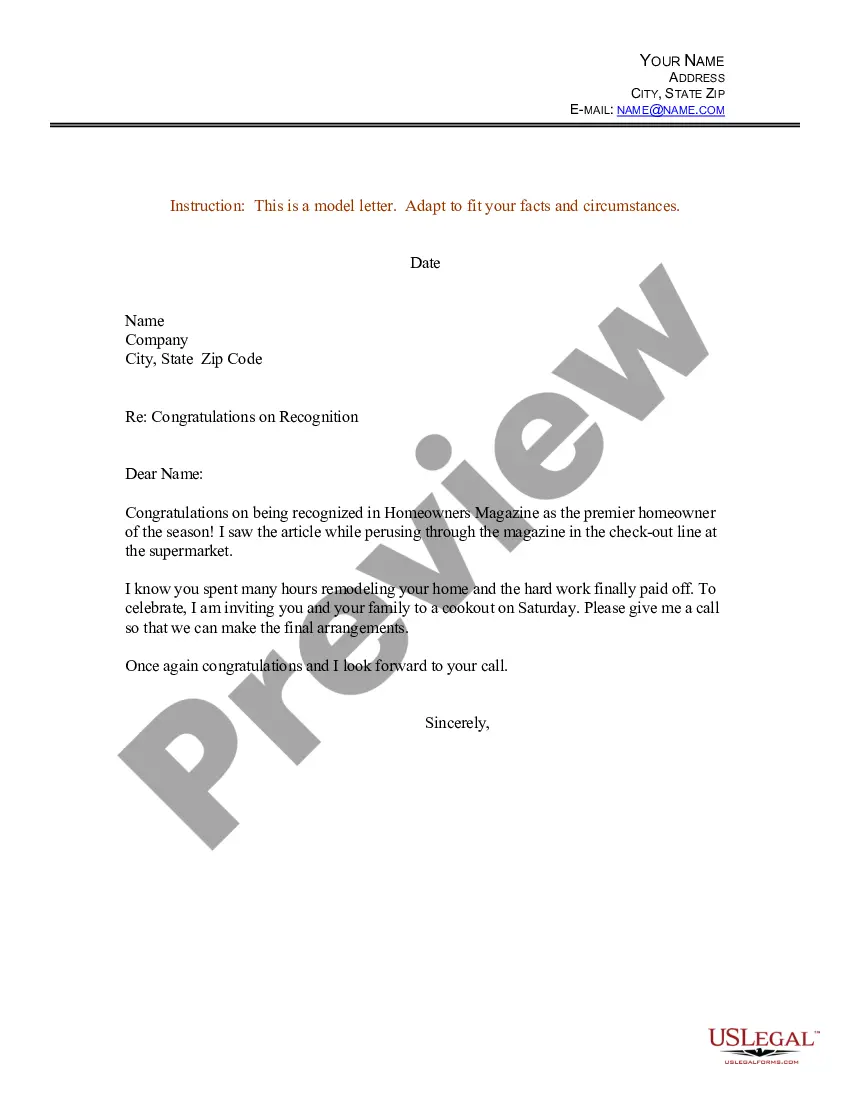
Next, include a greeting such as “Dear,” followed by their first name. After this, open your letter with a sentence that details your reason for writing. This helps the addressee quickly understand why you wrote them a letter. Typically, you should begin by thanking them for their workplace contributions and efforts.
Dear Employee's Name, Thank you for your exceptional efforts, commitment, and dedication and for being the backbone of all our successful projects. Your consistency, attention to detail, and determination are appreciated and always impacted the organization. Cheers to many future outstanding works!
Here are nine key tips for writing an employee recognition letter: Choose the appropriate format. Personalize the message. Determine why you're writing the letter. Recognize specific achievements. Use active voice and positive vocabulary. Express your sincere appreciation. Share others' recognition.
I've noticed your significant improvement in Specific skill recently. Keep up the great work! Your dedication to learning and continuous improvement is truly commendable. Employee Name, thank you for your excellent problem-solving skills on the Situation.
I wanted to take a moment to express my sincere appreciation for the outstanding work you consistently deliver. Your dedication, attention to detail, and commitment to excellence do not go unnoticed. Your contributions have played a pivotal role in our success, and we are grateful to have you on our team. Thank you!
5 Employee appreciation letter best practices 1) Be timely. Appreciation is more impactful when it's immediate and in the moment. 2) Be specific. A generic “great job” might be easy to write, but it's just as easy to forget. 3) Make it genuine. 4) Give appreciation often. 5) Cultivate culture.
"I really appreciate your hard work." "You're an invaluable member of this team." "Thank you for your dedication and commitment." "I'm impressed with the progress you've made and the contribution you've made to this team.
Selected by the community from 1 contribution. 1 Identify the purpose. Before you start writing, you need to identify the purpose of your compliment letter. 2 Be specific and detailed. 3 Use positive and respectful language. 4 Add a personal touch. 5 Keep it concise and clear. 6 Here's what else to consider.
How to write a cover letter with minimal experience Address your letter professionally. Express your interest. Describe your specific knowledge and skills. End your letter with a call to action. Include a signature line. Proofread and check the length.
It's okay to briefly acknowledge your lack of professional experience, but don't focus on it. Dedicate most of your cover letter to your strengths and what you can bring to the role. Express confidence in your ability to learn and grow in the advertised role.