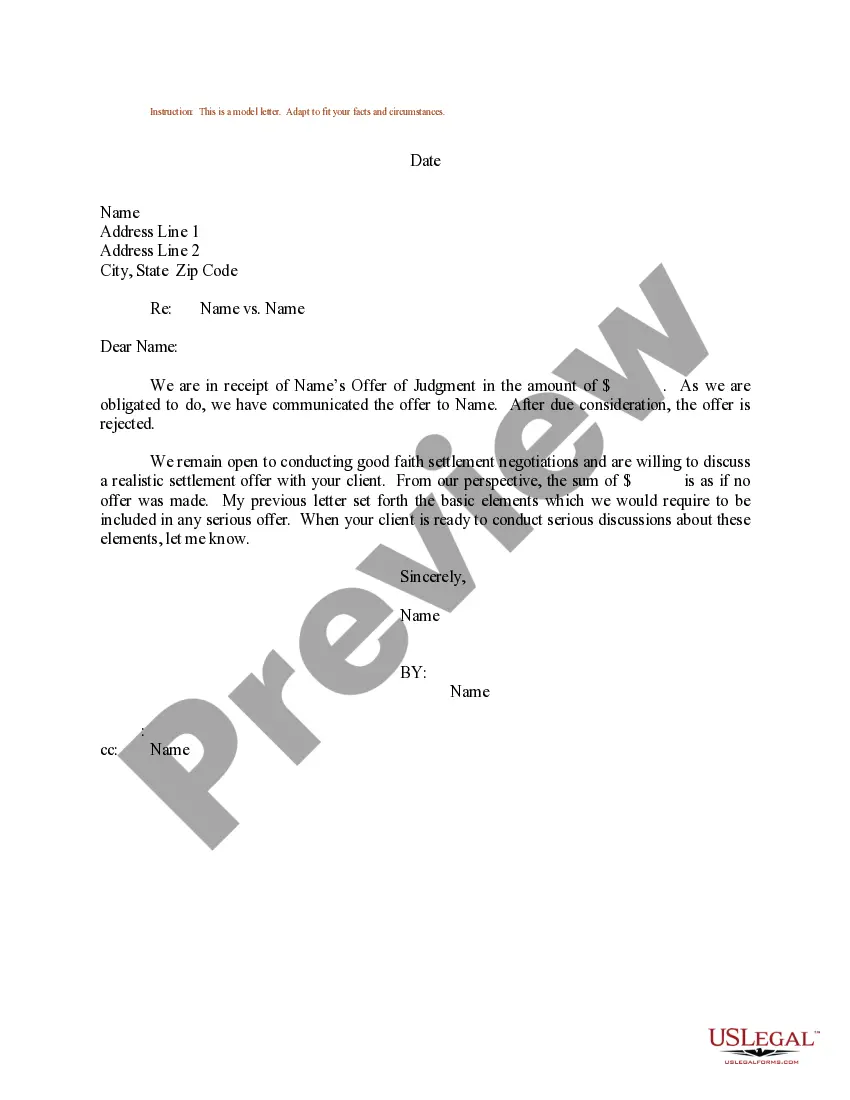
Sample Letter Rejecting Settlement Offer Without Prejudice Template In Hillsborough
Description


Get your form ready online
Our built-in tools help you complete, sign, share, and store your documents in one place.
Make edits, fill in missing information, and update formatting in US Legal Forms—just like you would in MS Word.
Download a copy, print it, send it by email, or mail it via USPS—whatever works best for your next step.
Sign and collect signatures with our SignNow integration. Send to multiple recipients, set reminders, and more. Go Premium to unlock E-Sign.
If this form requires notarization, complete it online through a secure video call—no need to meet a notary in person or wait for an appointment.
We protect your documents and personal data by following strict security and privacy standards.

Make edits, fill in missing information, and update formatting in US Legal Forms—just like you would in MS Word.

Download a copy, print it, send it by email, or mail it via USPS—whatever works best for your next step.

Sign and collect signatures with our SignNow integration. Send to multiple recipients, set reminders, and more. Go Premium to unlock E-Sign.

If this form requires notarization, complete it online through a secure video call—no need to meet a notary in person or wait for an appointment.

We protect your documents and personal data by following strict security and privacy standards.
Looking for another form?







Form popularity
FAQ
Whereas a case that is dismissed “with prejudice” is dismissed permanently, a case that is dismissed “without prejudice” is only dismissed temporarily. This temporary dismissal means that the plaintiff is allowed to re-file charges, alter the claim, or bring the case to another court.
Without prejudice meaning In general, a party's admission to something can be used against them in court. The without prejudice (WP) rule means that statements which are made in a genuine attempt to settle a dispute cannot be used in court as evidence of admissions against the party that made them.
A without prejudice offer can be used to resolve a legal dispute by enabling parties to make settlement offers without the risk of those offers being used against them in court. This protection encourages parties to engage in genuine negotiations to reach a settlement.
name of claims adjuster, I received your letter dated date of written settlement offer. I have reviewed your letter very carefully, including your settlement offer. Unfortunately, I cannot accept your offer for the reasons discussed below.
I am writing this letter to state that on _ (Day) i.e. (Date), I got relieved from your _ (Company/ Organization) but my full and final settlement has not been done. I request you to kindly do the full and final settlement and send me all dues (if any).
In the formal legal world, a court case that is dismissed with prejudice means that it is dismissed permanently. A case dismissed with prejudice is over and done with, once and for all, and can't be brought back to court. A case dismissed without prejudice means the opposite. It's not dismissed forever.
Your letter in response to a settlement offer 1) In your introduction, start by saying that you are surprised and a little hurt that your employer wishes to terminate your employment. Then state how hard you have worked and how much your job means to you. This will elicit sympathy and create goodwill.
However, refusing a settlement offer does extend the life of your claim and delays when you receive compensation. If you have pressing medical bills or other expenses, this is a factor to consider. You'll also need to invest more time and energy into your case, including providing more documentation of your damages.
Provide specific reasons for your rejection, highlighting the damages and losses not covered by the proposed settlement. These reasons could include medical expenses, lost wages, property damage, pain and suffering, and other relevant costs.
There is no particular magic in the words “without prejudice” in a letter. The substance of the communication will be considered to determine if it forms part of genuine negotiations for the settlement of a dispute.

