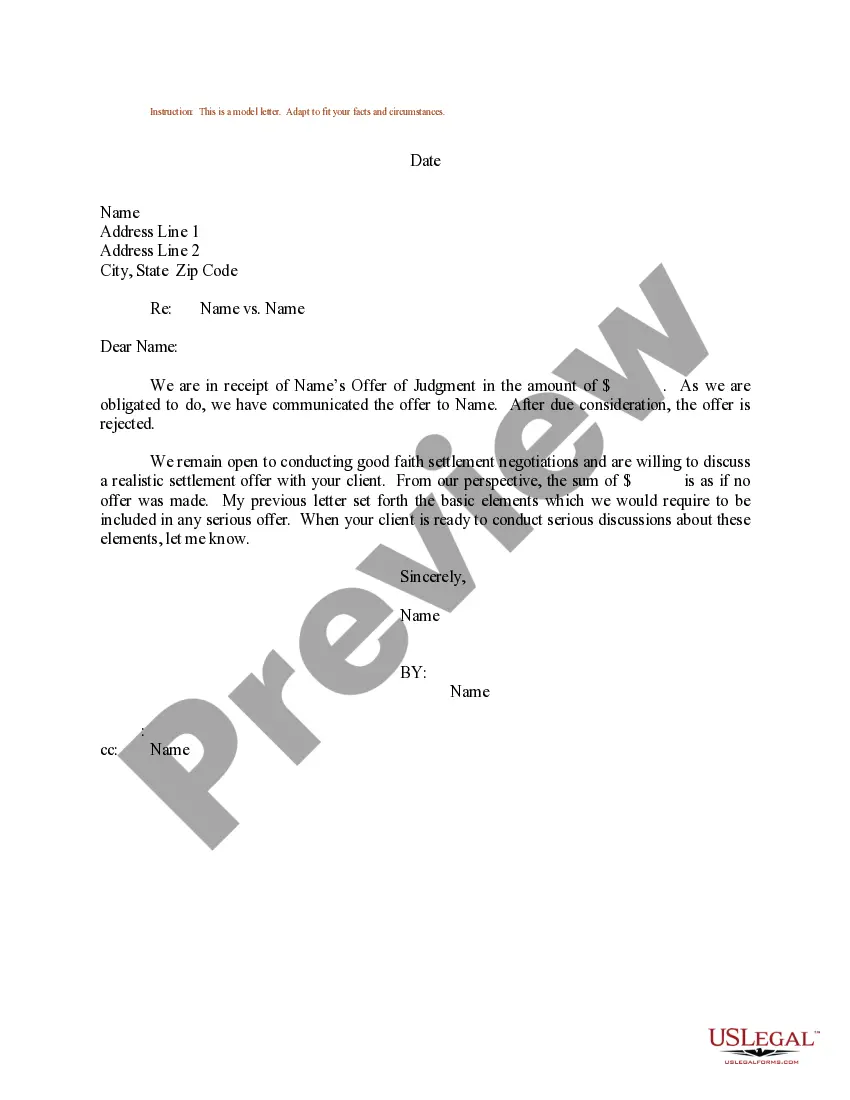
Sample Letter For Settlement Proposal In Fairfax
Description


Get your form ready online
Our built-in tools help you complete, sign, share, and store your documents in one place.
Make edits, fill in missing information, and update formatting in US Legal Forms—just like you would in MS Word.
Download a copy, print it, send it by email, or mail it via USPS—whatever works best for your next step.
Sign and collect signatures with our SignNow integration. Send to multiple recipients, set reminders, and more. Go Premium to unlock E-Sign.
If this form requires notarization, complete it online through a secure video call—no need to meet a notary in person or wait for an appointment.
We protect your documents and personal data by following strict security and privacy standards.

Make edits, fill in missing information, and update formatting in US Legal Forms—just like you would in MS Word.

Download a copy, print it, send it by email, or mail it via USPS—whatever works best for your next step.

Sign and collect signatures with our SignNow integration. Send to multiple recipients, set reminders, and more. Go Premium to unlock E-Sign.

If this form requires notarization, complete it online through a secure video call—no need to meet a notary in person or wait for an appointment.

We protect your documents and personal data by following strict security and privacy standards.
Looking for another form?





Form popularity
FAQ
The Fairfax Circuit Court serves the residents of Fairfax County and Fairfax City. The Fairfax Circuit Court (19th Judicial Circuit) is the trial court of general jurisdiction and is the largest trial court in Virginia, composed of fifteen full-time and five retired trial judges.
If you choose to file a lawsuit without an attorney, you first must go to the offices of the Clerk of the GDC in the city or county where: • the defendant lives, is employed or has a regular place of business; • the incident upon which your claim is based took place; or, • if the defendant is a corporation, its ...
A person may have more than one residence, but can only have one domicile at any particular time. For a divorce in the state of Virginia, the jurisdiction is held by the county or city where the two parties last lived together as husband and wife.
The circuit court also handles family matters, including divorce. In addition, the circuit court hears cases appealed from the general district court and from the juvenile and domestic relations district court.
To obtain a divorce in Virginia, either you or your spouse must be a resident of Virginia for at least six months prior to filing for divorce. If there are no children from the marriage, you must be separated for a minimum of six months and have a written property settlement agreement before you may file for divorce.
Short answer: Whether your case is a family law case, which includes divorce, or is a civil case, you'll be going to the Superior Court in the county where your case is filed.
The VS-4 form is a statistical form that must be provided before a divorce can be finalized. This form requires basic information about the client such as their date of birth, education level, and each spouse's address. After the form is endorsed, it is used for statistical purposes by the state.
Decisions in District Courts – both General and J&DR – may be appealed to the Circuit Court. Circuit Courts hear criminal cases involving more serious offenses, called felonies, civil actions involving larger monetary claims, and appeals from District Courts.
In Virginia, you may file for divorce at the court clerk's office in any county or city in the state. However, if your spouse objects to that venue, the court might transfer the case to the county or city where: you and your spouse last lived together.
In order to be binding, a proposal for settlement must be in writing and signed by both parties. The terms of the agreement must be clearly stated, and both parties must agree to them. If either party breaches the agreement, the other party can file a lawsuit to enforce the agreement.

