Church Invitation Letter Format In Broward
Description
Get your form ready online
Our built-in tools help you complete, sign, share, and store your documents in one place.
Make edits, fill in missing information, and update formatting in US Legal Forms—just like you would in MS Word.
Download a copy, print it, send it by email, or mail it via USPS—whatever works best for your next step.
Sign and collect signatures with our SignNow integration. Send to multiple recipients, set reminders, and more. Go Premium to unlock E-Sign.
If this form requires notarization, complete it online through a secure video call—no need to meet a notary in person or wait for an appointment.
We protect your documents and personal data by following strict security and privacy standards.

Make edits, fill in missing information, and update formatting in US Legal Forms—just like you would in MS Word.

Download a copy, print it, send it by email, or mail it via USPS—whatever works best for your next step.

Sign and collect signatures with our SignNow integration. Send to multiple recipients, set reminders, and more. Go Premium to unlock E-Sign.

If this form requires notarization, complete it online through a secure video call—no need to meet a notary in person or wait for an appointment.

We protect your documents and personal data by following strict security and privacy standards.
Looking for another form?







Form popularity
FAQ
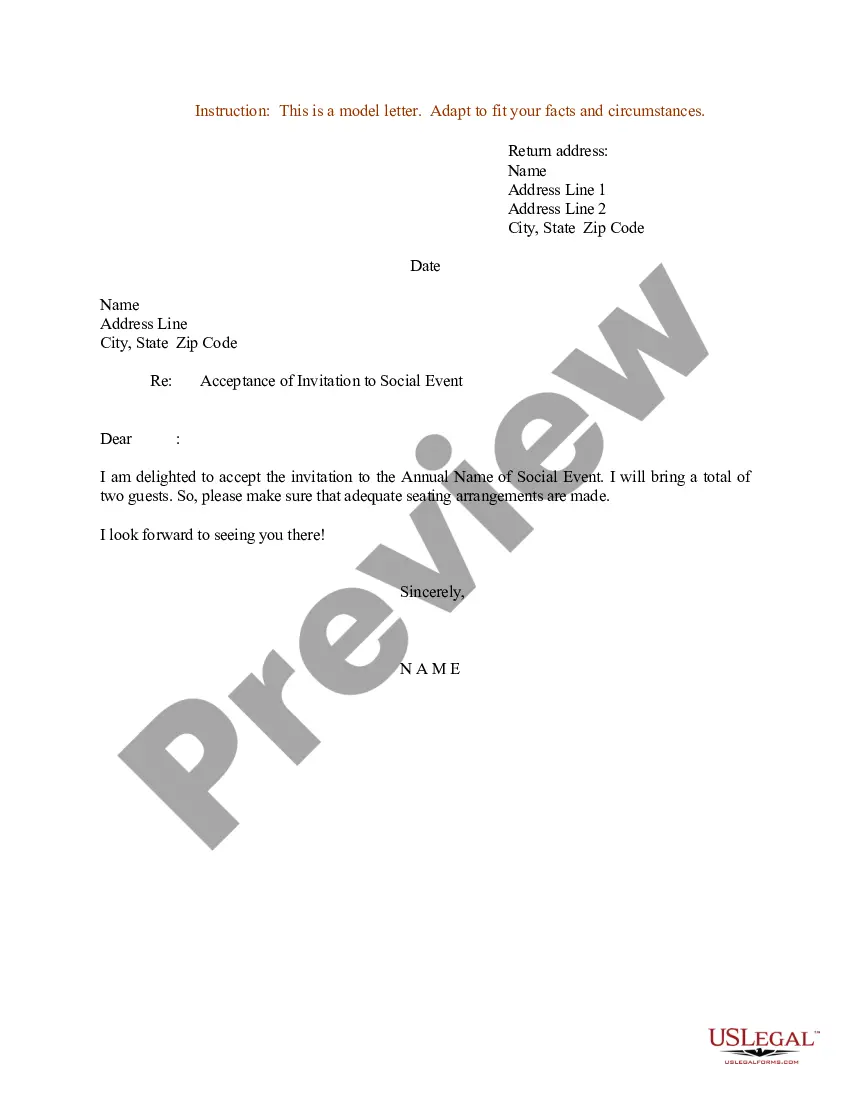
Mention precisely the details of the event including date, time, venue, and purpose. Be very specific about the event date, the time, and the duration. Keep guests well informed. Give as many specific details as you can, like the location map, the dress code, event venue type, among others.
Guidelines for writing invitations: State the occasion, date, time, and place. If you need a response, include a self-addressed, stamped reply card or envelope with your invitation. Express that you are looking forward to seeing the person.
Here's an example of an invitation to a professional event:You're cordially invited to the end-of-year city-wide networking event for business experts. This networking event takes place this Monday from 10 a.m. to 5 p.m., and we're providing lunch and drinks. Please RSVP if you plan to attend.
Example: Dear Recipient's Name, I am pleased to invite you to Event Name, which will take place on Event Date at Event Time at Event Venue. The purpose of this event is to briefly describe the purpose or agenda of the event.
That's where church invitation letters come in. How to Put Church Invitation Letters into Action. Start with a Warm Greeting. Introduce the Purpose of the Letter. Provide Key Event Details. Explain Why Their Presence Matters. Include a Call to Action. Close with a Blessing and Contact Information.
Informal Invitation Letter – Guidelines and Tips It is written in the first person (I/we). The sender's address is written as usual but the receiver's address is not mentioned. The date of writing the invitation is given but there is no need to write the year. The salutation is Dear + name.
To invite a chief guest, we have to write a formal letter of invitation to them. The letter should be very polite and respectful and should include the reason why you want this particular person as your chief guest. The chief guest attends the event only on special invitation.
Start with ``Dear (Church Name/Church Leader(s)),'' or ``To Whom It May Concern,'' if you're unsure of specific names.
Dear Recipient's Name, I hope this email finds you well. We are pleased to invite you to attend the upcoming Event Name meeting, scheduled to take place on Date at Time. The meeting will be held at Location/Online Platform, and we would be honored to have your presence and participation.
While writing the letter, we have to first introduce ourselves, then mention all about the event which is being organized and give the proper venue for the event. Moving forward, we would appreciate the presence of such special guests. End the letter by expecting a positive reply from their side.

