Notice Meeting Corporate With Example In Montgomery
Description


Get your form ready online
Our built-in tools help you complete, sign, share, and store your documents in one place.
Make edits, fill in missing information, and update formatting in US Legal Forms—just like you would in MS Word.
Download a copy, print it, send it by email, or mail it via USPS—whatever works best for your next step.
Sign and collect signatures with our SignNow integration. Send to multiple recipients, set reminders, and more. Go Premium to unlock E-Sign.
If this form requires notarization, complete it online through a secure video call—no need to meet a notary in person or wait for an appointment.
We protect your documents and personal data by following strict security and privacy standards.

Make edits, fill in missing information, and update formatting in US Legal Forms—just like you would in MS Word.

Download a copy, print it, send it by email, or mail it via USPS—whatever works best for your next step.

Sign and collect signatures with our SignNow integration. Send to multiple recipients, set reminders, and more. Go Premium to unlock E-Sign.

If this form requires notarization, complete it online through a secure video call—no need to meet a notary in person or wait for an appointment.

We protect your documents and personal data by following strict security and privacy standards.
Looking for another form?








Form popularity
FAQ
When the Open Meetings Act applies, what does it require the public body to do? The Act requires the public body to give “reasonable advance notice” of its meetings, to make an agenda available in advance except in cases of emergency, to hold its meetings openly, to adopt minutes, and to retain them for 5 years.
Meetings must: Be noticed in advance; Include only business described in the agenda; Take place within agency boundaries; Be completely accessible by the public. Notice and agenda for regular meeting must be: Posted 72 hours in advance; Posted in an accessible location; Mailed to persons who request notice.
Common types of nonprofits that are subject to open meeting laws are: State, local and federal boards, commissions and authorities. State educational institutions. Private entities receiving public funds.
The notice for an annual meeting must state the time of the meeting, the place of the meeting, if any, and the means of remote communication, if any, by which stockholders and proxy holders may be deemed to be present and entitled to vote at the meeting. Quorum and Presence at the Meeting.
Maryland's Open Meetings Act is a statute that requires many State and local public bodies to hold their meetings in public, to give the public adequate notice of those meetings, and to allow the public to inspect meetings minutes. The Act permits public bodies to discuss some topics confidentially.
HOA Board Meetings, Recordings, and Ground Rules Any member wanting to record the meeting must seek permission from the board. An HOA board has the authority to establish the rules of conduct for association meetings. The authority to do so is typically found in the CC&Rs or Articles of Incorporation and bylaws.
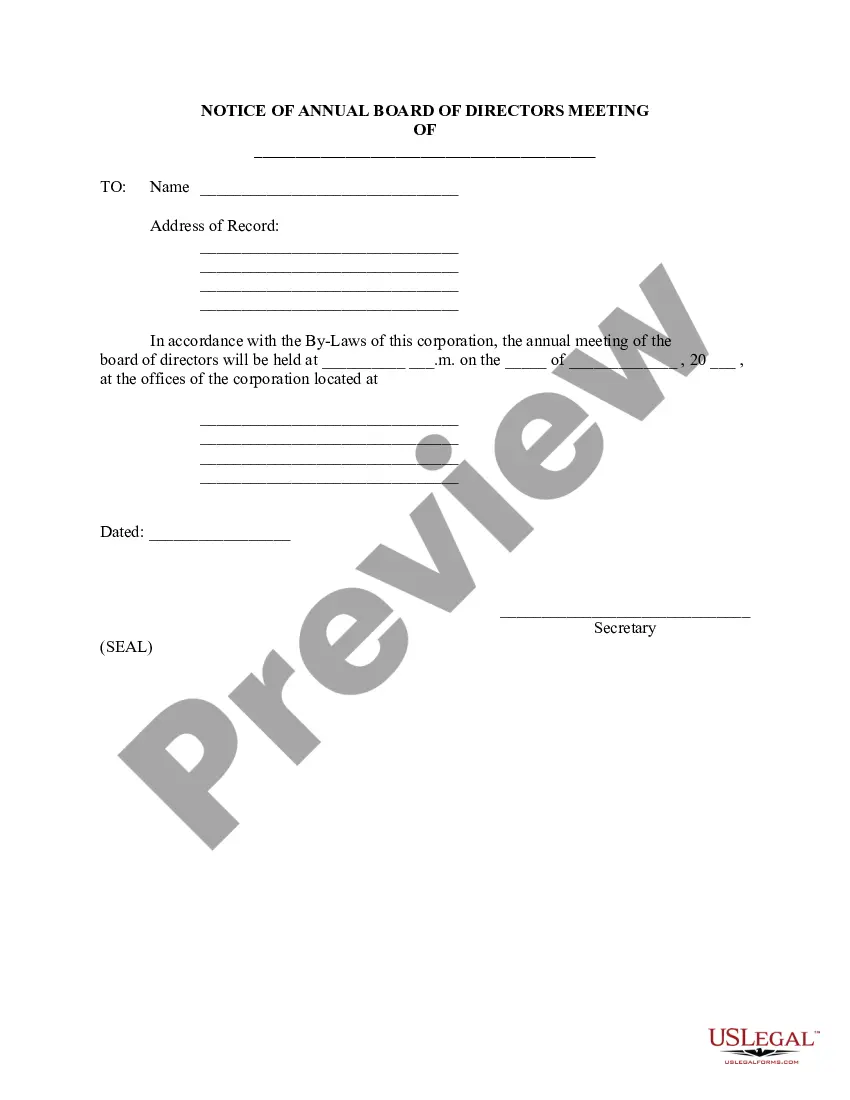
A Notice of Meeting informs a company's shareholders, directors, or other interested parties of the time, date, and place of a corporate meeting. This document can be attached to the minutes of a meeting and can be used as evidence that notice was provided.
A proper meeting notice should include: Date, Time, and Venue: Clear details on when and where the meeting will take place. Purpose of the Meeting: A brief description of the meeting's objectives. Agenda: An outline of topics to be discussed; this helps attendees prepare for the meeting.
The _________________ Name of Governing Body of the _________________ Name of Public Entity (hereafter referred to as "governing body") will be holding a __________ regular or special meeting on _____________ Date at ________ Time.

