Notice For Meeting In Dallas
Description


Get your form ready online
Our built-in tools help you complete, sign, share, and store your documents in one place.
Make edits, fill in missing information, and update formatting in US Legal Forms—just like you would in MS Word.
Download a copy, print it, send it by email, or mail it via USPS—whatever works best for your next step.
Sign and collect signatures with our SignNow integration. Send to multiple recipients, set reminders, and more. Go Premium to unlock E-Sign.
If this form requires notarization, complete it online through a secure video call—no need to meet a notary in person or wait for an appointment.
We protect your documents and personal data by following strict security and privacy standards.

Make edits, fill in missing information, and update formatting in US Legal Forms—just like you would in MS Word.

Download a copy, print it, send it by email, or mail it via USPS—whatever works best for your next step.

Sign and collect signatures with our SignNow integration. Send to multiple recipients, set reminders, and more. Go Premium to unlock E-Sign.

If this form requires notarization, complete it online through a secure video call—no need to meet a notary in person or wait for an appointment.

We protect your documents and personal data by following strict security and privacy standards.
Looking for another form?
Form popularity
FAQ
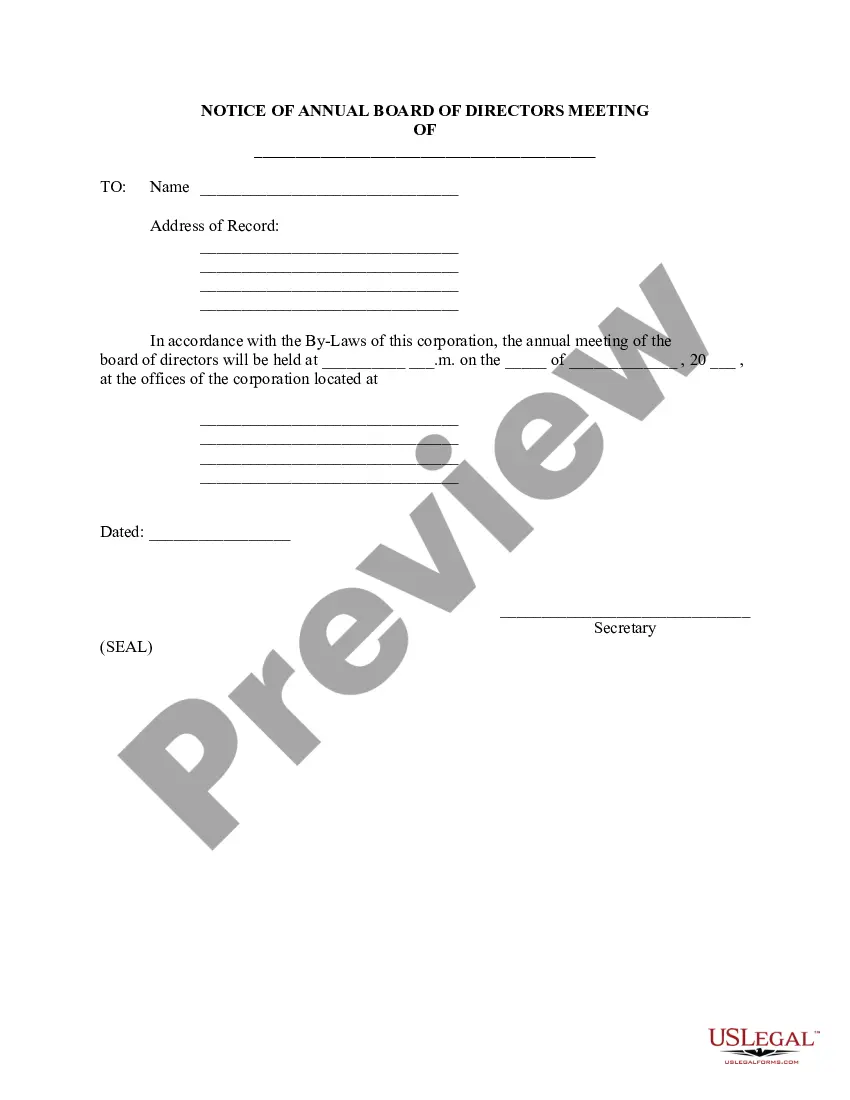
A proper meeting notice should include: Date, Time, and Venue: Clear details on when and where the meeting will take place. Purpose of the Meeting: A brief description of the meeting's objectives. Agenda: An outline of topics to be discussed; this helps attendees prepare for the meeting.
Purpose and Clarity: Notices should clearly communicate their purpose. The language should be straightforward to avoid confusion. Structure: Follow a structured format—heading, date, subject, audience, details, and contact information. This ensures that all necessary information is included and easily accessible.
A meeting notice should include the following key details: Name and contact information of the meeting chair. Name and role of the sender of the meeting notice. Names and roles of all the invitees. Type of meeting — regular, annual, or special. Date, time and location of the meeting (the notice should also be dated)
A proper meeting notice should include: Date, Time, and Venue: Clear details on when and where the meeting will take place. Purpose of the Meeting: A brief description of the meeting's objectives. Agenda: An outline of topics to be discussed; this helps attendees prepare for the meeting.
(1) Subject to subsection (2), at least 21 days notice must be given of a meeting of a company's members. However, if a company has a constitution, it may specify a longer minimum period of notice.
In addition to the company name, the name and title of the person sending the notice should also be included. This person will also have signing authority and be responsible for signing the notice of meeting.
Date, time and location of the meeting (the notice should also be dated) Purpose of the meeting, such as budget approval or discussing current operations. Meeting agenda — objectives and action items to be voted on. Instructions for attending the meeting — in-person or via conference call.
Under the Act, the length of notice required to be given for a general meeting called by the directors is generally a minimum of 14 clear days, although the articles may set out a longer period. (A longer period is also required where certain resolutions are being proposed.)
Notices provide information about an upcoming meeting, including date, time, and location. Agendas outline topics to be discussed, and minutes provide a written record of what was discussed and decided at a meeting.
