Arbitration Case In Malaysia In Wayne
Description



Get your form ready online
Our built-in tools help you complete, sign, share, and store your documents in one place.
Make edits, fill in missing information, and update formatting in US Legal Forms—just like you would in MS Word.
Download a copy, print it, send it by email, or mail it via USPS—whatever works best for your next step.
Sign and collect signatures with our SignNow integration. Send to multiple recipients, set reminders, and more. Go Premium to unlock E-Sign.
If this form requires notarization, complete it online through a secure video call—no need to meet a notary in person or wait for an appointment.
We protect your documents and personal data by following strict security and privacy standards.

Make edits, fill in missing information, and update formatting in US Legal Forms—just like you would in MS Word.

Download a copy, print it, send it by email, or mail it via USPS—whatever works best for your next step.

Sign and collect signatures with our SignNow integration. Send to multiple recipients, set reminders, and more. Go Premium to unlock E-Sign.

If this form requires notarization, complete it online through a secure video call—no need to meet a notary in person or wait for an appointment.

We protect your documents and personal data by following strict security and privacy standards.
Looking for another form?



Form popularity
FAQ
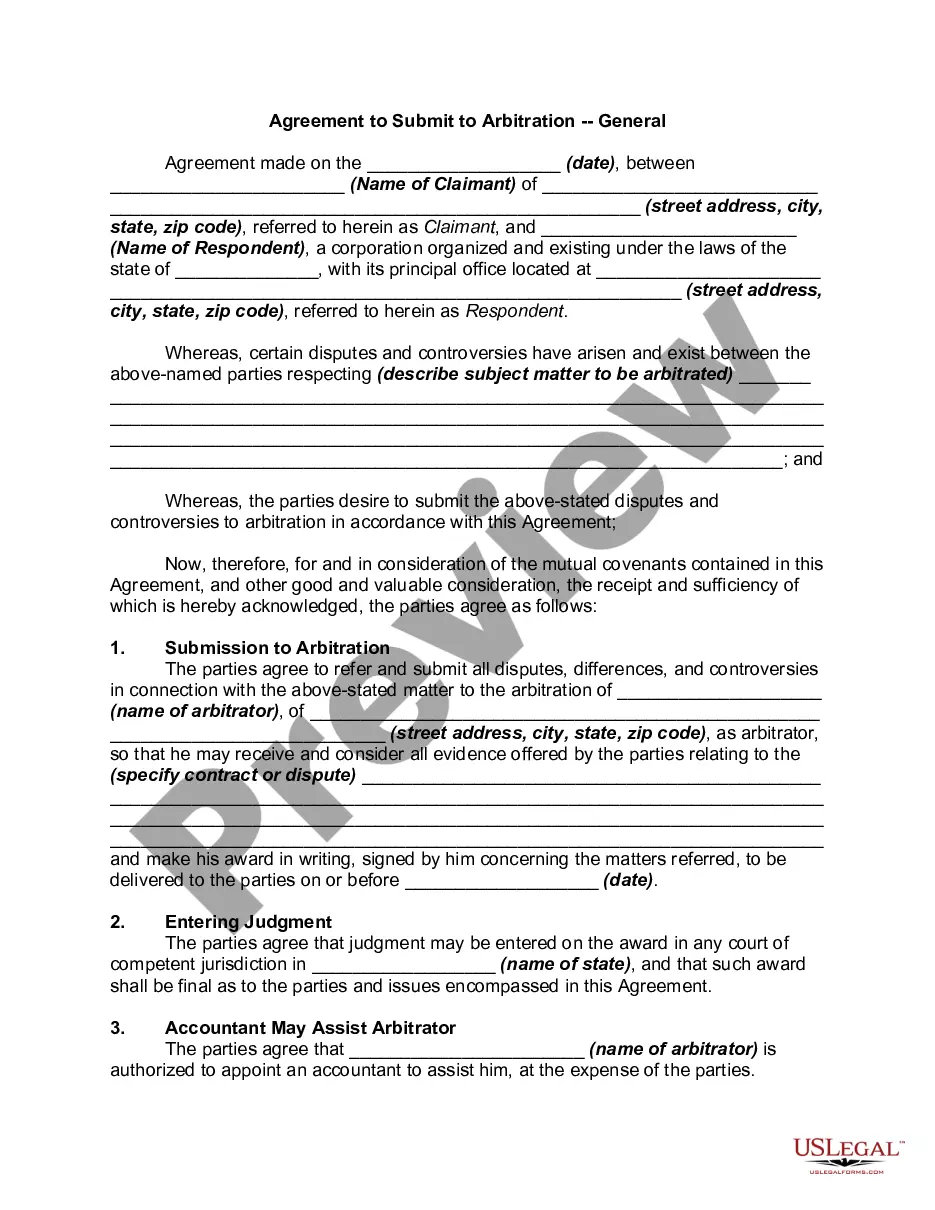
Methods of commencement Some rules require parties to commence arbitration by filing notice with the relevant arbitration institutions for eg the Regional Centre for Arbitration Kuala Lumpur (KLRCA), the International Chamber of Commerce (ICC).
In arbitration, you don't have to have a lawyer represent you (unless state law requires it), but it's important to know that arbitration is a final and binding process that can affect your rights. So, if you are considering representing yourself, it's a good idea to talk to a lawyer.
But first, let's get some context. What is arbitration? ... #1: Understand the arbitration agreement deeply. #2: Understand the applicable rules. #3: Conduct preliminary research and gather information. #4: Know your arbitrator. #5: Prepare your client. #6: Draft the opening statement. #7: Manage the hearing day.
Always get straight to the merits without berating the other side or whining about how badly it has treated you. Another threat to your credibility is the “kitchen sink” arbitration demand or a response that includes numerous claims or defenses that have little chance of succeeding.
How To Prepare for Arbitration: 5 Essential Tips Prepare Witness Statements. preparation is crucial before entering into an arbitration hearing to present your case in the best possible manner. Prepare Exhibits. Consider Your Strategy. Attend Pre-Arbitration Conferences. Hire an Attorney to Help You Prepare for Arbitration.
Parties are encouraged to file their Requests electronically using ICC Case Connect. Via the Request form, claimant(s) will be invited to supply key information in relation to their Request, and to upload their Request and any relevant annexes.
The Request must: be written in English, French or Spanish (the official languages of the Centre) include the name and contact details of all parties (including e-mail, street address and telephone number) be signed and dated by the requesting party or its representative.
A claimant will typically start arbitration by sending a document known as a “request for arbitration” or a “notice to arbitrate” to its opponent.
But still, the simple difference in time to resolution is almost startling. Trials in court average over two years. Arbitrations average under a year. Anyone who has done litigation for a while knows that the longer a case lasts, the more you spend.