Arbitration Case Statement With Multiple Conditions In Maryland
Description



Get your form ready online
Our built-in tools help you complete, sign, share, and store your documents in one place.
Make edits, fill in missing information, and update formatting in US Legal Forms—just like you would in MS Word.
Download a copy, print it, send it by email, or mail it via USPS—whatever works best for your next step.
Sign and collect signatures with our SignNow integration. Send to multiple recipients, set reminders, and more. Go Premium to unlock E-Sign.
If this form requires notarization, complete it online through a secure video call—no need to meet a notary in person or wait for an appointment.
We protect your documents and personal data by following strict security and privacy standards.

Make edits, fill in missing information, and update formatting in US Legal Forms—just like you would in MS Word.

Download a copy, print it, send it by email, or mail it via USPS—whatever works best for your next step.

Sign and collect signatures with our SignNow integration. Send to multiple recipients, set reminders, and more. Go Premium to unlock E-Sign.

If this form requires notarization, complete it online through a secure video call—no need to meet a notary in person or wait for an appointment.

We protect your documents and personal data by following strict security and privacy standards.
Looking for another form?


Form popularity
FAQ
Escalation (or multi-tier dispute resolution) clauses are commonly found in commercial contracts. For example, an agreement may require the parties to enter into good faith negotiation, mediation, conciliation and/or adjudication before an arbitration can be commenced.
If the arbitration agreement is claimed to be invalid based on reasons such as error, fraud, or threat, the validity of the arbitration agreement will be governed by the law chosen by the parties, and in the absence of a choice of law, the law of the place of arbitration applied.
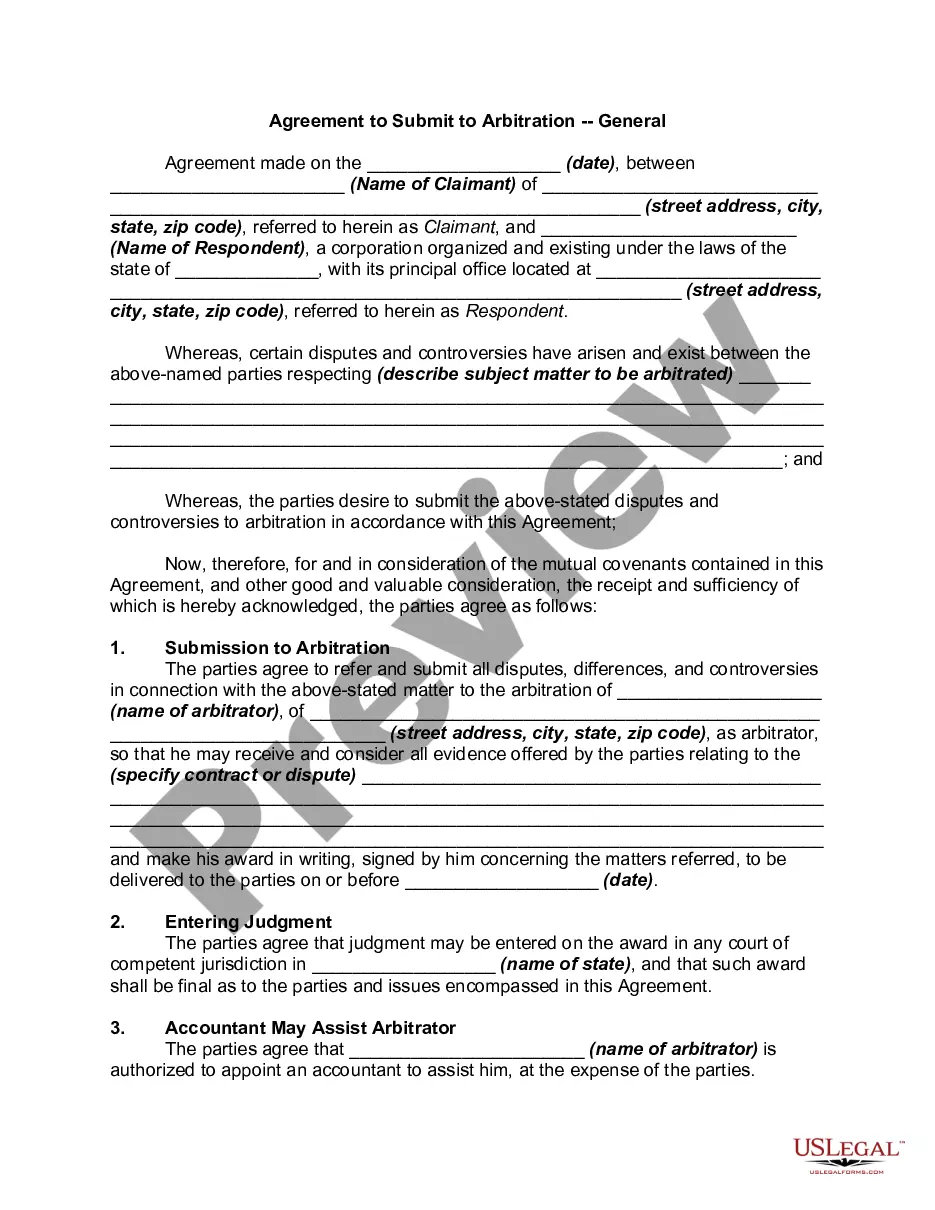
An arbitration can only take place if there is an arbitration agreement between the parties. We recommend that a dispute resolution clause is included in any business agreement. The dispute resolution clause shall state the manner in which any dispute between the parties shall be solved.
A condition precedent is therefore a provision or condition in a contract which must be fulfilled for either the contract to be valid or certain contractual obligations to come into effect and is a mandatory pre-condition.
Escalation (or multi-tier dispute resolution) clauses are commonly found in commercial contracts. For example, an agreement may require the parties to enter into good faith negotiation, mediation, conciliation and/or adjudication before an arbitration can be commenced.
Tiered dispute resolution clauses aim to minimise costs and save time, by allowing parties multiple chances to resolve their disputes without proceeding to arbitration or litigation proceedings.
The arbitrator's final decision on the case is called the “award.” This is like a judge's or jury's decision in a court case. Once the arbitrator decides that all of the parties' evidence and arguments have been presented, the arbitrator will close the hearings. This means no more evidence or arguments will be allowed.
The Award Must Be in Writing The award must be signed by the arbitrators and, under the laws of some states, be notarized or witnessed. If two or more arbitrators are involved, the award must have the signatures of a majority. Arbitrators usually meet after the last hearing to agree on the award.
Arbitration is the most commonly used method of alternative dispute resolution (ADR), and you'll find an arbitration clause in the fine print of all kinds of contracts these days.
Upon entry of the circuit court's order under Rule 7-113 (g), or upon any other termination of an appeal that was not heard de novo in the circuit court, the clerk of the circuit court shall transmit a copy of the order to the District Court. Any order of satisfaction shall be docketed in the District Court.