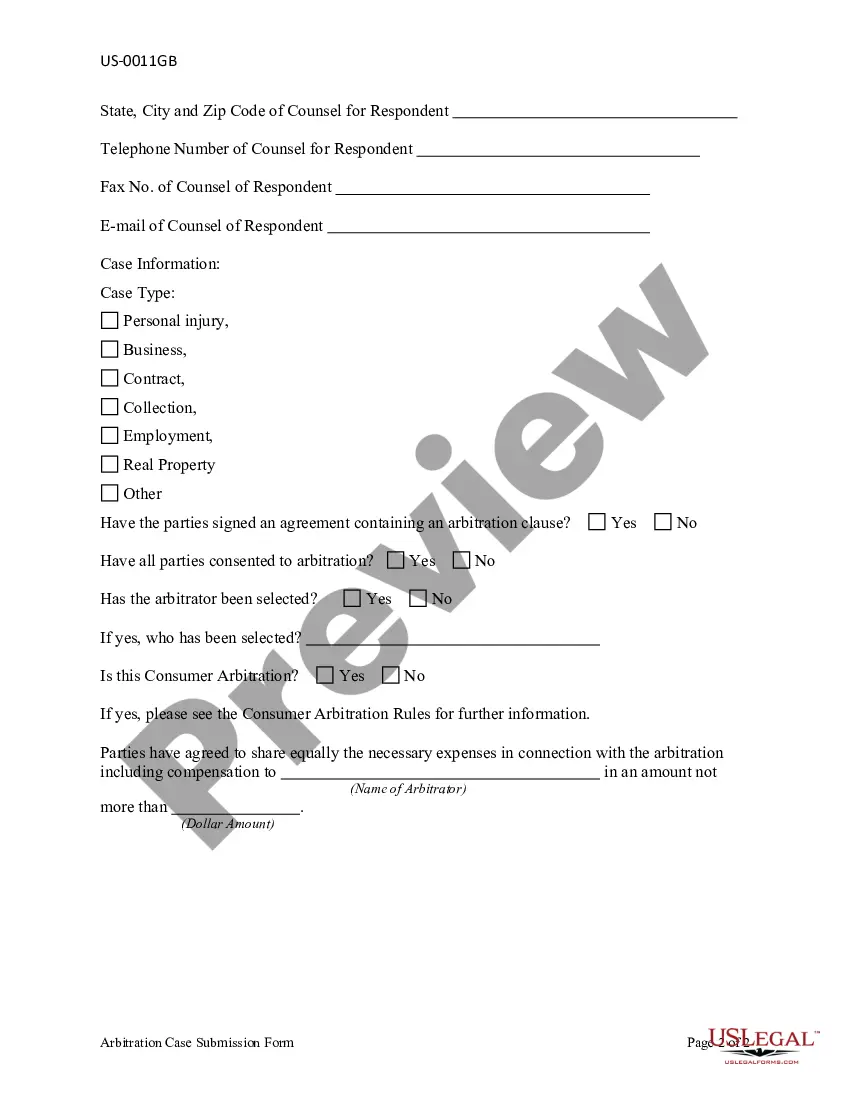
Arbitration Case Statement With Or In Florida
Description



Get your form ready online
Our built-in tools help you complete, sign, share, and store your documents in one place.
Make edits, fill in missing information, and update formatting in US Legal Forms—just like you would in MS Word.
Download a copy, print it, send it by email, or mail it via USPS—whatever works best for your next step.
Sign and collect signatures with our SignNow integration. Send to multiple recipients, set reminders, and more. Go Premium to unlock E-Sign.
If this form requires notarization, complete it online through a secure video call—no need to meet a notary in person or wait for an appointment.
We protect your documents and personal data by following strict security and privacy standards.

Make edits, fill in missing information, and update formatting in US Legal Forms—just like you would in MS Word.

Download a copy, print it, send it by email, or mail it via USPS—whatever works best for your next step.

Sign and collect signatures with our SignNow integration. Send to multiple recipients, set reminders, and more. Go Premium to unlock E-Sign.

If this form requires notarization, complete it online through a secure video call—no need to meet a notary in person or wait for an appointment.

We protect your documents and personal data by following strict security and privacy standards.
Looking for another form?
Form popularity
FAQ
Arbitration is litigation, just not in court. Arbitration might be the right choice for some cases. Limited discovery rights and costs might be useful when less is at stake. Arbitration might feel less adversarial, which could be an advantage where ongoing relationships are hoped to be preserved.
In conclusion, an effective opening statement will tell the arbitrator in a concise, courteous fashion exactly what the factual situation in the case is, what the issues are, how the advocate wants the arbitrator to rule on the issues, and exactly what relief is being requested.
Parties will need to provide material evidence during the arbitration process. Some arbitrators may require that some types of evidence (such as invoices, pictures, and party correspondence) be presented in a specific format, such as in a binder and labeled in a certain order.
Outline a concise factual background and then move on to a discussion of the issues at the heart of the case. Your arguments should flow easily from the relevant facts and applicable law. And, by all means, avoid exaggeration of the strengths of your case as well as disparagement of the opposing side.
Outline a concise factual background and then move on to a discussion of the issues at the heart of the case. Your arguments should flow easily from the relevant facts and applicable law. And, by all means, avoid exaggeration of the strengths of your case as well as disparagement of the opposing side.
If possible, avoid the use of technical jargon or "shop talk." Remember that the arbitrator may not know the details of your work or the Postal Service. However, if you must use "shop talk" to clarify a point, be sure to briefly define what you mean.
Pursuant to chapter 44, Florida Statutes, arbitration is a process whereby a neutral third person or panel considers the facts and arguments presented by the parties and renders a decision which may be binding or nonbinding. (a) Integrity, Impartiality, and Competence.
Sample Clauses Providing for Ad Hoc Arbitration. “Any dispute, controversy or claim arising out of or relating to this contract, or the breach, termination or invalidity thereof, shall be settled by arbitration in ance with the UNCITRAL Arbitration Rules as at present in force.”
In conclusion, an effective opening statement will tell the arbitrator in a concise, courteous fashion exactly what the factual situation in the case is, what the issues are, how the advocate wants the arbitrator to rule on the issues, and exactly what relief is being requested.