Submission Agreement Sample With Witness In Virginia
Description




Get your form ready online
Our built-in tools help you complete, sign, share, and store your documents in one place.
Make edits, fill in missing information, and update formatting in US Legal Forms—just like you would in MS Word.
Download a copy, print it, send it by email, or mail it via USPS—whatever works best for your next step.
Sign and collect signatures with our SignNow integration. Send to multiple recipients, set reminders, and more. Go Premium to unlock E-Sign.
If this form requires notarization, complete it online through a secure video call—no need to meet a notary in person or wait for an appointment.
We protect your documents and personal data by following strict security and privacy standards.

Make edits, fill in missing information, and update formatting in US Legal Forms—just like you would in MS Word.

Download a copy, print it, send it by email, or mail it via USPS—whatever works best for your next step.

Sign and collect signatures with our SignNow integration. Send to multiple recipients, set reminders, and more. Go Premium to unlock E-Sign.

If this form requires notarization, complete it online through a secure video call—no need to meet a notary in person or wait for an appointment.

We protect your documents and personal data by following strict security and privacy standards.
Looking for another form?










Form popularity
FAQ
An assignment and assumption agreement is used after a contract is signed, in order to transfer one of the contracting party's rights and obligations to a third party who was not originally a party to the contract.
We noted that arbitration clauses are made before any dispute arises. Submission agreements, however, are agreements to arbitrate made after the dispute has arisen.
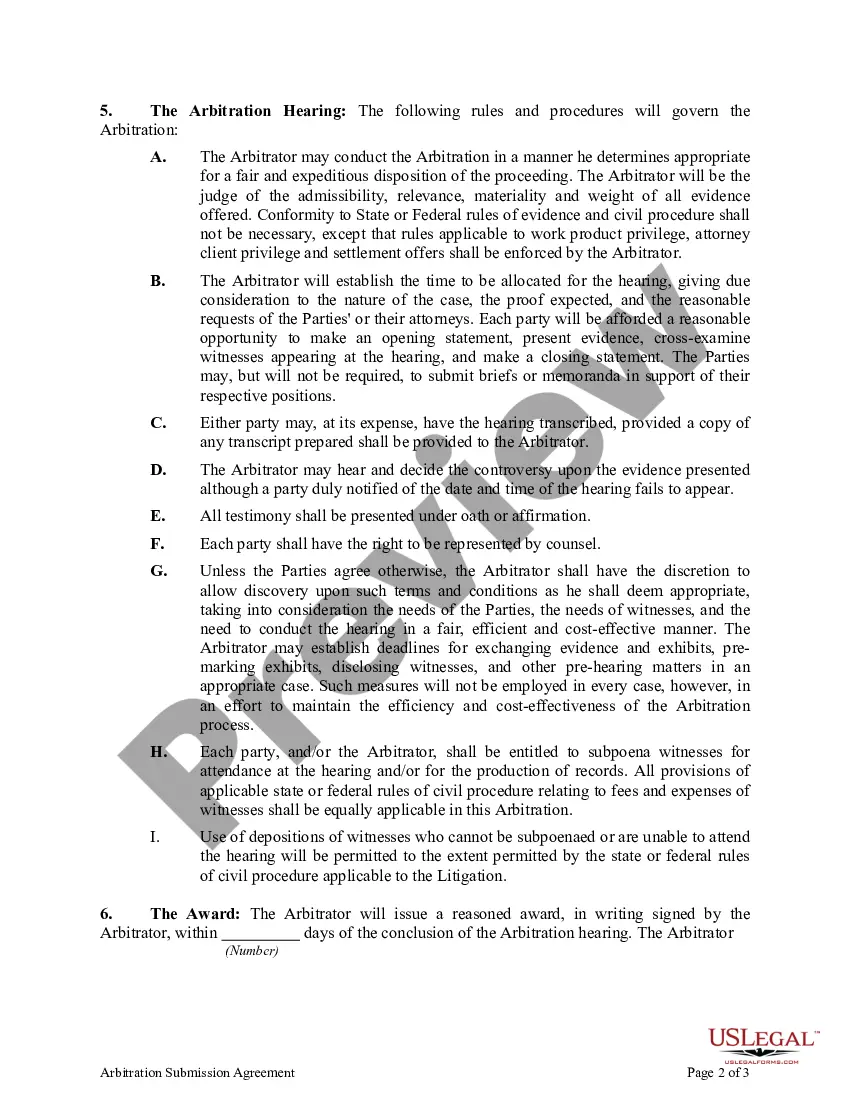
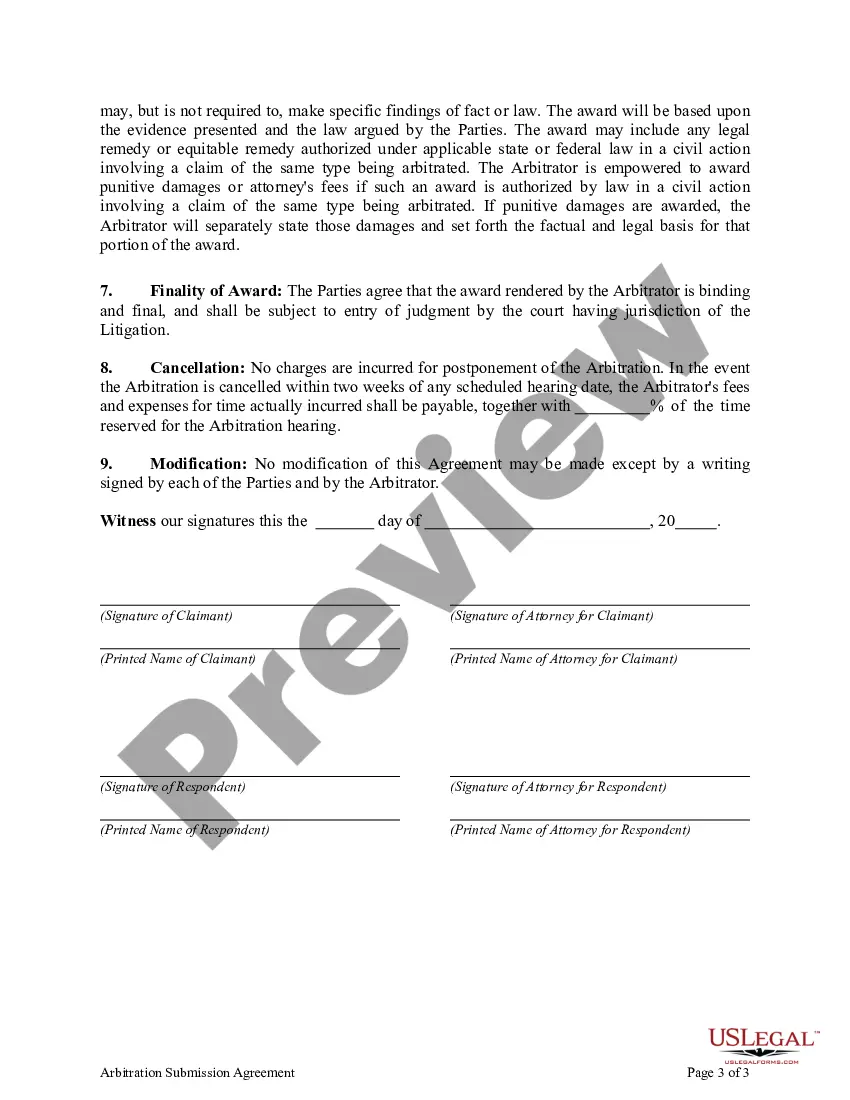
A submission agreement is a contract between two parties that establishes the use of arbitration to settle any disputes that may arise between them.
A submission agreement is a contract between two parties that establishes the use of arbitration to settle any disputes that may arise between them.
In Virginia, the signing of a will must generally be witnessed by two competent persons, who also must sign the will in front of the testator. Although the law does not require a will to be notarized, it is a highly recommended practice followed by most lawyers.
In Virginia, the signing of a will must generally be witnessed by two competent persons, who also must sign the will in front of the testator.
No witnesses are required for a Virginia wedding, but, unfortunately, you can't self-officiate your marriage the way you can in nearby DC. This means that you do need someone to act as an officiant and the state doesn't perform Justice of the Peace/courthouse weddings. Can anyone officiate a wedding in Virginia?
In Virginia, the signing of a will must generally be witnessed by two competent persons, who also must sign the will in front of the testator. (An exception to the witness requirement is made if the testator writes out the entire will in his or her own handwriting and signs and dates it.)
What Does a Person Plead When They Don't Want to Testify in Court? If you receive a subpoena and do not want to testify in court, you can plead the Fifth Amendment to the U.S. Constitution. The Fifth Amendment gives you the right against self-incrimination.
If any subpoena is served less than five calendar days before appearance is required upon any judicial officer generally incompetent to testify pursuant to § 19.2-271, such subpoena shall be without legal force or effect unless the subpoena has been issued by a judge.
