Submission Agreement Sample For Hire Purchase In Queens
Description



Get your form ready online
Our built-in tools help you complete, sign, share, and store your documents in one place.
Make edits, fill in missing information, and update formatting in US Legal Forms—just like you would in MS Word.
Download a copy, print it, send it by email, or mail it via USPS—whatever works best for your next step.
Sign and collect signatures with our SignNow integration. Send to multiple recipients, set reminders, and more. Go Premium to unlock E-Sign.
If this form requires notarization, complete it online through a secure video call—no need to meet a notary in person or wait for an appointment.
We protect your documents and personal data by following strict security and privacy standards.

Make edits, fill in missing information, and update formatting in US Legal Forms—just like you would in MS Word.

Download a copy, print it, send it by email, or mail it via USPS—whatever works best for your next step.

Sign and collect signatures with our SignNow integration. Send to multiple recipients, set reminders, and more. Go Premium to unlock E-Sign.

If this form requires notarization, complete it online through a secure video call—no need to meet a notary in person or wait for an appointment.

We protect your documents and personal data by following strict security and privacy standards.
Looking for another form?








Form popularity
FAQ
Local Law 102 (Buyout Agreement Law) Under Local Law 102 of 2019 (Buyout Agreement Law) owners who enter into a buyout agreement with a lawful occupant of their building, resulting in a tenant vacating the unit, must inform HPD about the terms of the buyout agreement.
Depending on the type of case or procedure, New York's statutes of limitations generally range from one (1) year to six (6) years. The point at which the clock starts ticking is typically the date of the incident or discovery of a wrong.
The Civil Court has monetary jurisdiction up to $50,000.00, including replevin when the value of the chattel does not exceed that amount. It has jurisdiction of real property actions, such as partitions, and foreclosures, within the monetary limit.
How to set up (structuring) an agreement Identification of (key) subject matters. Identifying and grouping the transaction or the main elements of the contract which need to be addressed. Splitting up. Use of definitions. Classification. Prioritisation and logical ordering.
An agreement is a promise or arrangement between two or more parties to do, or not do, something. It's usually informal and sometimes unwritten (but not always). Some examples of agreements include a letter of intent, or a confidentiality agreement that precedes a commercial discussion.
7 Best Practices When Drafting Simple Agreements Start with a clear statement of purpose. Define key terms and definitions. Use clear and concise language. Include dispute resolution provisions. Consider the potential consequences of the breach. Include termination and renewal provisions. Use a standard contract template.
1 Use plain language. 2 Define key terms. 3 Structure your clauses logically. 4 Be specific and precise. 5 Use examples and scenarios. 6 Review and revise your clauses. 7 Here's what else to consider.
How to write an agreement letter Title your document. Provide your personal information and the date. Include the recipient's information. Address the recipient and write your introductory paragraph. Write a detailed body. Conclude your letter with a paragraph, closing remarks, and a signature. Sign your letter.
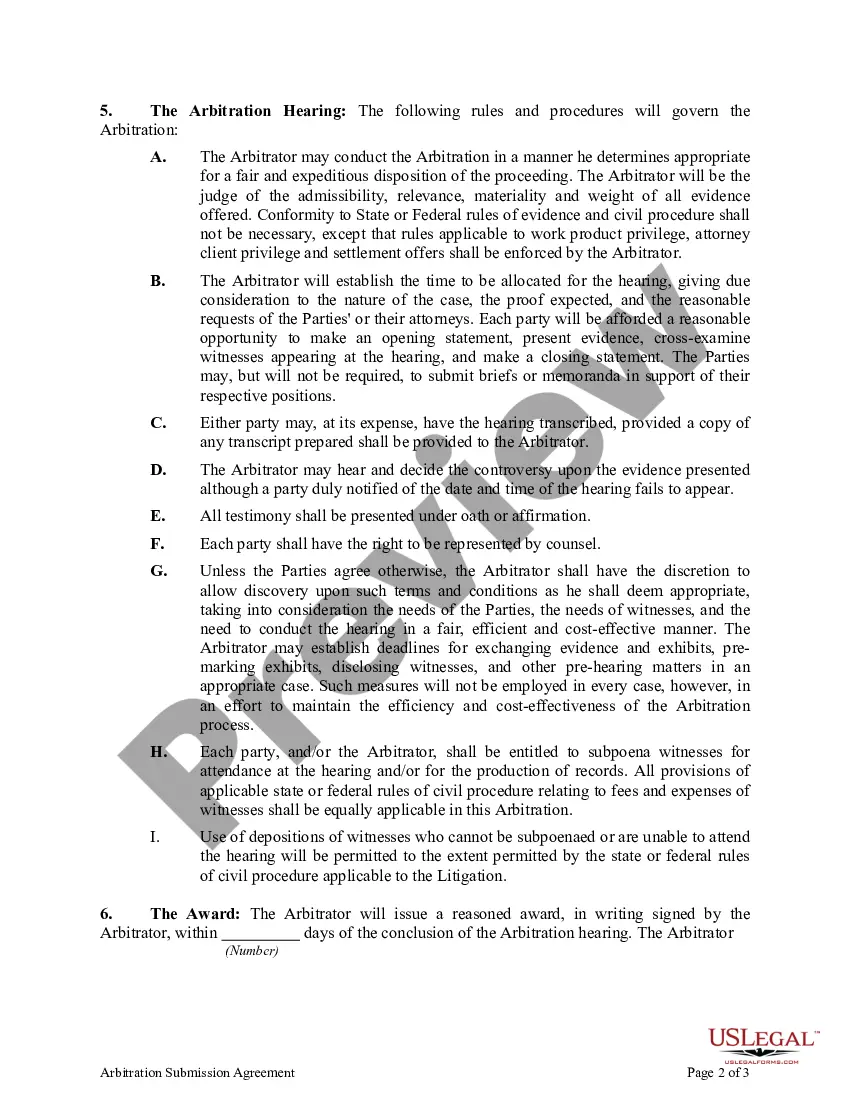
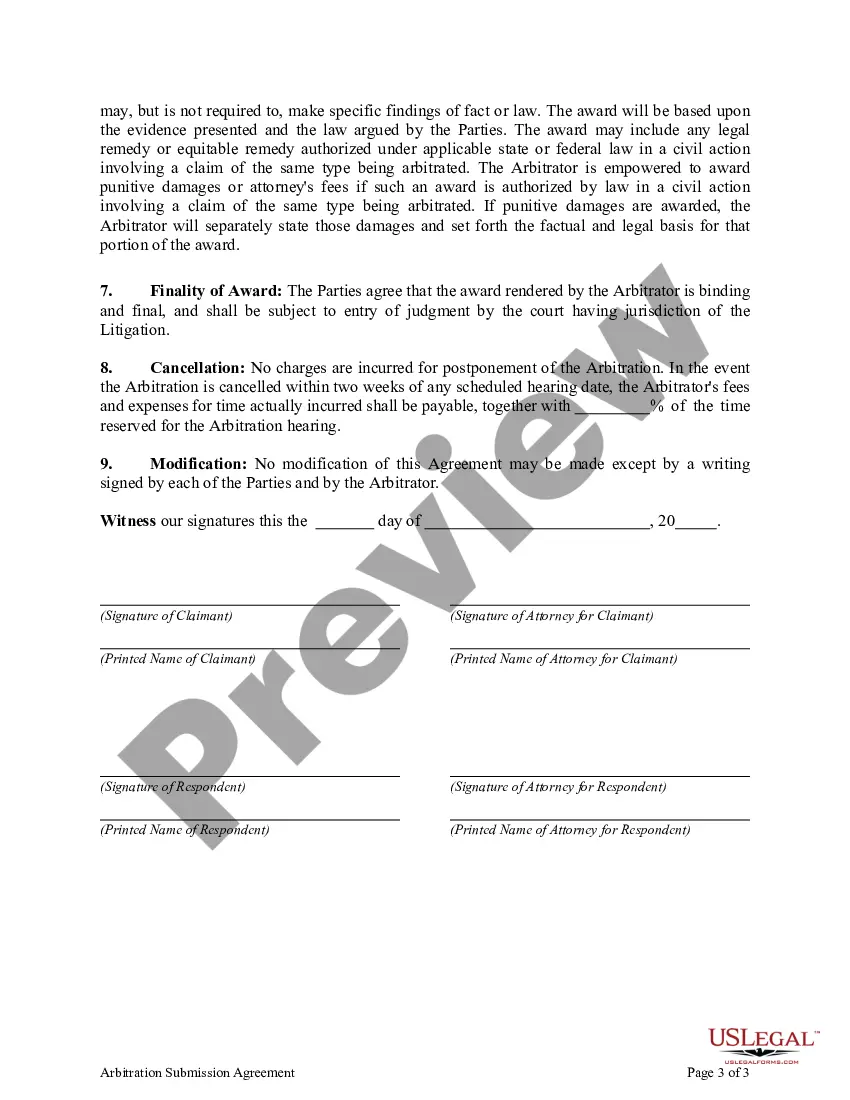
A “submission agreement” (also called an “agreement to arbitrate”) is a written agreement between two parties that establishes the use of arbitration to settle a dispute (or any and all disputes) that may arise between them.

