Principles Law Of Armed Conflict In Wake
Description


Get your form ready online
Our built-in tools help you complete, sign, share, and store your documents in one place.
Make edits, fill in missing information, and update formatting in US Legal Forms—just like you would in MS Word.
Download a copy, print it, send it by email, or mail it via USPS—whatever works best for your next step.
Sign and collect signatures with our SignNow integration. Send to multiple recipients, set reminders, and more. Go Premium to unlock E-Sign.
If this form requires notarization, complete it online through a secure video call—no need to meet a notary in person or wait for an appointment.
We protect your documents and personal data by following strict security and privacy standards.

Make edits, fill in missing information, and update formatting in US Legal Forms—just like you would in MS Word.

Download a copy, print it, send it by email, or mail it via USPS—whatever works best for your next step.

Sign and collect signatures with our SignNow integration. Send to multiple recipients, set reminders, and more. Go Premium to unlock E-Sign.

If this form requires notarization, complete it online through a secure video call—no need to meet a notary in person or wait for an appointment.

We protect your documents and personal data by following strict security and privacy standards.
Looking for another form?
Form popularity
FAQ
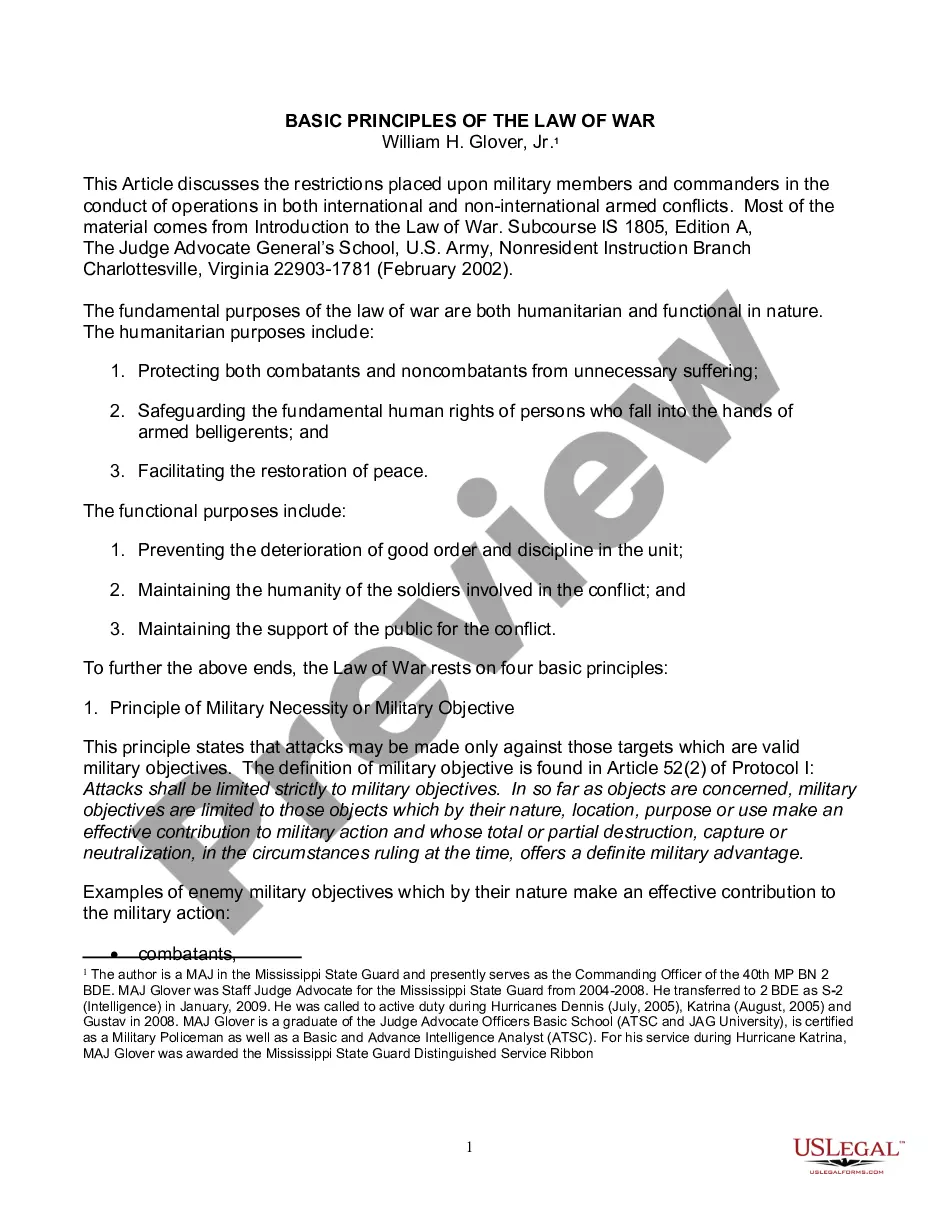
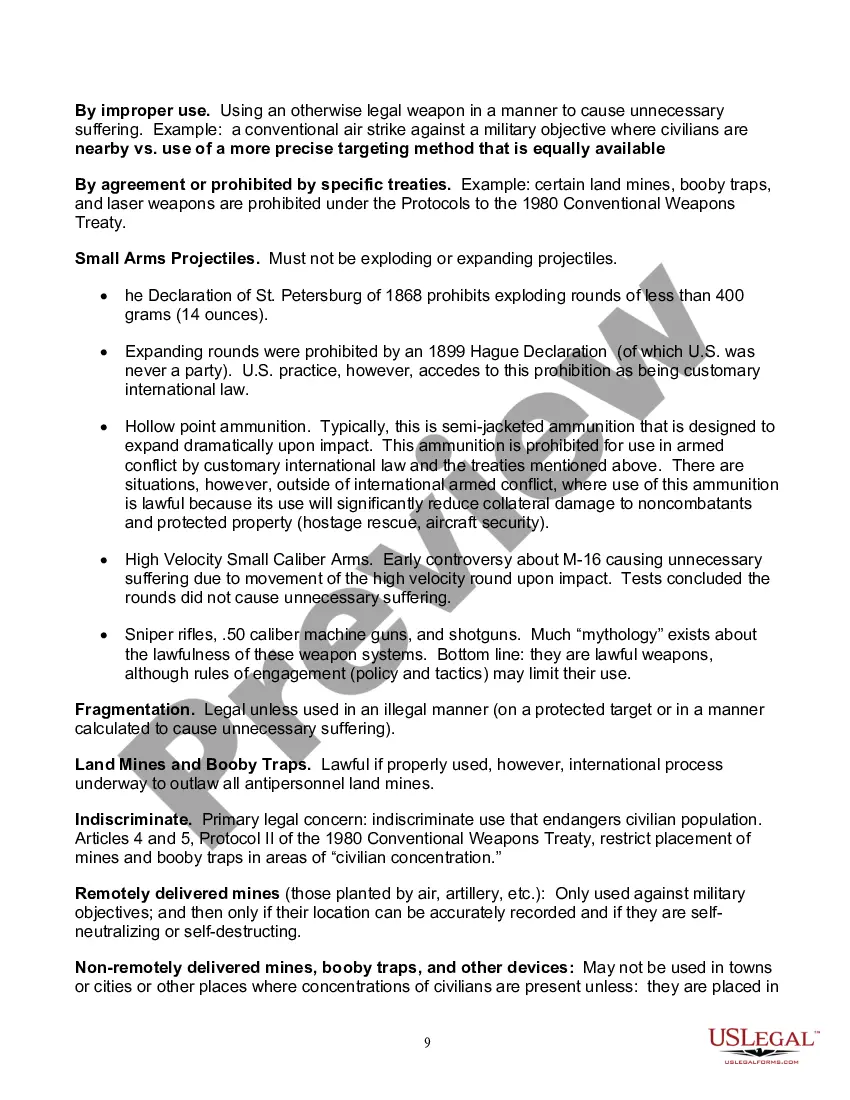
The law of armed conflict provides for the protection and humane treatment of combatants and non-combatants. The law both imposes duties upon and grants rights to individuals.
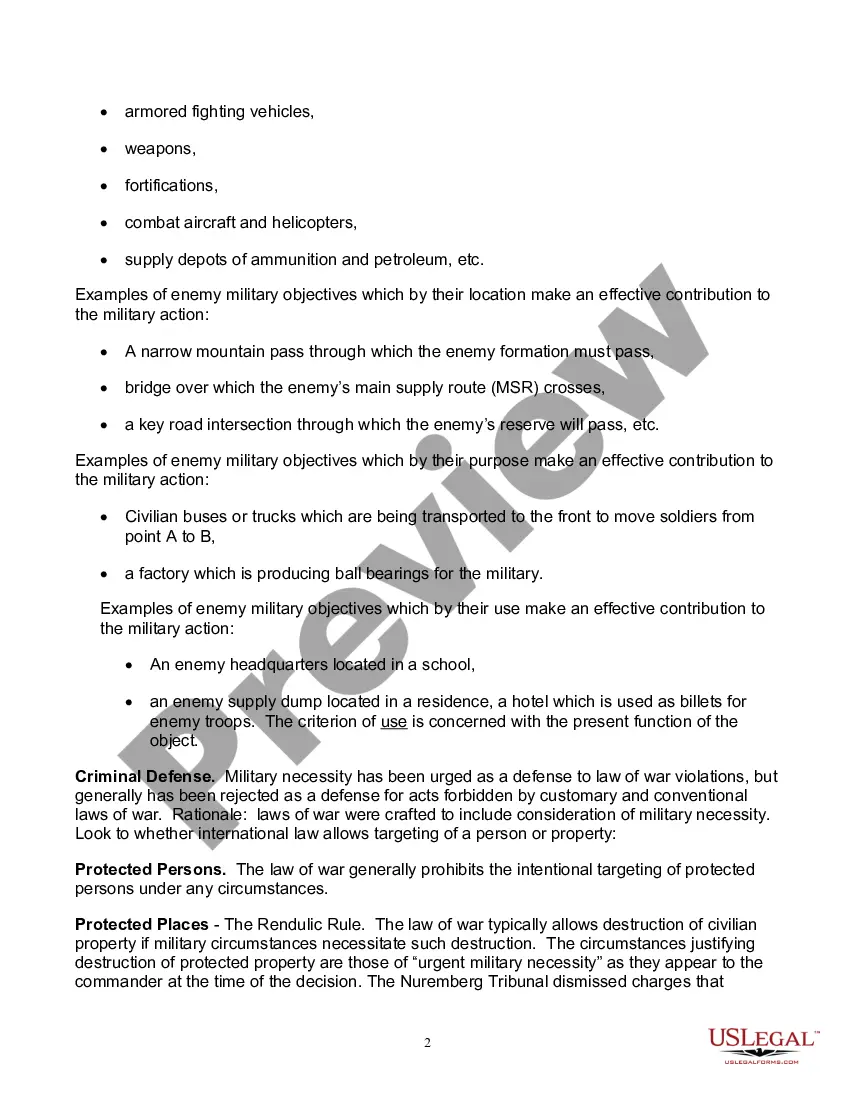
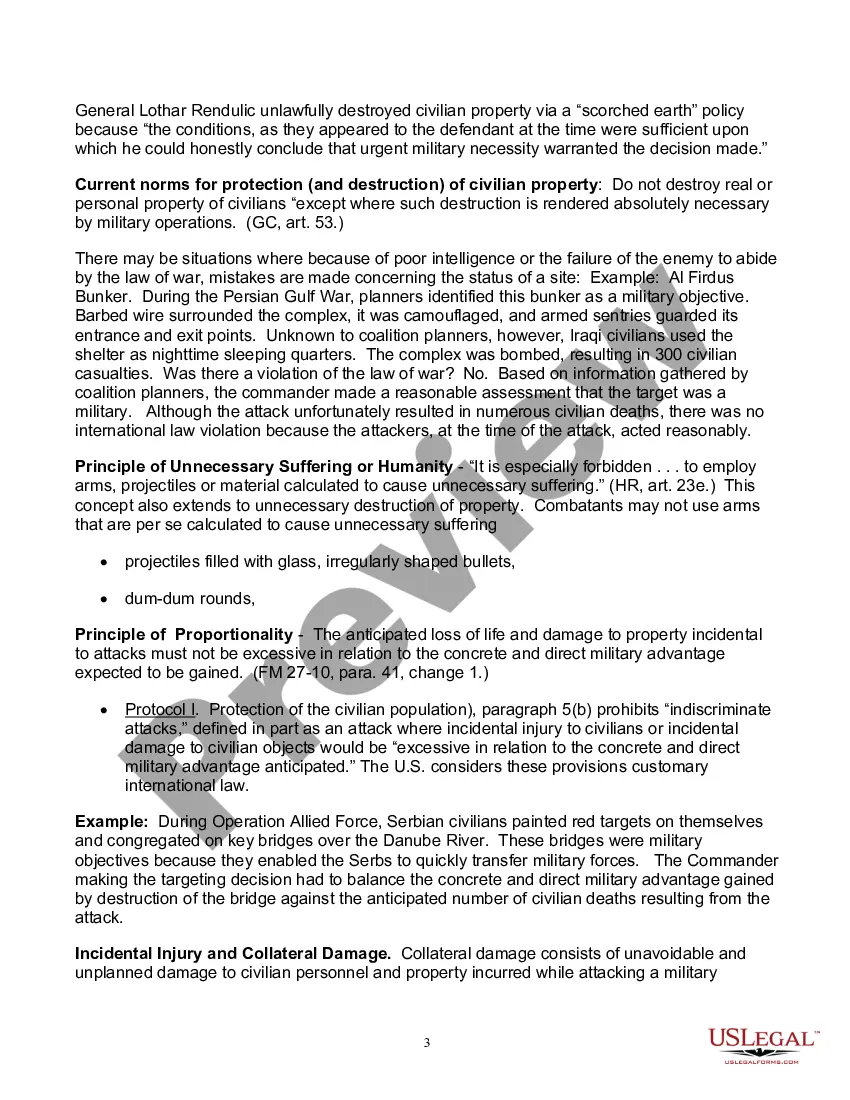
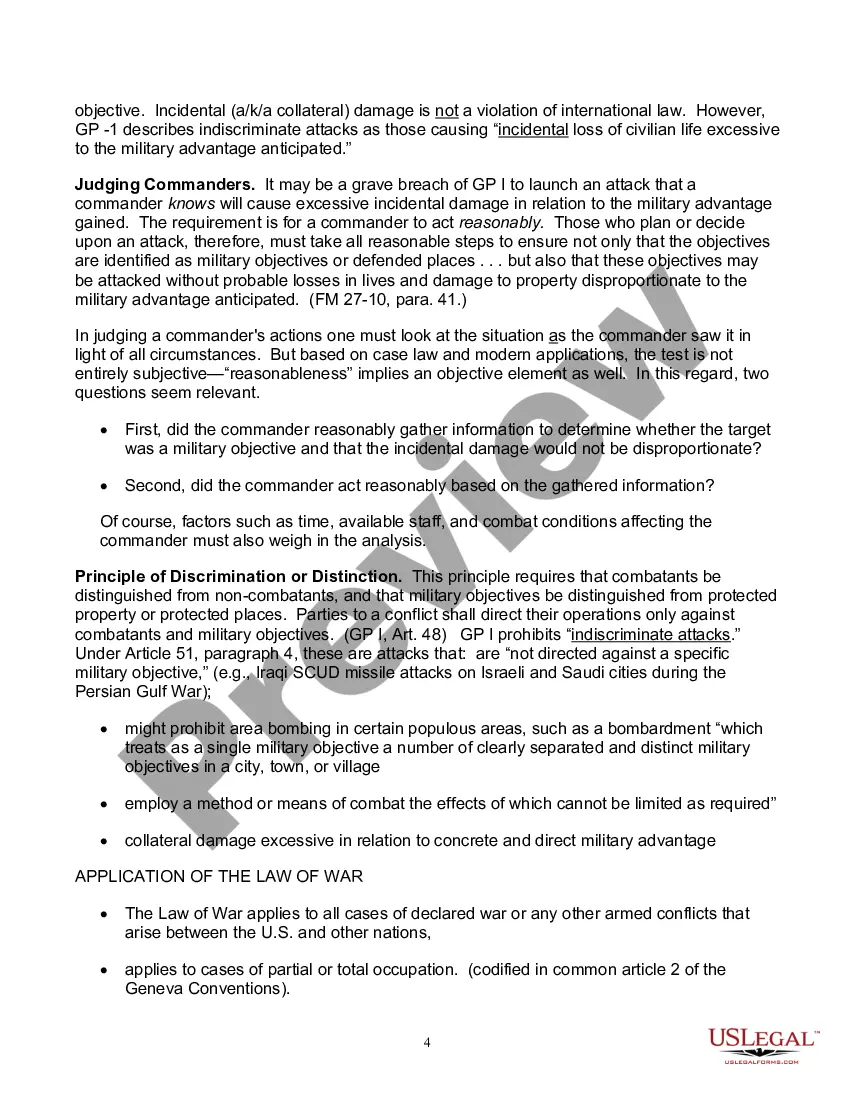
Principles of the laws of war Military necessity, along with distinction, proportionality, humanity (sometimes called unnecessary suffering), and honor (sometimes called chivalry) are the five most commonly cited principles of international humanitarian law governing the legal use of force in an armed conflict.
The “principle of military necessity” permits measures which are actually necessary to accomplish a legitimate military purpose and are not otherwise prohibited by international humanitarian law.
All personnel must be aware of the basic rules of the law of armed conflict, including the practical application of the principles of military necessity, proportionality, distinction and humanity.
Three interdependent principles—military necessity, humanity, and honor—provide the foundation for other derivative LOAC principles—most importantly, distinction and proportionality—as well as most of the treaty and customary rules of LOAC.
This historical precedent has inspired the military manuals of other countries and the subsequent codification of IHL. The principle of military necessity requires that a party to an armed conflict may resort only to the means and methods that are necessary to achieve the legitimate aims of the armed conflict.
This historical precedent has inspired the military manuals of other countries and the subsequent codification of IHL. The principle of military necessity requires that a party to an armed conflict may resort only to the means and methods that are necessary to achieve the legitimate aims of the armed conflict.
Military necessity, the claim that, because of extreme circumstances, security concerns override competing considerations. A proposed course of action therefore ought to be pursued despite the considerable costs exacted by its execution.
In any armed conflict, the right of the parties involved to choose methods and means of warfare is not unlimited, i.e. IHL limits how weapons and military tactics may be used. Weapons and tactics that are of a nature to cause unnecessary suffering or superfluous injury are prohibited.
The rule of law is a durable system of laws, institutions, norms, and community commitment that delivers four universal principles: accountability, just law, open government, and accessible and impartial justice.