Agreement Arbitration Document With Employer In Virginia
Description

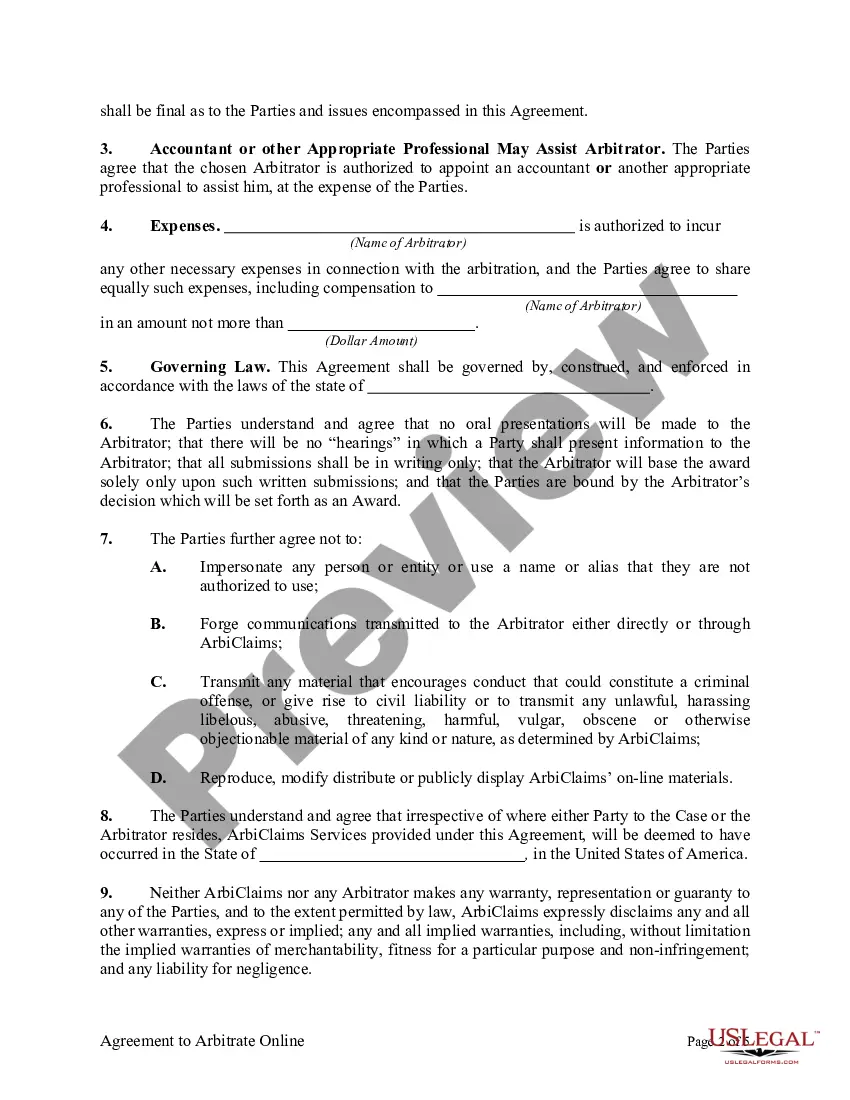
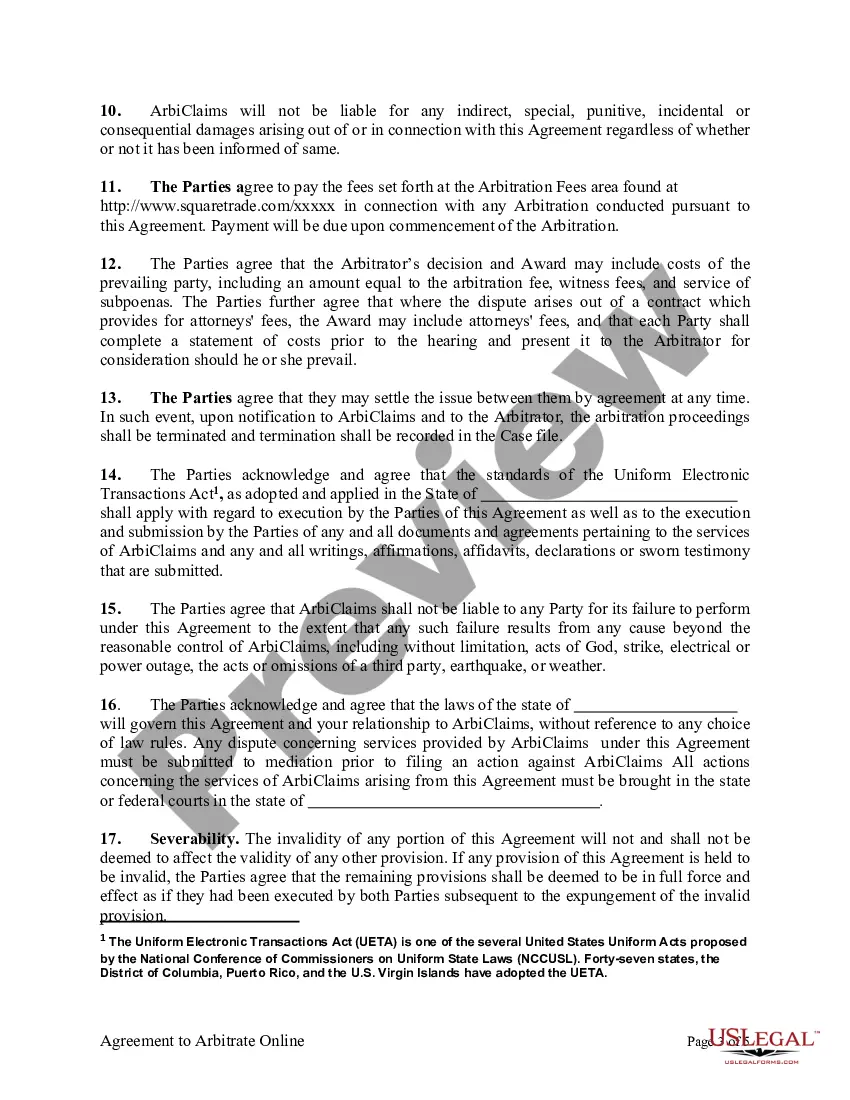




Get your form ready online
Our built-in tools help you complete, sign, share, and store your documents in one place.
Make edits, fill in missing information, and update formatting in US Legal Forms—just like you would in MS Word.
Download a copy, print it, send it by email, or mail it via USPS—whatever works best for your next step.
Sign and collect signatures with our SignNow integration. Send to multiple recipients, set reminders, and more. Go Premium to unlock E-Sign.
If this form requires notarization, complete it online through a secure video call—no need to meet a notary in person or wait for an appointment.
We protect your documents and personal data by following strict security and privacy standards.

Make edits, fill in missing information, and update formatting in US Legal Forms—just like you would in MS Word.

Download a copy, print it, send it by email, or mail it via USPS—whatever works best for your next step.

Sign and collect signatures with our SignNow integration. Send to multiple recipients, set reminders, and more. Go Premium to unlock E-Sign.

If this form requires notarization, complete it online through a secure video call—no need to meet a notary in person or wait for an appointment.

We protect your documents and personal data by following strict security and privacy standards.
Looking for another form?









Form popularity
FAQ
Arbitration might be the right choice for some cases. Limited discovery rights and costs might be useful when less is at stake. Arbitration might feel less adversarial, which could be an advantage where ongoing relationships are hoped to be preserved. Arbitration lends some confidentiality.
Arbitration agreements require that persons who signed them resolve any disputes by binding arbitration, rather than in court before a judge and/or jury. What is binding arbitration? Binding arbitration involves the submission of a dispute to a neutral party who hears the case and makes a decision.
Arbitration is a fairer, faster, and less expensive way to resolve disputes than time-consuming and expensive litigation.
An arbitration clause is part of a contract that forbids either of the parties from litigating a claim—i.e., bringing a lawsuit against the other in court. Instead, they “agree” to bring disputes to a private arbitration process, overseen by an arbitrator.
Within 30 calendar days following receipt of the notice of intent to arbitrate, each party shall provide written submissions in support of its position as well as the final payment offers directly to the arbitrator. At this time, the non-initiating party also shall provide its final offer to the initiating party.
Top 10 tips for drafting arbitration agreements Introduction. Scope of the arbitration agreement. Seat of the arbitration. Governing law of the arbitration agreement. Choice of rules. Language. Number and appointment of arbitrators. Specifying arbitrator characteristics.
A written agreement to submit any existing controversy to arbitration or a provision in a written contract to submit to arbitration any controversy thereafter arising between the parties is valid, enforceable and irrevocable, except upon such grounds as exist at law or in equity for the revocation of any contract.
Virginia law provides that parties to a controversy may agree to submit their differences to arbitration, with the stipulation that the award may be returned to and entered as a judgment of a court of the Commonwealth having jurisdiction over the subject matter of the controversy.
A claimant will typically start arbitration by sending a document known as a “request for arbitration” or a “notice to arbitrate” to its opponent.
Recently, the Supreme Court has held arbitration agreements to be valid in many consumer contracts. The Court opined that the Federal Arbitration Act (FAA) establishes liberal federal policy favoring arbitration agreements, and such agreements may only be overridden when there is a contrary Congressional command.
